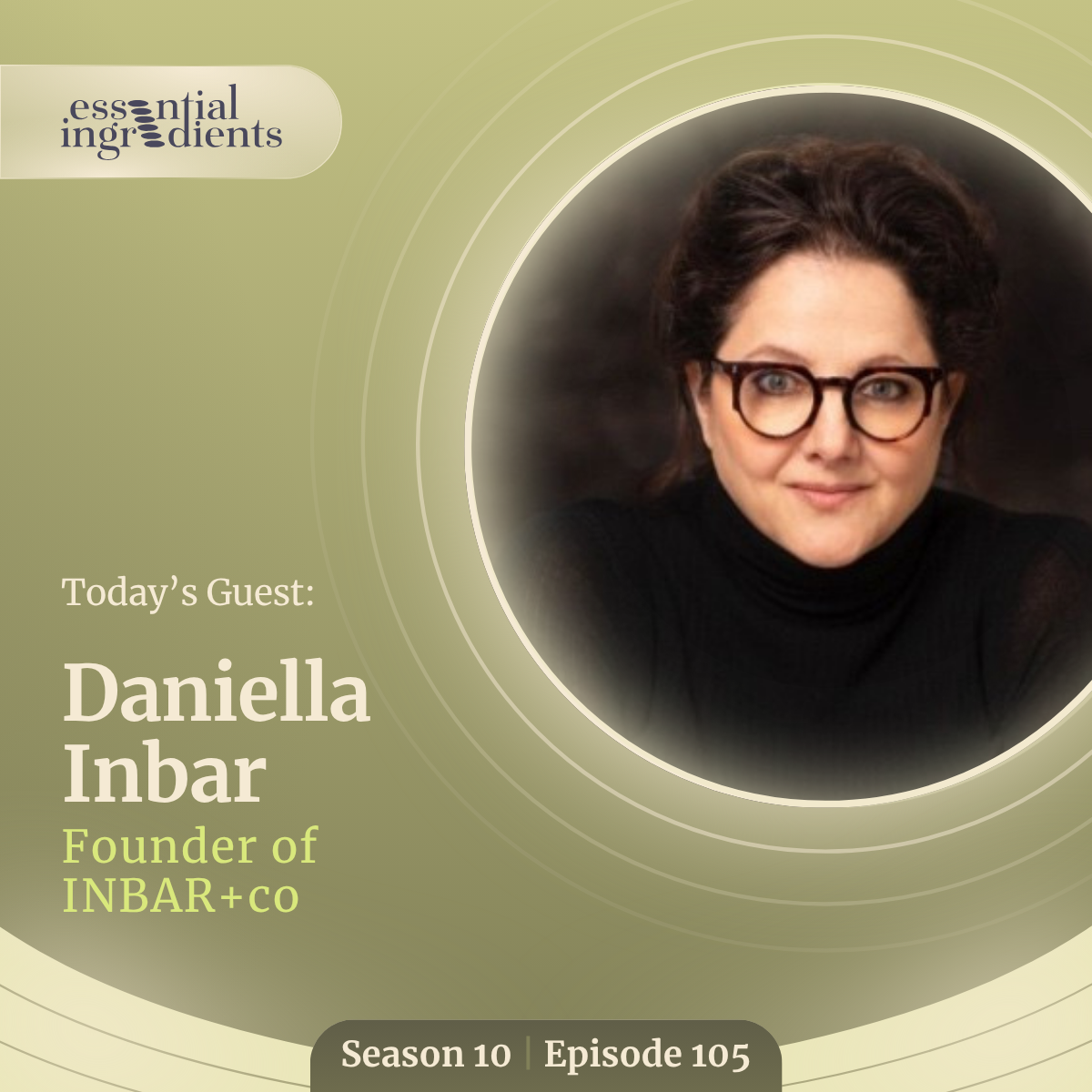
Daniella Inbar · Founder of INBAR+co & Resonance Marin Spa
Start With a 90-Second Clip
A calmer skincare routine begins by understanding what you are using and why it belongs there.
Watch the Full Conversation on YouTube →The Incorporation Method helps you turn what matters into practical changes that fit your life.
“What if your age isn't the problem? Justine sits down with Daniella Inbar—cosmetic chemist, product developer, and founder of INBAR+co and Resonance Marin Spa. After 30 years inside the luxury beauty machine, Daniella walked away—not because the industry was hard, but because it was dishonest. This episode pulls back the curtain on the clean beauty myth, aggressive actives, and why doing less might be the most radical skincare choice you can make.”
A practical starting point
What You’ll Take Away
A calmer skincare routine begins by understanding what you are using and why it belongs there.
Inventory your current products before adding another active or trend.
Read ingredient and usage guidance from the brand or a qualified professional.
Introduce one change at a time and patch test when appropriate.
Try This
Set aside one product you cannot explain and research its purpose before replacing it.
In This Episode
How over-complicating your routine disrupts your skin barrier, causing congestion and accelerated aging
Why "chemical-free" is a marketing gimmick—and why lab-made synthetics can be safer than trendy natural ingredients
The complex logistics of eco-conscious spa ownership: cotton vs. microfiber, glass vs. aluminum packaging
Why the best skincare approach is to do less, work in systems, and support your skin's natural biology
Full Transcript
Full conversation between Justine Reichman and Daniella Inbar.
Welcome to Essential Ingredients. I'm Justine Reichman, and today we're sitting down with someone who is asking a question the beauty industry has spent billions trying to make you afraid to ask. That question is simple: what if my age isn't the problem? My guest is Daniella Inbar, founder of Inbar+Co. and Resonance Marin Spa, a woman who spent 30 years inside the luxury beauty machine, building brands, developing products, watching how the machine actually works. And then she did something radical, she walked away, not because the industry was hard, because it was dishonest. She's a cosmetic chemist, a product developer, and the daughter of the woman who literally pioneered the German aromatherapy movement. What's extraordinary is that Daniella isn't selling anti-aging products, she sells something far more subversive, skin care that actually listens to your skin instead of lecturing it. For five years, she's been formulating, testing, and refining products, not in sterile labs, but in the real world at Resonance Marin, where 1000s of clients with real skin have lived with these formulas, question them, broken them down, and asked her to make them better. Daniella, welcome.
Thank you. Welcome here.
It's always great to be here. Next, I come home. Coming for a spa.
Yeah, good.
In the meantime, I'm so glad to have you here. It's really an exciting opportunity. This is part of a series that we're doing to really spotlight people in the Bay Area that are rooting themselves in sustainability and building with purpose. So, I naturally thought of you.
Well, yeah, those are my big passions. The filter that we try and do everything through. I'm proud and happy to be where I am, and all of those experiences and moments, you know, I carry with me. So yes, I don't actually know what I still have.
Well, because you've been practicing this for so long, but was there anything that came up throughout the years that you were really surprised about that you had to throw out?
In terms of sustainability? Yeah, a lot, from, you know, Tupperware to what kind of nail polish I use to choosing how I go shopping. What bags I take? How I transport water? If I'm going to take it with me? If I want mineral water, I can make it myself with a Soda Stream. I'm not buying mineral water from Italy or Germany anymore, you know. There'slots of little things.
You grew up on three continents, right, in different cultures, in households where wellness wasn't something you learned in a beauty ad, it was something your mother made. That's different. How did growing up watching your mother build this first German aromatherapy company teach you to think about the creation of versus marketing?
About authenticity, it's a lot about tradition and what you've learned, and it's very much the foundation of a holistic approach to health, to beauty, to nutrition to all of that is embedded in a euro in that eurocentric kind of mentality, which you don't see as much here. As progressive and wellness oriented as we are in California, it's we're learning it and it's all trendy, but it isn't like just part of how you manage a cut or a bang when your kids fall, or what you do when your eyes are burning, or that's something that was really just part of culture and growing up. Adding to that, having spent time being born in Ethiopia, having spent time in Asia, it, you know, you just pick up all of the local things that add in into that kind of holistic approach.
So how did that translate when you moved here? What was your experience? What did you see?
Well, moving here from how you recycle or don't, that you don't have a place where everybody communally brings their paper and their glass, that you can throw everything into one, maybe two bins, and that's it, like you're not really thinking about that was definitely one thing, and just, yeah, that again, I'm going back to food, but seasonal being able to have every fruit and vegetable at any time of the year was really strange. I think it stops you from enjoying, looking forward to it and making it into, you know, a ritual and a celebration of the season. So those are things that were really that changed and I that I try and include even when I'm here,
So when you first got here and you notice this here, you're younger, and it's well, and here your children here, and you're trying to raise them with the values that you grew up surrounded by, and that you're rooted in, right? And here you come here, and it's sort of a bit newer.
Yeah, I think that for me it's not like you did, I mean, you don't come here and say it was so just ingrained in how I do stuff that I didn't think about it. like I am not an activist or eco warrior or anything, that I certainly wasn't, it was just kind of the default setting, and so especially when we opened the spa, it became that big question of what we actually now have to start filtering and thinking about it, because it isn't default, it isn't policy it is none of that. And then having children, you know, they're now in their 20s, but in the last 10 years growing up with them here, they also forced me to think about these things much more consciously, like really, truly, the reason for all of this, and any of the things that we do in the spa or in the part in the product line is leaving a legacy. If that's the luxury, and I want to leave behind a planet that my children can leave to theirs, and that is what the other filters and the rules we set ourselves all come from, is in a to be able to do that.
Yeah, I mean, I think it's super interesting. I mean, I grew up in New York, and I feel like it's worlds away from here, in the way we think about sustainability, the way we think about local, and how we do things. I think it's becoming more and more familiar. Now, it's the narrative is a little different. I feel like there's a lot of questions that people have, how to make it work. It's not in all the systems, so there's a lot to fix here, and there's a lot of education I think that needs to happen. We talked about inheritance, the legacy, and the path not taken. How did you hold on to that ancestral wisdom while everything around you was screaming you need more?
Really lucky having seen experience two generations of those women who walked through the world and had the most amazing skin, and were always told how amazing they looked, and weren't aging, and just having that realization that it's like it's complicated to like get that segway, but having that be my default for so long, and being told this is what is better for you, and then learning. Learning about the skin's microbiome, that we, the skin works in systems, and we have a system. The OG skincare is the millions of bacteria, enzymes, and so on that are on your skin doing the work, and if you leave them alone, that's actually going to do you what you know, it's going to get better results than a lot of what we do, from harsh cleansers to aggressive actives to all of these things. Actually disrupting your barrier is going to cause congestion reactivity, and it's going to age you faster. So, really being gentle and working with what you've got and supporting that is the basis for every single product we make, and it's the same for, you know, the planet that we live in. Where we need to support it, we need to make sure that it works well, that the systems work, instead of taking away from it or adding things that don't belong. So having grown up with those kind of this is how you do it, to learning about physiologically how your skin works, it was like really easy to put them together and say, oh, okay, well, this makes sense, and you know, I have a lot. We have a lot of people come in. We were like, I want your skin, and you know, I'm going 60.
I do want your skin.
It's really, really, really simple. It's like, do less, not more. It's the order, and working in systems that get you there. Even those moments of, should I have something done? Should I do injectables or botox or whatever? No, you know, there's a moment, and then I feel like this is what I want to look like, this is who I am, this is who I will recognize in the mirror, and this is the roadmap for my children not to go down some crazy rabbit hole.
Well, just as an anecdote, I was on Instagram earlier, and I was scrolling through some photos, and there's a picture of a woman that I know, and it just didn't look like her anymore. And for me, that doesn't work, like, I want to look like me.
Yeah, I think there's also a dissonance of emotionally, mentally, of what you see in the mirror and what you're supposed to see and what you see, and that's really strange. And everybody has their own beauty standard, and everybody can do whatever they want. I just feel personally that I want to-- I don't want to look younger, I want to look better, and I want to look real and authentic, and not like I've done something to change myself.
Yeah, and you know, I look at people, and I look at my mother, I'll just use my mother as an example. She was beautiful. She had beautiful skin. She just put some moisturizer on it. I was like, "Is this genetics? Is this just what you're doing? I hope to look like this when I'm 80 years old, you know. But I look at a lot of older women, and they're very beautiful, and they get better with age, and they look more beautiful, and they look more themselves, even.
Yes, I actually do think they look more beautiful. And this isn't something that I'm making up now in hindsight. In my 20s and 30s, I was where it was like, when do I get those lines? When do I start looking interesting, as opposed to just, you know, pretty or something like that? I was looking forward to it. Now you know when they come, and when the first grades come in, it then starts to be from the society where we're in. We second guess it, like, oh well, maybe it isn't as cool as I thought it was, and maybe I do need to do something. And especially being in the beauty industry was like the first thing, oh well, am I supposed to look aspirational? Do I have to stand for what the beauty industry sets as a standard? Do I have to look like that? And there were definitely moments where I questioned that, but I think the older I'm getting and the more it's showing, the more I actually just want to stand by it.
But you do look aspirational, like as you sat there, you know, you were talking about age before, and you know, I feel like I look at a lot of people my age and a little older, and I'm like, "Wow, they look amazing, they look great, and that is aspirational to me.
Yeah, either you're on the one end of the spectrum or the other, there's not much in between, like either you're straight up doing every invasive procedure that's possible, or you stand by where you are. There's not a lot in the middle.
And I will say, I mean, I do. Some people, we all age differently, right? And I do think that plays a role for some people as well, right? As their age people age differently, they have different things that change on their body that change how they look to themselves, and then they're really uncomfortable with it.
Now this is the right way to change as opposed to, and there is the question, which part of it is you asking that, which part of you that is what you're being told you're supposed to look like.
So you'd felt as long successful in luxury, in home, in design, etc., and 30 years of it, you knew how to work inside that system. At what point did you realize that system itself was the problem? What was the moment you thought, "I can't keep doing this?"
I think it was when we opened the spa, and we had looked for brands that were clean, and we were using them, and when we looked a second time, I saw that that isn't actually a standard that is regulated, and what does that mean, and everybody has a different idea of it, and so then also my children being of a certain age was like okay, what I had to make my own standards, and when I realized what it was that was important to me in terms of sustainability, in terms of what do I want from a product, how do we define luxury, and that, for me, is it's a legacy. Luxury is more than just a pretty thing. That's when all of a sudden was like, oh, well, these are the things that are important, and I don't see any products ticking those boxes. And at that time taking sustainability boxes and still being luxurious.
So when you first started this and you're looking for, as you were saying, clean products. Tell me, what did clean mean to you at that moment?
It's a really good question. It meant something was being done right, like I didn't question what that meant, or if there was anything behind it, beyond mostly natural. Natural meant not using chemicals, not, you know, it was all of those markers that you still hear, non-toxic, free of natural, chemical-free, all of these things. Now, when you go into actually how products are made and how products are effective and what the whole supply chain of a product means that isn't good enough, that is not specific enough. It's so much more complicated, and chemical, for instance, is not a four-letter word in formulating, because then water would already be x out of any formula, it's a chemical, everything is a chemical. And then where is natural better, where is synthetic or lab made safer, and also definitely more sustainable for the planet, because I think people don't even think about whether it's argon oil or shea butter or any of these products. They need to be grown as soon as something becomes trendy, and you need a lot of it. You're going to have issues with monoculture, biodiversity, the amount of water when we're in California, that goes into growing some of these ingredients is enormous. So, where does that stop actually being sustainable? How stable and effective are all of these natural ingredients? I think you have to really be careful not to put all of the food, organic, natural markers onto something like beauty. It doesn't, you can't just take them and put them there and say this is going to work. It's not the same thing. So, what our sustainability filter is how is this going to affect your skin, and how is it going to affect the planet, and those two things have to overlap when we choose what we put into a formula
That must have been quite the process, though.
Oh my god, if I'd known when I started, I wouldn't have done it, whether it's what goes into it or what your packaging is. The complexity of trying to actually be sustainable and do the right thing is enormous. And once you've, you know, cracked one code, another 10 open up. There is no way of being perfect that doesn't exist. If you want to be completely perfect, go off the grid, you know, grow your own carrots, and that's it. Don't do anything, then you're not allowed to be doing any kind of consumer product or anything. So, when you are doing it, we really, really tried, whether it's, you know our detergents here in the spa, our cleaning supplies, the sheets that we use that aren't microfiber but cotton, all of these things are much more difficult to source, much more difficult to find, and you know making those choices, and then slowly figuring out, you know, you go from, okay, what's great, what's a good packaging glass. Everybody was doing glass six years ago, but you know it's really heavy, and so that the carbon footprint for the transport is higher. Well, then let's do wood. There's so many different options. We landed on aluminum. The biggest issue for us was landing on something that is not plastic, and whether it's the packaging or the product, using no petrochemical derivatives, like really staying clear of fossil fuels in any way, shape, or form, whether using renewable energy here to run the spa and the production to what goes into all of it is, that's I think that our biggest marker is that we don't use that, and plastic is a fossil fuel derivative, and it is also the whole microplastics issue that has now blown up, and that it's great. That it's become a mainstream issue. It wasn't before, and people didn't understand what the consequences could be.
Yeah. Now that I mean, there's so much conversation about the microplastics.
Microplastics, it's an enormous thing that's gone mainstream, and I love it. Five years ago, when we started with the aluminum, no one really understood that.
Are there any downsides to aluminum?
Not at all. It's light, it's small, it's great to travel with, it's recyclable, it can be recycled infinite amounts of time. It doesn't degrade, it keeps the product really stable doesn't oxidize. I mean, it just doesn't have a downside at all. And then whatever else we have, we use FSC certified paper, we use it for the outer boxes, we use it for the shipping. It has been now almost seven years from the very, very beginning of the idea to where we are now to the amount of things I've learned along the way, and things I was so sure of that I've had to let go in the process of making these decisions, and you're constantly weighing against economics,
It goes back to perfection. You can't be perfect,
You can't be perfect, and you have, you know, you've got the issue of cost, you have the issue of also client perception. For an ever, we refuse to make any products that needed to be sprayed, because there is absolutely no way to make this atomizer without a little plastic tube in it, and I stuck to my guns until last year, and everybody wanted the essence that we use in treatment here, and so we brought it in an aluminum bottle, and there's an opt-in atomizer that you have to pay for that we donate those funds entirely to the World Wide Web Fund. It was the compromise that was really hard, but people want to spray, so it's also changing consumer behavior of how they use things in order to be able to..
Is there another way to get that without it being a spray?
You can pat it, and so we have it, so people can put it, and they pat it on, but there's still 50% of the people that were like, yeah, but I won't buy it if it isn't sprayable. So, yeah, you start, like, oh, am I going to lose that revenue? You know, how consistent am I going to be. We're a small business, we, you know, and so there's a constant weighing of cost and revenue, and so on.
I'm curious about your consumers and your customers or clients, myself being one. Do many of them know the extent to which you know you go for sustainability, it's not just in the products, it's in every fiber, it's in every choice that you make here.
Yeah. I don't know how to communicate that, and it's definitely not front and center. We have it on our website, we will send out newsletters about it, but it's-- am I allowed to say this? We're in it. I'm feeling like it's become less and less important for people. Where you could lead with sustainability on the one hand, it's become table stakes, and on the other one hand, it's not like we don't talk about it anymore as much. I wish that it was more important, because then we would have an incredible advantage over almost all of our competitors, be it product or spa.
I want to make sure I understand. So, you're saying your thing is became less important now. What do you think prompted that shift?
Politics.
Oh politics. The dirty word. Okay, well, we won't get into politics right here, but okay, so fair enough.
I think that it's, and this is a really difficult one, and I don't know who's cracked the code in terms of luxury. We're in Marin County, we have a certain kind of clientele, we do a certain kind of service, and we have a certain kind of product, and you know, being able to have that refinement and esthetic and level of, you know, quality in on all sorts of, in all sorts of things, that is the most important part that has to be there, and then the sustainability kind of, it's not why people initially come, and it's not the reason people are going to choose us over another spa. I think it's the quality of our practitioners, the beauty of our space, the efficacy of our product.
There's nothing else in Marin like that? I mean, I remember saying that the first time I came in, I was like, 'Wow,
They're like, oh, that's nice. We're 100% plastic free. Most of people think, 'Oh, that's great, but I don't think it's going to inform their choice of whether they come to us or buy our products as opposed to going elsewhere.
So, does that mean if we're going to expand this conversation to support other founders and business owners to create change, that we need to start talking more to people like you that are doing this, so that we inspire the founders to create the change, because it's not dictating change at the consumer level?
No, that's not.
So, it's about inspiring those other business owners. So, if we're talking about your journey here, what was one thing that surprised you as you were going through this that you learned that was kind of a deal breaker for you around sustainability, or something that you were really surprised about in the industry?
How lazy everyone is. I think what I'm surprised about most, always again and again, is how easy it is to talk sustainability without actually walking it all the way, and to, you know, to be fair, maybe a lot of people don't realize that what they're doing isn't sustainable, but there's so many outs to greenwashing. So it's easy, and I think half of the people, at least, aren't doing it on purpose, but if there was more education and more policy and top-down regulation around it, then more people would know, and you'd be forced to do it.
Yeah. You and I have talked a lot about education and policy, and how we both feel like there's a real need for that, and I even think that it's really about it's beyond the consumers, it's about inspiring those next generation of business owners to create the change there. I think we need to inspire the consumers, so that they can make more informed choices, which is why we sit here and we have these kinds of conversations to try to inspire that. But I think from what I'm hearing from you is that it really talks about the businesses and the owners of those businesses and how they're building it, and choosing purpose.
Yeah. If there was a platform of, you know, what do I do in case x y z, in order to avoid, like, yeah, an educating platform for business owners of where to find these solutions.
There was no roadmap for it.
There is no roadmap, and it's really hard, and you've really got to want to do it. And for me, it's become a passion. I believe in it so hard that I don't care whether it's the easier way or the economic more efficient way to, it's like we're going to do the right thing.
And I remember you, I don't know if it was like last time we saw each other, but you'd mentioned the role you heard your daughter telling you something, and that that was pivotal for you also, and helping you, can you talk a little bit?
I would definitely have 10 years ago, I, you know, I come from luxury, I love luxury. Who doesn't? Fabulous, but getting to really understanding all of a sudden what the ramifications of certain decisions are, and having kids that really, you know, we, they thrift, they resell their, their, their clothes, they, they are talking and living it, not in order to save money, but because it's the right thing to do, because this is a generation that is truly scared. I think the big, big question is, in order to inspire others to do this, is how do you make it something positive? Because the fear mongering isn't working, it hasn't worked, it hasn't worked on a consumer level, it doesn't work on a business level. How do you make this positive conditioning, as opposed to fear mongering, and that's whether it's about age positivity or sustainability, or any of those things. It works better. I just haven't quite figured out how to do that yet.
Okay, we'll have to figure that out, maybe together. Yes, brainstorm a little bit,
Because scaring people is, you scare them for too long, they just turn off, they're not going to be scared anymore.
I also think with everything that's going on in the world. Every time we look at our phones, there's some news, right? There's something that's scary, there's some reason we're dying, there's some reason, you know, something's getting blown up. I mean, I think I'm a glass half full kind of person, even when I'm trying to create change, because it keeps me positive, it keeps me going. If I drown in that negativity, it feels like you're instead of swimming, you're sinking and you can't really get to the next level and continue. So, I think that there's something there. Not sure how we do it, but
It's about getting lots of people to do 10% and not one person to do 100 because that gets us further,
And so I think that talks to the way that the community relates to all this, right, understanding the industry and knowing where your comfort level is, and what you can do, and what you can get behind, because if I'm just using this as an example, some people, they like to thrift, and they like to do that, and that's, and they get new things that way. Other people don't like the idea of putting on clothing, and I'm not judging one way or another, right? But if that's their thing, and they're doing that, well, you know what, they're doing their part. Maybe they're not perfect, but I think that should be celebrated, acknowledged, and shared, because that is good, as opposed to telling people, well, you ordered in food tonight, and now you know, think about your carbon footprint and all the stuff that came with it, the plastic, although I did order food the other night, it came into styrofoam. I did not even still do that, I really thought that was a thing of the past. So I'm curious. Okay, as we like wrap up this conversation around the industry, and you walking away from luxury in home and product development, not completely - you came to beauty, and you're still in this, but what gave you the permission to go from one to from there to here.
Oh my gosh, that might the permission of my parents. I spent my entire life watching them move from continent to continent and start one business after the other, and there's nothing you can't do if you're not interested in learning it.
I feel the same way. That's how I was raised. If my parents told me the same thing,
It doesn't matter where you start, and as long as you're interested, and you know, God bless Google and YouTube and Cloud, and all of those places where you're able to be a lifelong learner without having to be enrolled in something, yeah. It's great. There's no one stopping you.
No curiosity. It's about curiosity. So, it's solving problems that are important to you, because if it's important to you, you know, all of a sudden, it's a whole new thing, right?
Not rocket science.
Not rocket science. So let's talk about the philosophy reframing beauty, aging, and the body's language. So because age is not a defect that we're looking to erase, as you and I just discussed, right? Skin needs structure, hydration, barrier support, and daily protection, so it can keep functioning over time. I read that multiple times, it's so elegant and so simple, but it's also completely at odds with how the beauty industry speaks. We've all watched those TikTok videos, etc. How do you articulate that philosophy? What was the thinking? What was the thinking process?
Well, I think maybe part of it comes out of design, less is more, and that is true for absolutely everything, and it's about being supportive as opposed to tearing things down, and we can do that here. We got to the easy part was because we use everything in treatment, and because every product was development in treatment and made better, and we talked with everyone that comes in and out of here, people see the results, we see the results, it works, so that made it easy to kind of go on working on it, and standing behind it. You have to stop the cycle and be consistent, and you don't need more. You just need to do the right thing, and you need to let your body and do its thing.
And I love your process that you talk about. How it's tested on people.
Oh yeah, we test on humans, and they like it. And it's been amazing getting all the feedback every time someone comes out, every time someone takes something home and comes back and says, oh my god, that worked, I want more, or you know, can you make it a little less sticky, or it's every single day, and it isn't because we have a meeting or we set out time, it just happens organically because we're seeing so many people coming in and out and talking to us about it.
And they probably feel like they're part of the process too, which is amazing, right?
Yeah, absolutely. I mean, they walk in and they see it, and we're often making it during spa hours, anything that's not making noise, otherwise we do it when we're closed, and they-- yes, I think everybody knows that they're they're part of the process. The R and D department is all of us here, and everyone that comes in,
And so when you recruited all these new people that are here, this must be a really unique role for them to play, because you don't really go behind the scenes in the same way at most places and be part of the RMG and be part of that production. There's usually a separate team. It might be in a lab somewhere else, but you have this all in one place. What's that like recruiting for and for the team?
I think it's again curiosity, and whether the estheticians that are really, really psyched to be a part of it, because they're not always asked. Same with the clients, they love to give feedback, because they're not in the, they're not usually in the process, and you know, you go through a lot of people and you see who stays and who's interested and who's has fun and realizes how much more interesting it is, like this. As long as a bit of love for skincare and a bit of love for the industry, and, and you're good to go. You'll learn everything here. You don't need to bring it to the table. I didn't, and no one else does.
Which is really great. As you know, people are listening to this, and they want to change careers, or they want to be inspired to create their own brand, to hear from another fellow entrepreneur that they were able to build their own thing, that if with a little curiosity, ingenuity, and some drive, you can figure anything out.
And joy, and just the joy of the result of the process of making it, of seeing something come to life, like I am so happy every time I take this in, I'm like, oh my god, this is the renew pm, but it's the packaging, it's the tube, I see it, it, this is all of the ideas, all of the midnight oil, the thinking, the second guessing, the questioning, and then something beautiful comes out of it, and you see it, and that Christmas, Easter, Hanukkah and my birthday, all on one day, is when you know something works.
I mean, great stocking stuffers, great for each night of Hanukkah, you can have, like, you can get, like, eight different products. That's fun. Really likes all that kind of stuff. Let's talk about In Barco. Here we go. This brand that you built for your 50 plus skin, so that your teenage daughters would want to steal it from your bathroom. That's the inverse of how beauty works most brands segment. They divide, but you unified. Why was that so important? And what did you have to give up to make that choice?
It's a marketing message. This is the only thing I needed to give up. I think it's also a question of economy. When you're a small brand, you can't do an endless amount of SKUs so you find the products that work for more people, and it's actually not that hard, because you don't need different products, you need different combinations and different proportions, depending on your age, depending on, you know, just your skin type. Is it summer? Is it winter? Are you flying? Are you in the tropics? It's not about needing so many different products, it's just about how you combine them and how you use them, and it comes back to just the physiology of skin.
Can they send the products?
Oh yeah, and their mummy, can you please send me. My greatest evangelists, and they love coming with, like, going into a cafe in Paris. Mommy, someone just commented on my skin,
And all their friends, I'm sure, right? Yeah, exactly.
We don't need different things,
So they say that there's no such thing as skin type in your world, only skin conditioners trying to communicate. Walk us through that distinction and why it matters, because it sounds like philosophy, but I suspect it's actually chemistry and observation.
So this whole skin type, I'm oily skin, I'm dry. You aren't a type, you can have a need or a concern at a certain time that needs to be addressed, and all of most of those issues, again coming back to the skin microbiome, whether it's congestion, which is usually over, you know, semen production, whether it's aging or sensitive skin, which we see so many people come in with, it's an imbalance. So, what you're doing is balancing it out with the right combination of products. You don't have a type, you just might have an imbalance of what your skin is doing, not enough enzymes, not enough bacteria on it. You know, these are the things that if you have aggressive cleansers, for instance, and you're stripping your microbiome, you're changing the bacteria that are on there, and then the enzymes with a lower pH, the enzymes can't work to do their thing, to build their own ceramides and stuff that people put in creams, so that you can put back on your face. A lot of it, your skin can do itself, and it's about balancing it out. That's it. It's about homeostasis. It's not about a type, and it's not about tweaking it or changing it.
I want to ask you some questions, so we can better understand what you did, hopefully to inspire others. So, sustainability in beauty is often a trend, a marketing angle, but for you it seems foundational, baked into every decision. Why is sustainability non-negotiable for Imbar & Co, not as a nice to have, but as a core value?
To leave behind a planet my children can leave to theirs.
The beauty industry creates 120 billion units of packaging waste every year. Most of it is in plastic. When you decided to go plastic free, what was the conversation with yourself, what were you choosing to give up, and what were you choosing to gain?
We chose to give up the less expensive alternative, easier to find in low quantities, with, you know, zero moqs, and we chose a path that took really long and was winding through what alternatives to plastic are actually sustainable, or what are we weighing against each other in terms of C02 or waste management, and that's where we ended up with the aluminum and the paper, and we're plastic-free, and not less plastic, like most companies. No plastic,
A lot of companies can't say that.
No, I don't know anyone who can, actually,
Aside from you.
Yeah,
So I know that the packaging choice we touched on, and we talked about, you chose aluminum. I'm wondering if there were any constraints as a result of that, and did it improve the product, and what did it cost to make that change?
It cost time finding suppliers to make our tubes, you know, branded. It took us, we needed to have more quantity, we needed to take more quantity, and we needed to change the formulas. We did start at the very beginning with glass, and we did jars and pump bottles, and that changed the tubes, changed the viscosity that was needed for the product, so we had to change a lot of the formulas to make them thick enough to be in a tube and not fall out. In the process, actually, they got better in that process, and through time, in the course of the six, seven years that we've been doing it, also green chemistry has come a long, long way, so also ingredients that we use, we got to choose options that were safer for the planet made less waste, made less toxins, and all of those things. So, yeah,
So one other thing that we spoke about that was important to you was leaving a legacy, and that you said leaving a legacy is a luxury. I think what you mean is choosing sustainability and integrity is a luxury in an industry where everyone is also racing to the bottom, racing it to the bottom. Can you unpack that, because I think there's something important there about who gets to make ethical choices and why? And I want to say, I feel like it's a challenge where I feel like making the right choice should not be a luxury, but it feels like it often is.
I think it is, and I don't want to swap with a CEO of a publicly traded consumer goods company that is forced to show results every quarter, and it is not very hard to do that when you make choices that are more sustainable, and as a small business that started out with these filters, it was easier. We didn't have to change any existing manufacturing lines, we didn't have to change supply chain. We went into it from the get-go with those filters. I think the bigger you are, the harder it is to make those choices.
How do you think policy could help or hinder?
Oh, it's the single easiest way to make a difference, you know. We all have good intentions, but we don't know if they're right, and we don't have anyone checking us on them. Those of us who are trying to be sustainable, and there's lots and lots and lots of different versions of it, and it would be really good to know that there is a body of something doing that research for you, defining it, making sure that you know there aren't domino effects in other directions that you're not thinking of. I think policy is the single most effective way to really change things, not for those that don't have good intentions, it forces them, and for those that do have good intentions, it supports them in making the right decisions and not having to do all of that research and make all of those decisions alone,
And so for right now, there really is no policy. Why do you think that is?
I think that's economic interests. I think there's a lot of lobbying groups that have done a lot in order for that not to happen, because it seems like the path of least resistance, and because a lot of industries, the fossil fuel industry, again with its plastic lobbying group that have sold us all on recycling, and so we think we've got the problem solved, where actually it's just become worse.
So, if you could share with those listening today your idea of how to create change within there, what would that be? What would you want everyone to get on board with you to so?
Plastic-free, get rid of plastic. I think plastic is the number one worst perpetrator of, you know, doing harm to the planet, and with that, you're also automatically managing the fossil fuel and the carbon footprint. So, yeah, let's all rally around trying to reduce the amount. It's impossible to, you know, remove it completely, but definitely reduce the reliance that every industry and every home, every household has on plastic.
Thank you for that. I'm with you,
Because plastic neutral is not a thing. It's not a thing, it doesn't work.
So, as we move out of sustainability in that conversation, it doesn't really - we are not moving out of him, but just sort of going to adjacent to talk about conscious consumption, because sustainability does play a role in conscious consumption. One of the most powerful things about your business is that it teaches people how to think, not just what to buy. So, let me ask you, what questions should people be asking when they're shopping for skin care? What would a conscious consumer ask, and what would completely change what they choose?
What happens to this when I'm done with it? When I've finished this tube and it's empty, what happens with it? Because that is really the big question. Yes, what's in it needs to be safe and good for you and not do harm to the planet, but what happens with the packaging, because what you said earlier, 120 billion units of packaging a year from the beauty industry, of which 90% is packaging, when you walk into an insert name here store, and you see all of these beauty products, I 90% of the volume, the space taken up in that store is packaging, not product. So ask yourself that.
So let me ask you this, just as a another thought for consideration. So I walk into Sephora, Alta, you name it. Bloomingdale doesn't matter, and I asked the person behind the counter, what happens to this packaging? I think that's where the problem starts. That's where that's the question. Yeah, right, like they're not going to know. I don't think they're not going to know. So, how do we empower? What can we share with the consumers, the people out there that are going to go out, that aren't walking into residence to buy their product, where everybody here knows what their packaging is, where it comes from, why the choices were made, because not everybody's staff understands the full cycle of their products that they're selling.
Nor do they care. I don't know, you know, that's a really good question. I don't have an answer to. I wish I did. It's the secret sauce of communication and marketing for our product and for the spa, because coming back to earlier, is do people do people care enough to make the sustainable choice?
So, wait, let me phrase it this way. Let me think about it this way. If Resonance was not just one store, if it had 500 stores, if it was, you know, in Le Marche in Paris, and etc, what would you do to ensure that those people working for you, representing your brand, could answer that question.
Well, yeah, the education of what are the implications of plastic, and what happens to this when it's gone, when it's finished? Like, I think.. yeah, I think that's definitely it's-- but it's almost enough, because people don't ask us for the big philosophy when they're choosing a cream or an oil, it's enough to say there's no plastic. I actually think that that's already, I mean, that's that's landed, thank God. Because the microplastics discussion has, like, blown up and has become, you know, politically neutral. So that's great. I think plastics is becoming enough of a boogeyman. Thank God.
Okay, I like that. So, basically, we say that you say there's no plastic, and that's a really strong statement which then people are gonna be like, okay, I'm on board, there's no plastics, not on my face, not in the product, not when I recycle, etc. Most people don't realize that what they put in their skin on their skin ends up in the water system. Can you explain that connection? Because I think if people really understood that their skin care is literally entering the ecosystem, it would change their choices.
Yes, I mean, a really easy way to explain that one is in all of the rinse off product, so any cleanser that you're using, you know, it cleans and then all of it drank, goes down the dose down the drain and lands in in the water system, it'll drain into, you know, down into the earth, and it comes back in your food, and not only the product itself, but again, coming back to plastic, the container that it's in is leeching into the product, and it's going to go back down and I think it's one credit card's worth of plastic is something you consume a month. Now through clamshell packaging, what's in the water systems, and all of these things, it's not to be underestimated, and it's the plastic, and you know, any other ingredients that are in there that don't biodegrade.
I never knew all that, like I didn't even say it's not that I didn't know it, I just don't think I thought about it in that way, you know, that's why I ask the question, because what I was learning about this, I was like, wow, there's a lot there that people, I just don't think people know, and I don't think they think of that question to ask. But it goes beyond the skin health, right, emotionally, mentally. When a woman stops accepting the narrative that her age is a problem, what does that freedom feel like?
Oh, exhilarating, and I feel beautiful. It immediately gives you license to to love yourself and to say I'm beautiful because I decide not a 25 year old poster that a marketing executive put together somewhere across the world because they think that's what we were supposed to look like it's a bit like, you know, men making fashion for women.
Yeah, I also like when men talk about menopause. Oh, that's really fun. So now let's zoom out. If everyone, just as a thought experiment, made the choice to buy sustainable, ethically made skin. Care from companies that actually care about the planet. What would happen to the beauty industry? What would be forced to change?
That if the consumers could push enough and wanted this, then the big conglomerates are going to be forced to change, and if they change that dominoes down, so that even for smaller companies, access to sustainable options become bigger, so whether it's policy or the consumer from the consumer side, if we manage to make it so, if that is so strong that the large companies in the industry have to change that will accelerate it for everybody else.
I couldn't agree more. I mean, I think that that's really kind of simple. So you talk about the health of the planet and the health of your skin as being connected. Walk us through that. How is the pesticide in my skincare connected to the soil and Marin? How is my consumption connected to climate change?
Well, you know, we can go back to this example, that is, you know, my natural versus biotech. You know, natural isn't always the cleaner option, and if, for instance, there's a trend for Kapushau butter or argan oil, or whatever, you know, TikTok's latest game is, and everybody jumps on that, and you, we need more and more of that. Then I'm not only, these are these are especially argan oil or capoushao, these kind of exotic ingredients are made in places where people be really happy if they have something that they can grow, that they can sell at a, you know, that is, that there's where there's a demand, and that causes biodiversity issues, monoculture issues that will force these kinds of communities to use pesticides on those products in order to be able to generate the kind of harvest that they need, and that ends up back in your product. It's kind of, again, it's circular, everything comes back around. So that's also one of the issues why natural isn't always the better option, because it does have an impact on the planet, and the stability of those things, or if I like to do the C serum comparison, so vitamin C is someone that every, I mean, it's a jack of all trades, pretty much everybody's got a vitamin C serum, if they're doing skincare. There's about now I'm not going to get the numbers right, but there's about 3000 milligrams of the C in a tube this size. I think you need 100 lemons in order to get that amount of vitamin C. So if everybody wanted to go completely natural and they'd need 100 lemons every time they buy a tube of vitamin C serum. They would understand that natural is not the better option for the planet, for themselves, for and it's not stable, it's not as efficacious as a biotech alternative.
And that's a whole nother conversation, the whole biotech versus natural, though that is just,
But also again it plays into sustainability enormously.
It does, it does. What do you think the biggest thing is that people are misunderstood about biotech for skincare?
I think it's part of the the misunderstanding around chemicals and toxic free and etc, but that's really complex, and everything is a chemical, and natural isn't always better, safer, biotech has the opportunity to regulate the strength of something, and it usually has a much lower carbon footprint, and lower waste management, and lower use of water. All of these things that play a role in Biotech is really something that we need to take seriously, and that is a part of many more things than just pharmaceuticals and skin care. It can, you know, lab-grown is something when done under the premises of green chemistry, which is a whole episode in itself, is amazing.
Yeah, I mean, there are there's a whole other conversation around, you know, the natural versus the biotech, and how, you know, people lean into one or the other, they don't necessarily, and they have very different perspectives and point of views.
This is polarization and less and finding the middle ground and the compromise and understanding the mechanics and the consequences of both of them, and then making the decision of what you use, and I'm not, I'm not anti nature or anti natural, and I'm not pro chemicals, I want to make the decision every single time that's correct in this situation, and I think that is how we formulate how we go at everything, whether it's a decision to have cotton sheets on the on the massage tables, or yeah, renewable energy for the building,
Yeah, I mean, there's so much more to unpack there, but we're going to talk about the future of beauty, and where you see beauty going, and if brands actually started to treat skincare as something to listen to, not fix, so if they respected aging instead of profiting from fear, because so much of this is about profiting from fear, and all the things we need to do to fix, quote unquote, fix ourselves. So, if they looked at the planetary impact seriously, you know, where do you see this? What do you see for us in the future?
I mean, this is the big question that humanity has always been running after the fountain of youth, and I don't think that's ever going to change understanding that you, there is no hack, there's just consistency, practice makes perfect, like in everything, moderation is good, less is more. The future is policy, and some people making right choices.
What would be the top three choices you think, if from a policy standpoint, that could be created to really create impact that would create change?
I think that we could. It's actually not that complicated, because the EU is already doing it, and they've made a lot of changes that are like meta big ones, and ones specifically for the beauty industry around green initiatives, how much plastic you can use, fossil fuel, renewables, just setting targets and limits for things, and that this is the one thing, and that happens in the EU, making the industry responsible for the waste that it makes beyond its own production. So making the industry responsible for this after we're finished with it will go a very, very long way making the industry responsible for its waste and for its output and for its co will go a really long way in changing things.
Yeah, the EU is ahead of us in so many ways, as it relates to beauty and fashion and sustainability, and I mean, that's so much to share that might, you know, inspire so many others here hopefully. It's not complicated, and there's a roadmap for it. So, what are you working on right now that you're most excited about? What's the next evolution of Inbar?
Working on packaging that solves some problems that we currently can't without using plastic. So for instance, spray mechanisms. Yes, sprays and pumps that we can do without using plastic, and there's some amazing developments in materials, like so that we're not using glass or aluminum, or all of the things we know. There are plastic alternatives being made out of materials. It's not just making them out of sugar cane, or so that doesn't actually make them better. Bio plastics, again, are not a thing, but actually making them in such a way that the polymers are then biodegradable, and you put them into the earth, and they're, they're gone, gone in a couple of weeks or a couple of months, and there's some incredible biotech companies working on these, and I'd like to be able to work with them, but that's again dependent on minimums.
Awesome, yeah, I can imagine, but that sounds exciting. So if you could tell every woman one thing about her skin, something that would genuinely change how she approaches beauty, what would it be?
Leave it alone. If there's one thing you do, if there's only one single thing you want to do, it's use an oil-based cleanser. For your double cleanse, anything. If you're double cleansing, do it twice with an oil-based cleanser. Leave the foaming cleansers, leave the surfactants out. You leave that out, you have a lot less work to put back in again. One single thing
I like that. It's very easy, straight forward. Everyone can follow that.
Just do that, and you're 50% there.
So, now I'm sure you're very excited to hear we're near the end. I have, like, a few rapid fire questions, just for shifts and giggles. Oops, can I say that? I guess I can. It's my podcast. Okay. Anti-aging serum or barrier repair cream, which one do you actually use on your own skin?
Barrier Repair,
Your mother's German aromatherapy legacy or modern cosmetic chemistry, which one shaped you more?
I'll come back and call my mother.
One ingredient from your family remedies that made it into Imbar and Co?
Arnica and lavender.
Most controversial thing that you've ever said in a room full of dermatologists?
I can't say that loud.
Go for it. You can do it, you can do it.
You don't need sunscreen. I absolutely cannot say that.
The skin care myth, you personally can't stand hearing anymore.
Well, which one did I say? There's some.. oh, my beef with tallow.
If you could formulate one product specifically for women over 50, what wouldit be?
Just use the cleanser,
You're consistent.
Yeah.
Perfect formulation or plastic-free packaging. You have to choose one.
Plastic free packaging,
Your biggest failure in five years that you learn the most from in developing these products.
There's so many things that went sideways and had to be reformulated. I'm better because of my mistakes, from it curdled to it separated to everything, all of it. I don't have an answer.
One woman over 40 who you think embodies age positivity, age positive beauty,
Princess Caroline of Monaco. The last time I looked, I don't know if she said anything done in the meantime.
If Inbar and Co had a manifesto, what would the first line be?
Plastic neutral is not a thing.
Awesome, I'm gonna, I'm gonna use that for like a lot of our videos. I like that.
I love it's one of my favorites, and I can't say it enough, and I hope at some time the point it lands.
So, I want to thank you so much. You did this last minute on the spot without any questions sent to you in advance. I'm so grateful.
Thank you. It was fun. It actually hurt less than I thought.
So, I love the conversation. It's not just about skin care, it's about reclaiming the right to age without shame. It's about building something in the real world, not in marketing materials. It's about choosing integrity when you could choose scale. It's about understanding that the most beautiful thing a woman can do is stop listening to an industry that profits from her self-doubt,. Ad it's about recognizing that every choice we make, every product we buy, every brand we support ripples outward. It touches our skin, our health, our water systems, our planet. What Daniella has built at Resonance Marin and Inba is a blueprint for what conscious living actually looks like. It's not perfectionism, it's not deprivation, it's just thoughtfulness. It's asking better questions, it's choosing integrity, it's understanding that sustainability isn't a trend, it's the only way forward. To our Essential Ingredients community, this episode, if this episode hit home, share it, send it to the women in your life who've been sold shame dressed up as skincare. Show it to anyone who's been told that getting older is something to fight instead of something to protect. Then go to www.inbar-co.care, and actually try a product. Feel the difference between skin care that was tested in real life versus something that sat on a shelf. Experience Resonance Marin if you can, because Danielle is right. The place itself is part of the formulation. Here are three questions I want you to ask the next time you're shopping for beauty. One, does this brand comply with EU regulations, or are they relying on the fact that the US bans so few ingredients? Two, can I trace where this product was made and by whom? Three, will this product biodegrade, or will it be in a landfill for the next 500 years? Those three questions will change everything. Daniella, thank you so much for walking away from the machine. Thank you for proving that beauty doesn't have to cost your ethics or the planet. Thank you for reminding us that we are not problems to solve, we are just skin that needs to function, age gracefully, and be respected. And thank you for being rooted here in Marin County, showing us what it looks like to build a business that's good for people and good for the planet. And to our listeners, keep making conscious choices. Support brands that mean what they say. Celebrate your age. Take care with your skin. Ask better questions about what you buy. Understand that your consumption is a vote for the world you want to live in. And remember, the most radical thing you can do in a world obsessed with staying young is to grow old beautifully and do it in a way that doesn't cost the planet. Until next time. Thank you.
Thank you. We're not anti anything, we're pro skin and pro time. We had to start our own lab because the standards I wanted I couldn't find in any product, aging can be a joy, empowering, and beautiful.
Share This Episode
Enjoyed this conversation? Share it and tag @nextgenpurpose
Listen on Apple ▶Listen on Spotify ▶Your Host
Justine Reichman
Founder & CEO of NextGen Purpose. Host and Executive Producer of Essential Ingredients — 11 seasons, 330+ episodes, and a growing movement.
About Justine →