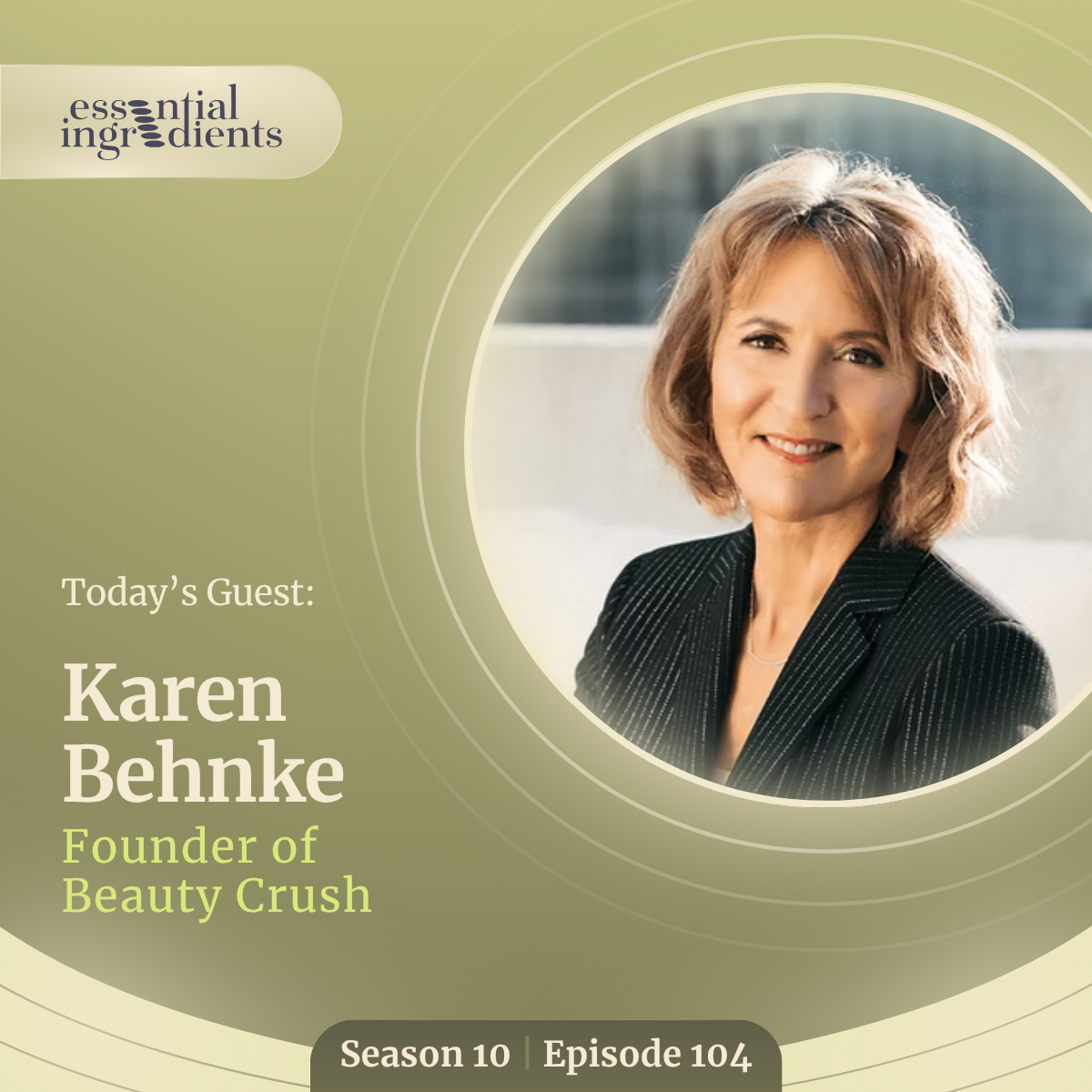
Karen Behnke · Founder & CEO of Beauty Crush
Start With a 90-Second Clip
Clean beauty is easier to evaluate when you look past a label and into the formula, sourcing, and standards behind it.
Watch the Full Conversation on YouTube →The Incorporation Method helps you turn what matters into practical changes that fit your life.
“Karen Behnke pioneered the clean beauty movement when she launched Beauty Crush—long before clean beauty became mainstream. Goldman Sachs named her the most innovative entrepreneur; Glamour, Elle, Forbes, and Cosmopolitan have recognized her as the OG of clean beauty. Now she's channeling decades of innovation into Beauty Crush—blending proprietary plant exosome technology from her certified organic Sonoma vineyard, cutting-edge biomimetic peptides, and radical sustainability to transform what we put on our skin.”
A practical starting point
What You’ll Take Away
Clean beauty is easier to evaluate when you look past a label and into the formula, sourcing, and standards behind it.
Ask what a brand means by clean and where that standard is documented.
Separate ingredient transparency from broad marketing language.
Choose products that fit your own needs instead of collecting more steps.
Try This
Pick one product you use daily and read the full ingredient list with the brand's explanations beside it.
In This Episode
Why Karen walked away from a thriving private-equity career to fix the beauty industry
The early battles convincing retailers that clean beauty actually works
Co-launching Goop Beauty with Gwyneth Paltrow — what celebrity partnerships really teach you
The Sonoma vineyard at the heart of Beauty Crush and its record-breaking antioxidant grapes
How plant exosome technology and biomimetic peptides deliver clinical results
Three-step skincare simplicity: cleanse, serum, moisturize — and why it matters
Sustainability from soil to packaging: refillable, ocean-waste plastic, tree-free boxes
What Karen wishes she'd known before starting her first company
Resources
Beauty CrushFull Transcript
Full conversation between Justine Reichman and Karen Behnke.
Welcome to Essential Ingredients. I'm your host, Justine Reichman. Today, Karen is the founder of Juice Beauty, the clean beauty company that put organic skin care on the map long before it was a movement, and the woman who famously co-launched Goop Beauty with Gwyneth Paltrow. Goldman Sachs named her the most innovative entrepreneur. Glamor called her a top eco leader. Elle, Forbes, and Cosmopolitan have recognized her as the OG of the clean beauty movement. But here's what I find most compelling. Karen is not someone who rests on what she has already built. She is on her fourth company. She grows her own rare grapes on a certified organic vineyard in Sonoma County. She partnered with a leading US biotech firm to develop a proprietary plant, Exosome Technology, and she is doing all of this not because beauty sells, but because she genuinely believes that what we put on our skin, how we farm it, and how we treat the planet are completely inseparable. Welcome to the Essential Ingredients Podcast, Karen.
Thank you, Justine. Wow, you really dug up some things about me.
Well, we had to give you a proper intro.
Okay, I love it. Thank you.
Everybody knows why they're sitting here listening to you today. Thank you.
Thank you. Thank you. I've worked for a long time.
I would want to throw this out there. So, what if the most powerful skincare ingredient in your bathroom came not from a lab, not from a pharmacy, but from a vineyard? And what if the woman who grows these grapes also helped launch Goop Beauty? That's who I'm sitting with today. Before we dive in, if you have been loving essential ingredients, the best thing you can do right now is share this episode with one person who cares about clean beauty. This is how we grow this community, one intentional share at a time. And if you're not yet subscribed, hit that button, so now you never miss a conversation. So let's get into it. Before Juice Beauty, before Beauty Crush, before any event, what first made you think and look at beauty industry and think about it in this way, and think that it was broken and you need to go fix it.
Well, I'll tell you, and I'm so excited about beauty crush, my new company, but it's interesting when I started in fitness and wellness and environmentalism became an environmentalist very early in life for a lot of reasons, and I started looking at beauty companies when, after I had sold my corporate wellness company to United Healthcare, and so I worked in private equity looking at beauty companies, fitness companies, and wellness companies. I had been slathering this stuff all over my body for years and never read an ingredient. Despite having been in corporate wellness and working very diligently with UC Berkeley and Stanford in nutrition programs, knowing a lot about ingredients it never occurred to me what I was putting on my skin until I started in private equity consulting and looking at ingredients. And that's when I was like, oh my goodness, what are all these things. I started researching it and I thought I can do it better. So fast forward to 2005 and I started the former brand, and then left there in 2023 but I still had another patent swirling around in my brain, and more ideas. My husband was kind of like, again, my kids were like, again, and then they said, No, it's actually better for you to start something, otherwise we'll all become projects. So yeah, I'm off to the races again with Beauty Crush.
Exciting, congratulations. So, Juice Beauty became the brand that really put organic skin care on the map. Take me back to those early days. What were the biggest battles that you had to fight to convince people that clean beauty actually worked?
At first I didn't really pay attention to what everyone was saying, because I was spending all my time researching ingredients with scientists and trying to find an ingredient for high efficacy yet more healthful ingredient replacement for every toxic ingredient. In the early days using zinc was impossible — things were turning blue, it was heavy. Fast forward years later, zinc is pretty refined and accepted. When I started to hit retail and entered Ulta Beauty nationwide, and was one of the best sellers at Ulta Beauty for almost 18 years, the bigger conventional brands would try to sell against us with "it doesn't work." So I leaned into clinicals hard — and that's why I'm so excited about Beauty Crush now, because it's the best clinicals and products of my career.
And what I've learned about chatter is that people are talking about it, they're curious. Not everybody has to agree with me. We can go side by side.
Good point.
But it takes their interest. Okay, so you co-launched Goop Beauty with Gwyneth Paltrow. That was a cultural moment. What did working at that intersection of celebrity, wellness, and clean beauty teach you that you could not have learned anywhere else?
It was delightful working with Gwyneth and her team. She has, first of all, amazing taste — just impeccable. She wanted to launch her own beauty products on Goop, and I wanted to launch makeup, so I knew someone like Gwyneth Paltrow could help us launch makeup seamlessly, and she wanted skincare expertise. So we launched Goop by Juice Beauty — those were her first branded beauty products. My chemist and myself developed Goop by Juice Beauty skincare on the Goop website, and Gwyneth was our creative director for makeup, very instrumental in helping us design our whole makeup line. Working with Gwyneth Paltrow and Kate Hudson, they were both very involved in our collaboration. We had a great three-year contract. I remember someone said, Why wasn't it 10 years? I'm like, three years is a long time — usually those contracts are about a year. She needed to focus on Goop and building it, and I needed to focus on the company I was running.
What was the magic behind choosing three years?
We launched a lot of products — maybe eight or nine Goop skincare products, and over 20 makeup products. It took a while to get all those out. Everything has a lifespan. There was a ton of enthusiasm the first couple years, then it became more repeat purchases. It was time to move on.
You went from Juice Beauty to Goop Beauty, and now why start again? You won Goldman Sachs' most innovative entrepreneur. You've built and scaled multiple companies. Most people would slow down.
Well, I'm still in my 60s. You know, it's in my DNA, that's all I can say. It's in my DNA, and part of it was also with beauty I knew I had another beauty brand in me. I wanted to modernize, I wanted to elevate. I wanted to go more biotech. I wanted to go higher efficacy. I have this stunning beauty vineyard, and I was like, I have to put all this to work. We have these rare grapes from Sonoma — Falanghina and Sagrantino grapes — that are among the highest antioxidant grapes in the world, so great for your skin. I also have an obscene amount of energy. I was born with it.
I get that. I like to keep doing things and innovating and being creative, and while it is work, it also keeps me going every day.
That's right, I never wake up and go, oh ho, hum. I wake up and go, oh my gosh, I have so much to do today. I don't work a million hours like I used to, but I hope I work smarter now. My husband is a scientist and cardiologist and has helped incredibly on the Beauty Crush patent. I call him retired cardiologist turned vineyard manager, but he's really chief science advisor.
It's fun to have somebody at home who gets excited with you and brainstorms. So tell me about the Sonoma Vineyard.
The Beauty Crush Sonoma Vineyard is the heart of the new brand, and it's now a biotech regenerative center. We've developed an exosome from one of our rare grapes with a leading US biotech company — exosomes are kind of carriers that efficiently deliver ingredients. Our Sagrantino and Falanghina grapes have incredibly high antioxidant levels — up to 8.5 times the antioxidant level of organic grapes, which are already 30% higher. What that does for your skin is it fights oxidative stress and all the environmental pollution happening around us. The end result is you glow.
I want to glow and feel dewy. Those are the things I strive for.
That's what I love too.
So curious about the intersection of biotech and clean beauty.
I'm trying to pioneer that again. High-tech pharmaceuticals that cure powerful diseases come from plants, yet in beauty, oftentimes people question whether plant ingredients can be as efficacious. But obviously they can, because these were the best clinicals of my career — 100% of study participants reported they felt and saw smoother skin. The biomimetic peptides are phenomenal — they're in our Beauty Crush antioxidant serum and mimic vegan collagen, which can help with visible appearance of firming. The technology is phenomenal, and biomimetic peptides come from fermentation in a lab, which is kind of where regenerative and biotech started.
It's exciting to have a conversation that connects clean beauty and agriculture. So many people isolate them — this is clean, this is biotech, the two shall not meet.
And that's what I tried to do with Beauty Crush — the new products are multitasking products in three simple steps: cleanse, serum, moisturize. With my former brand it got to be so many regimens — this is for firming, this is for smoothing. We're all so busy. So these are multitasking products that focus on anti-wrinkle, firming, smoothing, brightening — that dewy glow — in three simple steps. The biomimetic peptides, the plant exosomes, the super glow antioxidant grape powerhouse, supported by niacinamide, panthenol, vitamin C, hyaluronic acid, organic jojobas, and sheas — all powerful ingredients that make these products hum, make you glow.
I like that it's three products — not 75 things you have to remember.
It's really doable, and we have four products: step 1, 2, 3, plus an anytime body moisturizer with triple peptides for firming.
So what's your favorite product?
If it's like choosing between your children, which I could never — but I'm tied between the Exocellular Glow moisturizer and Exocellular Antioxidant Serum. They're just the powerhouses for your face. Feel how this serum glides on smoothly — it's not sticky, it glows on. That's the super glow grape, the hyaluronic acid. Does that feel silky? So clinically validated. And the moisturizer — it has a beautiful aroma of just light plant rose, very light. These products are for women or men, 25 and up — really multi-generational.
Why 25 and up?
At 25 and up, women and men are starting to get serious about their skincare, starting to see maybe their first fine lines. Those influencers in their 20s, 30s, and 40s — someone asked me, Do you teach them everything? It's like, oh my god, they're teaching me every five minutes.
The way they do things now is very different. The transparency as opposed to not being transparent — that's a huge comment.
Our daughter is 26 and she's our chief technical advisor — an engineer. She just does everything so differently, not just because she's an engineer but also her age. It's so refreshing.
I feel like this generation really has a pulse for how to create things and how they'll impact people.
And that speaks my language. Speaking of impact — I've been an environmentalist practically my whole life since high school. We grow ingredients here on a certified organic farm, and the ingredients in the bottle, you want as many organic ingredients as you can get your hands on — they have higher antioxidant levels and they're not going to be contaminated with pesticides. We practice regenerative viticulture — taking care of the land. We plant red clover to put nitrogen back into the soil. And then taking it to the packaging — it's refillable, recycled ocean and land waste plastic, sustainable glass, airless component to protect the ingredients, tree-free box made with sugar cane and bamboo. We're sitting in a solar-powered headquarters and vineyard. We try to take sustainability to every aspect of what we do, because when you build a company, you have impact. I try to do everything as locally as possible — printers in Santa Rosa, labs in the Bay Area. As low a footprint as I can possibly conjure up.
That's really thoughtful. I love the refillable bottle. What role does education play in conveying all this to your consumers?
Our website, BeautyCrushskin.com, will be a living site, because every time I talk to someone, I think, oh my gosh, I didn't add that fact. We've got to put things like the sugar cane and bamboo boxes, the plant inks, on the website, and occasionally put them out into emails. It is a journey, and I think anyone who has been an environmentalist hopes they don't say they've got it all figured out. You've got to just go step by step by step and do everything you can.
How do we get people to be curious as opposed to judging when they see packages?
Well, I think through podcasts like yours, Justine, you can spread the word. Okay, you got another package. If it's all cardboard, check your local regulations and recycle it. If it has plastic tape, take it off and recycle it. If you have a bottle with pumps, take the pump off. If it's got a metal spring, discard it, recycle the rest. Just educate them that we do all live in a world where we consume things, but I'm trying to do less products, more multitasking — to make it simpler for people while having a lower carbon footprint.
It really feels like sustainability is integral to your product and brand. Ten years from now, if Beauty Crush has succeeded in the way you dream, what has changed — not just from the brand, but from the industry?
I think this whole regenerative longevity biotech science is going to just keep exploding. There'll be more fermentation lab ingredients done in a clean way. At this vineyard we'll have figured out how to work with our olives more. I am looking at compostable products, but so far they're a little tricky — you don't want them to start biodegrading before you're done with the product. But that will likely be perfected in 10 years, where you could literally take a bottle and just plant it.
Was there anything you wish somebody had told you before you started your first company?
To trust my gut more. I remember in my 30s and 40s, if experts or private equity crews would come in and claim they were experts — but trust, oh my god, that women's intuition is wonderful. Women's intuition is amazing, and really, really trust in your gut. That is key. And then stop fighting your DNA. I fought my DNA for a while — oh my gosh, why do I keep doing this? Why am I starting another company? And then, instead of fighting it, just embrace it and figure out how to make it work in the best way possible.
I always like to close with this question, because it's the heart of what this podcast is about. Karen, what is your essential ingredient — the one thing that you value and practice that makes everything else possible?
I would say positive resilience. I've been through a lot in my life, and I've been resilient. I feel like positive resilience is what keeps me going.
I like that. And I tend to have a positive attitude, because I feel like that keeps you going.
I can tell.
So before we conclude our conversation, which I truly enjoyed, I like to do little rapid fire questions. They're kind of fun.
Okay.
Don't take them too seriously. Juice Beauty or Beauty Crush — which one was harder to build?
Beauty Crush.
One ingredient you'd ban from every bathroom cabinet tomorrow.
Hydroquinone.
Farm or lab — where does the best beauty innovation happen?
Starts with a farm.
Clean beauty — what's the greenwashing that still drives you crazy?
Ingredients.
Morning skin ritual. One product. What is it?
Serum.
Founder fuel: coffee, tea, green juice, or something from the vineyard?
Tea.
Favorite kind?
Organic English breakfast.
One thing you wish you knew before starting your first company.
It's a journey.
The beauty industry in 10 years — hopeful or skeptical?
Hopeful.
Exosomes — overhyped, underhyped, or just getting started?
Just getting started.
Who are you closer to — Gwyneth Paltrow or Kate Hudson?
Kate Hudson.
Okay, Karen, this conversation has given me so much to sit with. Thank you for your generosity, your science, your story, and your soil. To our listeners across 50 plus countries who show up for these conversations each week, thank you for being part of this conversation. If today's episode sparks something in you, share it with someone who needs to hear it. You can find Karen at BeautyCrushskin.com and on Instagram at BeautyCrush_skin. I'm Justine, and this is the Essential Ingredients Podcast. Until next time, keep asking what is really in it for your skin, for your food, and for your life.
Thank you, Justine. This is delightful.
Thank you so much. It was wonderful.
Share This Episode
Enjoyed this conversation? Share it and tag @nextgenpurpose
Listen on Apple ▶Listen on Spotify ▶Your Host
Justine Reichman
Founder & CEO of NextGen Purpose. Host and Executive Producer of Essential Ingredients — 11 seasons, 330+ episodes, and a growing movement.
About Justine →