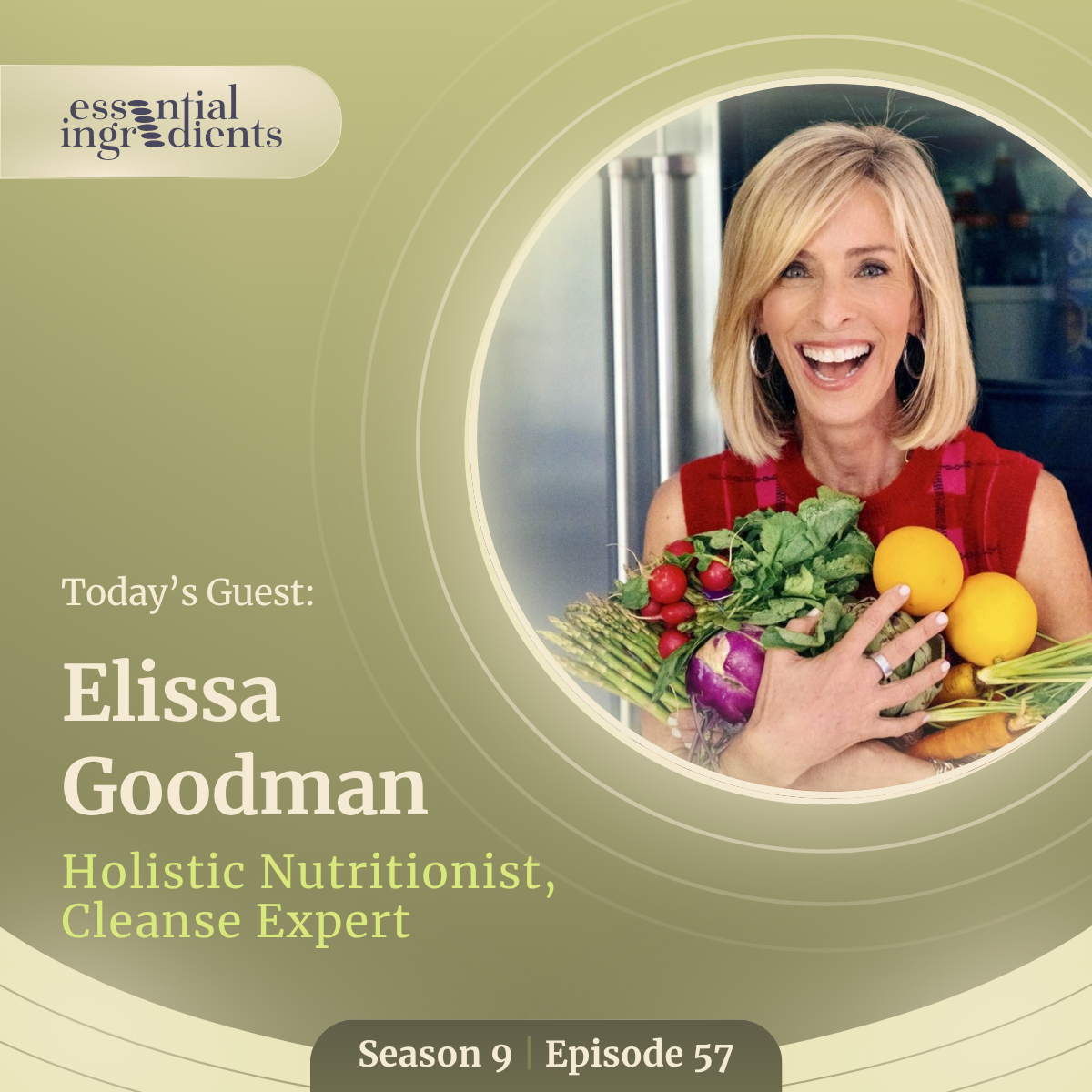
Elissa Goodman · Certified Holistic Nutritionist & Cleanse Expert
Watch on YouTube
Wellness Without the Hype: Food Fixes for Brain Fog, Bloat, and Blah Days
The Incorporation Method helps you turn what matters into practical changes that fit your life.
“Elissa Goodman, certified holistic nutritionist and cleanse expert, breaks down the real food-based fixes for the brain fog, bloating, and fatigue that so many people normalize — and shares the protocol she uses with her own clients.”
Full Transcript
Full conversation between Justine Reichman and Elissa Goodman.
Hi, guys. It's me, Justine, the host of Essential Ingredients. I'm so pleased to have my friends and community here with me this Tuesday, or whenever you seem to be listening to this podcast. I want to let you know that today's episode is an exciting conversation. I had a really expansive chat with one of the Co-Founder, Anthony, of ReGen Brands. Anthony talks about his personal struggles and what inspired him to build the business with his co-founder, Kyle. And together, they've built this podcast, which turned to a media company and now is a trade association. You're not going to want to miss this. So folks, for those interested in regen agriculture, ReGen Brands and building something that's regenerative, this is the podcast for you. Anthony, so great to have you here today on Essential Ingredients. I sort of ran into you guys a little bit in Expo West, but that was overwhelming.
Yes. It's an overly stimulating experience, for sure. But thanks for having me. Good to be here.
Great to have you here. Thanks again. Sorry, your co-founder couldn't be here, but we're excited to have the conversation. I feel like there's a lot to go over. So for those that are not familiar with ReGen Brands, maybe you can just give a brief description, and we can dig in after that.
Yeah. So we're an education collaboration and financing ecosystem, supporting brands that sell ReGen products. It all came about because we had this podcast, the ReGen Brands Podcast, and we got really intimately familiar with these brands and their unique problems. And we said, hey, there's enough of y'all that we should probably build some systemic, collaborative solutions to this. So we have not done that yet, but we are trying to do that now with really two existing nonprofits. But three existing pillars, the ReGen Brands Institute, the ReGen Brands Coalition, and ReGen Brands Capital.
Wow. Now tell me, you went from being a podcast, to being a media company, to now being a trade association, which makes a whole lot of sense because I have a very similar journey. Except that I'm not a trade association. But going world podcast to a media company creating that content. So how did it all evolve for you? What inspired this initial interest in ReGen Brands?
Yeah. The initial interest comes from my co founder and I, both had significant personal health struggles or issues that we've detailed in other interviews. but basically, I have an autoimmune disease that I've healed mostly through food, and through a kind of mold toxicity remediation. And then Kyle is a young male, but has already dealt with cancer, and kind of gone through the whole cancer treatment process. So we had a pretty intimate connection to the current issues with our food system, and we both were doing different passionate work in the reserve space. Kind of found each other, and ended up randomly living in the same place. We have been to Oregon together, and I was just a crazy guy that asked him to start a podcast with me the second time I ever spoke to him. So the right combination of interest and credibility was there for us too to kind of do it, and that grew over many conversations, many offerings of support for these brands and these products. I never, ever, ever thought I would be a nonprofit entrepreneur. And now, I have started and run two different nonprofits. So how we turn from a podcast into that is a multi year of winding journey, but it was very iterative. It feels very intentional now. But along the way, we were just trying to figure out what's the best way we could do this work, support these people, and somewhat make a living doing it. And we're still figuring that out. But yeah, it's been a journey to say the least.
Wow. I really relate as you're saying this. I feel like I did a lot of those same things, and I'm still doing that. We'll talk about my story another time. But it really does overlap in so many ways. So now that you guys came up with this ReGen Brands, and you're expanding to provide those resources and that expertise, are you finding any friends that are really important for you to focus on?
Yeah. And this will be a little bit long winded, because I'll give basically the reason why each of the three programs exist. So the ReGen Brands Institute is a 501 c3 nonprofit, and it does research and education. And its real mandate is to figure out what information, either doesn't exist, or isn't aggregated, or isn't understandable that would create more demand for regenerative agriculture through CPG. And we wanted to put it in a 501 c3 because we can use philanthropic donations and grants to fund that work, make it completely open source so that all brands, all farmers, all retailers, all investors could have access to that knowledge that doesn't currently exist. We uncovered that we could build systems that work there by having each episode with a brand, and each one of those episodes is a case study on how to make a regenerative brand work. We're now trying to do that across an email newsletter, and we're going to do databases, and we're going to do a big report, and we're going to raise money to do consumer research. But ultimately, that organization really has a strong philanthropic, open source kind of knowledge, education, and research mandate. The ReGen Brands Coalition is a 501 c6 nonprofit, which is the type of nonprofit you use for a trade association. And ultimately, that needs to be in a separate entity because that has explicit benefit for profit businesses, which are not allowed to have in a c3. So you can see, I've learned quite a bit about non profit law for the last couple years.
I'm actually curious. I don't want to stop you from saying the third thing. I often ask myself these questions and then wonder, why not a benefit company? So I'm curious, what's your thought on that? I don't want to hinder you from going on to the third.
Maybe we can circle back after. It's a quick answer because we've only made that decision from a hardcore perspective is the c3. And the answer is, I didn't want to be forced to commercialize and monetize this information when I felt like the greatest, fastest good for actually seeing more of it in the world was gonna happen in a more philanthropically funded and open source kind of model. Had we made it for profit, I would have to figure out how we drive more revenue for everything, and how we monetize everything, instead of just putting out really good quality education, information and research. So that was really it on the c3. The Coalition exists because we have brands and products out there in the universe that are regenerative that we believe don't receive the right business ROI for being so. So we saw three real opportunities from all the conversations with the brands to drive value there. One is creating a community so that we could increase collaboration and kind of collective action. We've now done that. We've created the entity. We have 31 inaugural members, soon to be 50 members. The second thing was peer to peer support. All these brands have another brand in that cohort that has had a similar problem as them, or is going through something similar right now. So how do we create a hive mind mastermind, collective intelligence that makes us all stronger, better operators in a very competitive and cutthroat industry like CPG? And then the third thing, which is really the thing that didn't exist anywhere else is, how do we increase the ROI of them selling regenerative products? So how do we do collaborative marketing? How do we make more unified messaging to the consumer? How do we work with retailers to better identify regenerative products in store? We're working on anything and everything in that realm, some at various levels of sophistication and progress more than others. But that entity is going to do what any trade organization really does at the end of the day, which is increase the value of the specific work that those brands and products are doing on the capital side. ReGen Brands capital really came out of a fundamental understanding that regenerative brands are extremely underfunded, and they're funded with a lot of misaligned tools and capital. So the investors, the capital and the financial products that we need to fund the next generation of regenerative brands that are going to actually truly scale regenerative supply chains does not exist. So how do you do that? And we don't actually think we know exactly how we do that yet, but that entity and that programming is being created to figure that out.
So you kicked this off as a podcast. What was your background before you launched this podcast and got into regenerative agriculture and building regenerative brands?
Yeah. My family's been in the food industry for the last 100 years. My grandfather was a second generation Italian American orphan with very little economic opportunities. So he started selling wholesale produce, which was a pretty typical career path for a lot of Jewish and Italian Americans in Indianapolis, Indiana at the time. So he started doing that in the 1930s. I grew up in a business that my father, uncles, cousins kind of took over from him, and turned into a very successful regional produce distribution business in the Midwest. I went to college, played college football, did something different out of school because I didn't want to be a product guy like my dad. But I eventually found my way back to the business when we had sold it to private equity. And my dad, my uncle, my brother, my cousins all called me and said, hey, we have these new private equity owners. They really want to grow this business. We need people that really understand this business and want to see it succeed. So I went back there, helped run a big operating business, managed a big team, super, super fun to carry on the family tradition. And we had a lot of success and a lot of growth. I left because of the autoimmune disease that I mentioned earlier really to take a health sabbatical and deal with that significantly for the first time since I was diagnosed at age 14. I got asymptomatic from the disease for the first time during that sabbatical. Medical and I got very passionate about the things that led me to become symptom free, like food. And basically, in January of 2021, I just decided that I'm gonna work on regenerative agriculture. I don't know what that means, what it pays, where I'm going, what I'm doing, but we'll figure it out. And I started an apparel brand called Regeneration Nation to advocate for regenerative agriculture, which was just a really good way to burn money. I started making investments in space. I had a full time role with an amazing organization called Regenerative Food Systems Investment that really is a media and events company covering, investing in the space. And along that period six ish, I forget exactly the number, but I had made multiple investments into CBG brands. I found that the focus, the attention, the capital allocation, and the awareness of the need to support brands from a regenerative perspective was really low. We were constantly talking about the farmers and the farmland practices. Which is, yes, that's the whole point. That's the whole point. But if we never figure out how to process it and sell it to a consumer, that's going to be an issue. And so we started the podcast really just as two gentlemen that wanted to help with that, and were curious about that topic. And what it allowed us to do was get the clarity and the intimacy of these people, these products, these brands and their problems to then go try and create some stuff to help support them.
And I'm curious because regenerative brands are, people are defining it in so many different ways. Not regenerative brands, regenerative agriculture and being regenerative, right? How many different examples of what that means do you have? I probably have 20 different definitions. I'm curious, when you're working with these brands, is it hard to get everybody on the same page? I'm guessing they all have the same ethos, even if it's not the same definition.
Yeah. No, it makes a ton of sense. And as a fellow California now, we're lucky with the amount of fresh whole foods we can buy, versus a lot of other people. In the work that we do with packaged CPG products, it's all about labels, it's all about claims, and it's all about certifications. And your question is a good one because regenerative is a mess. It's a hot mess. I can understand, articulate and define it really easily. But the average consumer, I don't think can, for a myriad of reasons. But what it looks like from our perspective is there are close to 10 different certification bodies that all have products in the marketplace in some way, shape or form. There's probably three or four leading those efforts that have more products than others, and kind of more of their reputable brands and products than others. And then there's also people that are just making regenerative claims and not really substantiating them at all. That's on the product side. On the overall regenerative agriculture side, there's these practices that you can just do one of the practices and you can say, we support regenerative agriculture. Or we are regenerative, which I think is the entire reason regenerative was created is the beauty of that being a transition tool to improve conventional agriculture. The challenge is it's super easy to green wash if it's not legit, or it's really easy to lower the bar as low as possible. We don't work a ton in that space because I largely believe that we can't have a lot of effect on that. What I'm more concerned about is, how do we support these brands that have products that they are saying are regenerative, that have some sort of third party validation? So for us, for membership in the trade association, you have to produce at least one product that has regenerative somewhere on the package, and it has third party validation from one of eight different third parties. Seven of those eight are certification bodies. And then the eighth option is the Whole Foods Market because they have a specific regenerative assessment for brands that are not certified.
I think that makes it pretty clear for people because if there's any question, you can go about investigating it that way. And I think that if I were to go to the market and look for a cracker or something, I would look at all the ingredients, and I would look at all those things. I don't buy anything with sugar, or gums. That is my thing. We all have our things, right? That's fine. It took me ages to find some milk that didn't have any gums. Whatever the nut was, the water and the milk, and the salt, a little salt. I think that that's a really smart way to break it down, and it really makes it accessible for those people building businesses to better understand how they fit into that niche. So can you give us a couple examples of people or products that fit into that niche?
I'll wrap the last conversation with just one more thought, which is the challenge at the retail store. When you walk the aisle, there are articulations of regenerative, right? Because it might be this certification, it might be that certification. But the one unifying factor right now is, typically, the word regenerative is at least on the packaging somewhere. So we're trying to just create more unity and harmony around the consumer experience, and the identification mechanism like, can we do shelf tags that all look the same? Can we do POs that all look the same? Because it's not as uniform as non-GMO, organic, kosher, and gluten free. There's these multiple different languages that it's being communicated in, which is a challenge.
Also venture to say that it's hard to add anything else to some of these space problems.
To your question of brands to spotlight, that's a hard question you're asking me to pick children here.
I knew you were gonna say that, just to give our audience an idea of what to look for if they want to see an example. A good example.
And we used to have a full brands list on our website, which we are revamping, and we'll republish here soon. But we still have all the coalition brands listed on the website, so I'll share a few of those as examples. And my favorite, I will play favorites. (inaudible) in the company, and they're a member of the trade association, a huge ice cream guy. So Alec's Ice Cream, they're a great brand. They're doing extremely well. You can find them at Whole Foods, Sprouts and probably your other favorite natural food store. So I love Alec's Ice Cream. They source from Alexandre Family Farm, which is a very famous regenerative and organic dairy that you can find in most of your kind of dairy sets with regenerative certifications and claims on it. There is coffee and nuts, and snack chips, and coconut water, and bone broth, and all these things now but to just name a few that maybe people don't know about that are very like household brand names, like harmless harvest. They have regenerative, organic certified coconut water. They're in the trade association. They're still rolling out the certification on packaging, but it's all regenerative organic certified coconuts, Kettle and Fire, which is obviously kind of the natural channel Bone Broth leader. Now, they have two regenerative skews. Obviously, Kyle works there. We have awesome snack food chip brands like Artisan Tropic. They have a cassava and a plantain chip. We have Zach's Mighty. They're an amazing regenerative corn based tortilla chip. We have GoodSAM Foods. And they're doing tons of fun snacks, nuts and coffee, all kinds of fun stuff. But I'm leaving many out. If people are most interested, they can go to regen-brands.com/coalition, and they can start with those 31 brands that are listed on that page, and get a ton of fun stuff.
I think that's a great resource for those folks that are interested in getting into regenerative, trying to figure out how and what to look for to be able to make sure that they're heading in the right direction. And for somebody, like yourself, who had an autoimmune disease and saw the benefits of regenerative, can you share a little bit about the impact of incorporating regenerative into your body to inspire all those others to maybe get on board and build regenerative?
Yeah. That's a really great question. And as you're asking, I was kind of noticing that I never mentioned a meat brand, and I probably should always lead with that because that's the OG regenerative, many other OG regenerative brands. Because basically, that cohort proved that we can have a positive ecological and environmental effect with livestock when the conventional narrative is that you never can. So we just had White Oak Pastures on the podcast. They've been on Rogan, they're very famous for their regenerative work. The most up and coming hot brand in that space nationally is Force of Nature meats. I buy their product. It's amazing. I love what folks like hickory nut gap are doing. They're in the coalition. They're an awesome kind of regional brand. We've had many others on the podcast as well. But there's a lot of ranchers doing amazing work with both beef cattle and bison. They're creating amazing, healthy, nutrient dense foods that are also good for the planet, and good for the ecosystems that they ranch in. So those would be something to check out, and that's been the biggest shift in my diet. I grew up in a business where we had access to tons of fresh, healthy, organic fruits and vegetables, so I never had any problems there. I'm sure we ate decent meat growing up. But like you said, go to the butcher shop, go to the grocery store, and have no idea how it was raised. Does it have nitrates? Blah, blah, blah. Was it a feedlot? Was it not? And I eat some sort of a generally raised meat probably once or twice a day, usually grass fed, grass finished beef or bison.
Now, as you've incorporated that in, what is the impact that you've seen on a personal level?
Well, my autoimmune disease is called Hidradenitis suppurativa. It's quite a mouthful. It's a skin related condition. So my biggest symptom or lack thereof are these large boils, zits, lesions to not get too graphic that people don't like, and basically the alleviation of getting them. So that's the biggest symptom that I've seen. I don't have to deal with that anymore. And then just from an overall vitality, energy recovery from athletics and weightlifting, huge increase. And I can really feel the difference when I don't have access to that, that regeneratively raised protein source. So those would be the big ones for me.
Okay. So in terms of feeling that, is it that you don't have those anymore, but you also have more energy, or you're less tired. I don't want to put words in your mouth, but I'm thinking about football players. As you said, you were a football player. I'm thinking, what's up? What was it like making that transition? Because obviously, as a football player, that's a lot of work. It's hard on your body.
Yeah. I wish I knew then what I know now. I'll tell you that if I had some of the nutritional awareness, knowledge or access that I do now, I think I would have been a lot better off when I was training at that level. But I think I've been living this lifestyle for quite some time now, and so I actually see less of the benefits in myself personally. I notice more of the deficiencies in others that are not doing it more from living in the world around a lot of people that maybe aren't which you don't want to be super judgmental, pontificate and shove it down people's throats. But it offers a lot of nice opportunities to be like, hey, have you ever tried this? It tastes really great. I think you'd feel a lot better. Blah, blah, blah. It's fun to get texts from some of my buddies from college and be like, hey, I need some more reserve meat. Who should I buy from? Or, hey, it tasted so good. So that's been a fun experience,
Yeah, I'm sure. And very rewarding, too. Because not only are you now feeling better, you're now investing in other companies, providing the community for them, and access to information so that they can figure out how to do it themselves. So for those folks that are tuning in that maybe are looking at becoming a ReGen Brands, what are some key things or tips that you might be able to recommend on this journey for them?
Start with one ingredient. A lot of people just start that way, and they eventually have an entire SKU where all the ingredients are regenerative, and then they eventually have a whole line that's regenerative. There are plenty of ingredients. There's supply out there that exists at the right cost for you to put it into a product. Many have been showcased in a lot of the brands we've had on the podcast, because many of them are farmers or processors that also sell B2B ingredients on top of the products that they produce themselves. So yeah, start with an ingredient that's meaningful in at least one of your products, and work with information sources like ours. Go to the certification websites, find regenerative farmers, maybe near your co-man or you manufacture, or near where you work. There's enough supply out there to get started. We are supply constrained in some capacities, either from an availability or a cost perspective when it comes to some ingredients. But there's plenty out there. And my advice would be, choose one ingredient to get started, and reach out to us if you're looking for sources and or knowledge. We don't have paid consulting engagements for that stuff, but we can definitely get on a 30 minute Zoom and see how we can help and get you connected with the right folks.
Awesome. Anthony, I am so excited to continue to watch how things expand in your world. In your orbit, I should say, with all the different things that you have going on, from the coalition to the funding, to capital, all of it. It's a lot, and it's exciting. I can see the impact it's going to have on the future of the next generation of regenerative brands and people also accessing information for education around it, with resources like yours, like mine, etcetera. Hopefully, people will be able to make more informed choices.
Yeah, I hope so. That's the goal. We've seen that so far, which is why we continue to do the work, and we just have to find ways to do more of it. I appreciate you having me on to talk about it.
Thanks for joining us. And for those folks that maybe want to learn more about you or connect with ReGen Brands or get involved, what would be the best way to do?
Our central hub is just www.regen-brands.com. And the best way to stay involved with us is to subscribe to our newsletter, or follow our LinkedIn page. We are putting stuff out there daily on LinkedIn, and then weekly on the newsletter. And if people just want to listen to the podcast, if they just search ReGen Brands Podcast, it's available on all podcast platforms, YouTube, etcetera.
We'll make sure it's in the show notes too. Thank you. So thanks so much for tuning in, and we look forward to continuing to watch you, and come back so we can continue the conversation as things progress.
Sounds good. Thanks for having me.
My pleasure. So thanks for tuning in today to our Essential Ingredients Podcast. It was a great conversation with ReGen Brands. We learned a lot. It's a great resource, and it supports and provides a community for anybody that wants to build a ReGen Brands. So I want to thank you, my friends, my colleagues, those tuning in to the podcast or the the video cast. Don't forget to follow us on Instagram at essential.ingredients. And don't forget to like and subscribe on Spotify, iTunes, or wherever you listen to your podcasts. And for those that want to watch the video, we are available on YouTube. Thanks again, and see you next week.
Share This Episode
Enjoyed this conversation? Share it and tag @nextgenpurpose
Listen on Apple ▶Listen on Spotify ▶Your Host
Justine Reichman
Founder & CEO of NextGen Purpose. Host and Executive Producer of Essential Ingredients — 11 seasons, 330+ episodes, and a growing movement.
About Justine →