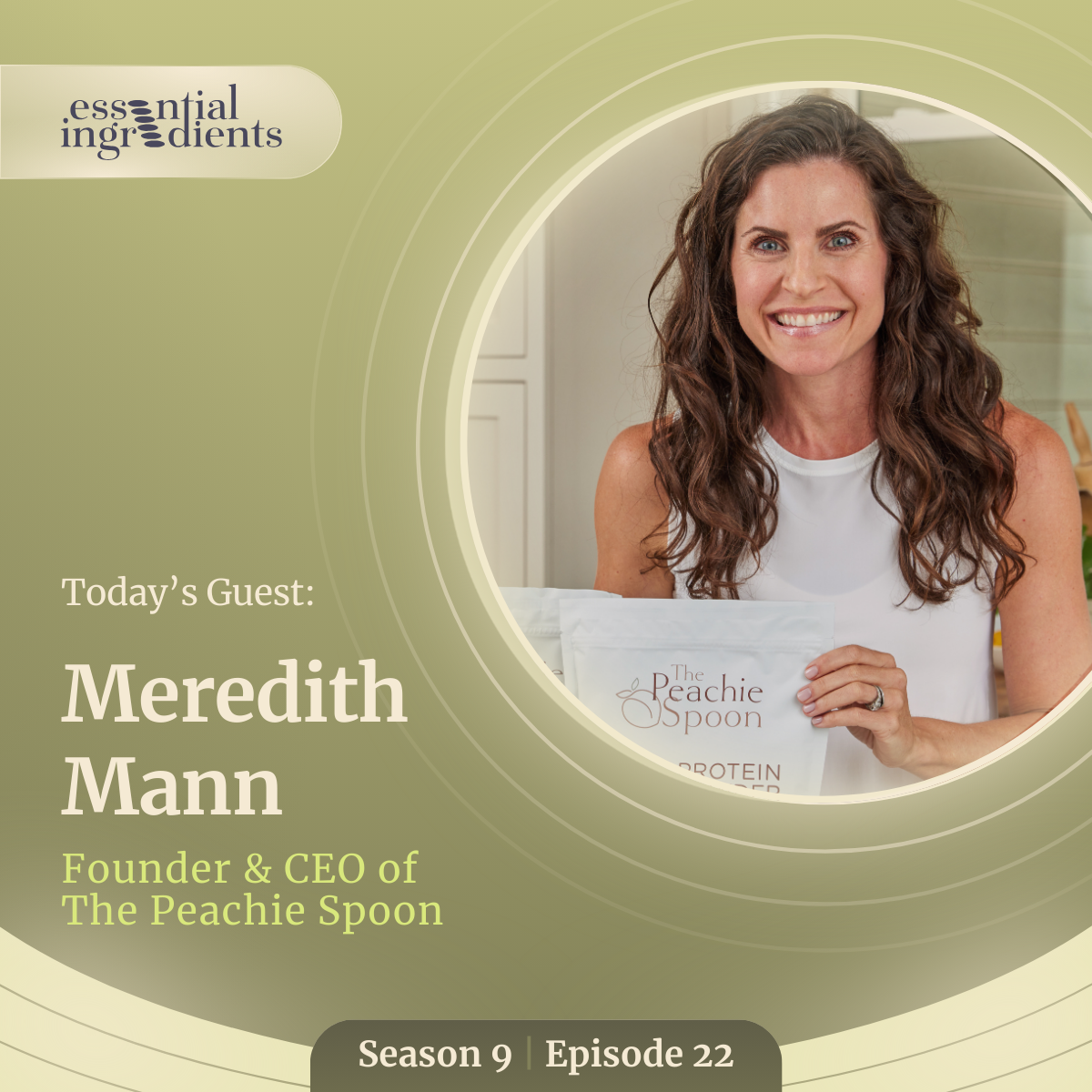
Meredith Mann · Perimenopause Nutritionist & Health Coach
Watch on YouTube
Perimenopause and Protein: Nourishing Your Body Right Through Hormonal Changes
The Incorporation Method helps you turn what matters into practical changes that fit your life.
“Meredith Mann, perimenopause nutritionist and health coach, explains why protein becomes the most critical macronutrient during hormonal transitions — and how strategic eating can help women feel strong, clear-headed, and in control during a period that often feels like the opposite.”
Full Transcript
Full conversation between Justine Reichman and Meredith Mann.
Good morning, and welcome to Essential Ingredients. This morning, I have the distinct pleasure of having Meredith with me. She is the Founder and CEO of The Peachie Spoon. Welcome, Meredith.
Thanks for having me. I'm so glad to chat with you today.
I'm really excited to learn a little bit more about The Peachie Spoon, what inspired it? And what you're working on? But before we dig deeper into this and get into all sorts of topics to explore, I'd love for you to let our community know, those that are watching and listening, what is The Peachie Spoon?
I'm really passionate about blood sugar balance. I've had some blood sugar issues my whole life. It just started as an Instagram, a recipe blog in 2019. I was like, I'm just gonna start, go for it and start an Instagram. Start sharing these smoothies that made me feel really good, and these recipes that have helped tilt my body. But the behind calling it The Peachie Spoon, literally, I just thought it sounded cheerful and southern. I'm in the south, and nobody had it on Instagram yet, so there's not a lot of meaning behind it. It just sounded fun and not like a diet or anything like that. So I just grabbed it, and it's evolved into a business.It was a coaching business. And then now, I have a product, and it's still a recipe blog too. But that's kind of what The Peachie Spoon is right now.
You really just created content to share with people what was working for you as it related to blood sugar. So over time, it became less of a hobby, more of a functioning business. Now, it actually connects with people, supports them, coaches them, and offers them a product based on your experience.
That's right. I have two cookbooks now too. I just really am passionate about simplifying nutrition and helping others because I think blood sugar is an issue for, like a lot of Americans, and I don't realize it. I didn't realize it because I was a healthy weight, but I had hypoglycemia and insulin resistance. I just didn't know, and so I feel like you can't live out your best life, fulfill your passions and be a good spouse, or mom, or dad, or whatever, and work if you don't feel good. So yes, I'm super passionate about helping others.
If you don't feel good, you can't really function in the same way. You're tired or whatever it is. You're not terribly motivated, and your focus is really that you want to feel better or that you don't feel well. It's not even sometimes that you want to feel better, that you just feel like that's going to happen. But at that moment, you're just focused on the fact that I don't feel alone. I can't do anything. Let's go back a minute. Let's just start with your background.
My first job after school was a personal trainer, and then I got married and had kids back to back and that kind of thing. Starting The Peachie Spoon and my holistic nutrition coaching and all of that, and the recipe blog, that's kind of like a second season of life. I just journey with my food and healing, my insulin resistance and hypoglycemia. I just had this passion, and I knew that I wanted to do something. I didn't want to be at the gym counting reps anymore. That wasn't really like a passion, and so that's when I started Instagram.
I think that's amazing. I'm curious, you know. Do you look at food as the source that helped you cure some of these issues, whether it was insulin or otherwise that you're talking about?
I really do. I feel like food is medicine. But for me, I did the whole 30 in paleo so the type of food for me wasn't the missing link. Because for over a year eating paleo, that was when I got diagnosed with insulin resistance. I think blood sugar is super individual. But for me, I create recipes that are refined sugar free. And usually unrefined sugar free because I can't do maple syrups, honeys and those types of things much because they still spike my blood sugar. I wear a glucose monitor off and on all the time. I've worn one for years, and I've tested on my recipes with one. And so that's just one of those things where, for me, it just depends. It's the food balance and the food quality. I'm also passionate about your relationship with food and wellness without obsession, and that's individual too. So I'm not about fear mongering, but of course, whole foods are best, and all of that stuff.
You kicked off your Instagram and your blog, and you started sharing your recipes. At what moment did it turn from a hobby into a full fledged business? What was that moment like for you? What was that aha moment?
I've still wrapped my brain around it. I'm still, wait a minute, do I own a business? Is this happening? I don't know if there was a moment, but it definitely has evolved. I was doing one to one nutrition coaching for a while, but I got overwhelmed with that, and couldn't keep up because I'm a little bit of an introvert. That was hard for me. And so I made Well Made Academy, which is an online course, so that felt business-ish. But now that I have my protein powder and I have a product, I feel like it's another step in that, okay, this is really a business. I have a product, and it's really fun. 'm not really a go-getter like that. I can't believe it's out of business.
Sometimes you're like, is this really me? Is this really happening? There's a bit of that sort of incredulous checking in with yourself to be like, okay, what am I really doing here? But you went from being a trainer to being a business owner. Not to say that as a trainer, you can't be a business owner, because you can run your own business and have many clients. But now in addition to selling a service, you're also selling a book. You also wrote a book, and you're also selling products. So walk me through that journey because there must have been a lot of learning on the job that you had to do to be able to create a product test, a product sample, a product work with suppliers, all sorts of things and regulations and it doesn't sound like you came from that world. We're ready to jump into that.
We're definitely learning as we go. My husband is working with me now too, and so that's been great because I can't do it on my own. And I think that might be an aha moment where I'm like, okay, we really own a business now, because he's working with me. Because at first, it was just a little side hustle and fun, my Instagram. My first book, I self published. And then my second book, I had a deal with a publisher, so I've done both of those. I feel like I just learned as I went with both of those and then with the product. Honestly, my husband's in sales, and so he's more of a people person, and can talk to anybody. He knew I had in my heart that I wanted to have a protein powder because I love a protein supplement daily. Because I don't love meat that much, and I love high protein. I know I feel. So anyway, he just would pick up the phone and call, we just called manufacturers. We just have learned. It's literally just learning as we go. And then we found somebody, the bag designer, and then she knew somebody that was in marketing, and it's been evolving and learning as we go. But it's been great so far. But definitely, yes, just learning and learning on this journey. I don't know a lot about it.
For folks that might be interested in starting their own, you know CPG product, if you will, coming from your experience with no experience per se in this. What are maybe three things that you might recommend to them that they keep in mind, or that they think about while they're doing this so that they could maybe be more efficient, because they have wisdom from you, who's done it?
We'd just say, make sure that your product is different and could stand out in the market because it's a lot of money. It's a big decision to do this kind of thing. And then don't rush with it. I just think it's really important to have peace about the decision and make sure you know that you're moving in the right direction. Once again, it's a big commitment, and it's a lot that goes into it, to selling and the website. There's just so many things that I didn't know. I'm learning as I go, but I feel like it is a lot, and it's a lot of work. So that would be something else too. I don't know about number three.
Is there anything that you might say that, as an introvert, you might recommend to other introverts that are starting a business that might be really helpful for them?
Have your boundaries because it can get really over overdone, overtired, hustling too much. Instagram to me, talking to my phone doesn't feel overwhelming because it's just my phone. Nobody's talking back to me. But I think it really does help too to have a team, to have some employees, or somebody to run the business with you that is more of an extrovert, that can bounce off of each other and balance that out. Because that's been really helpful with me, with my husband.
So for folks that maybe are doing this on their own, are you, you're recommending, you know, to find a partner or somebody that maybe has the skill set you don't have? Is that kind of what I'm hearing from you?
I think that could really help. It's a lot to do it all on your own and to have it on your shoulders because it's emotional, because you are passionate about it. But also at the same time, there's a lot on the line with being a business owner, and pouring a lot of money into a product, and the testing and all of that. We had to do R&D and go back and forth with samples, and then everything takes a lot longer than you expect.
Talk to you a little bit about you developing this product. It's your first time creating a product. Who did you have to partner with to make sure that you could create a good protein powder that was unique and different to make it viable in the market?
I really wanted it to be tested for impurities so we had to find a manufacturer that would do testing, or I've done third party testing since it's something I eat every day. I'm passionate about it. And a lot of people in my community, my family, eat it as a protein supplement daily. And so just making sure that I could do that third party testing for the molds, heavy metals, any impurities and that kind of thing. So we did find a manufacturer for that. So that was one of the things. And then also just the quality standards of premium ingredients, and just making sure also that it tastes good. So it was a lot of back and forth. I landed on stevia, but I wanted to do alveolus, or monk fruit for the sweetener. So there was a lot of back and forth, but the monk fruit ended out having a weird odor with the vanilla. You just kind of learn as you go. I was like, there's not a protein powder on the market with alveolus. I thought that would be so fun, and it just didn't work out. And so I'm happy that the stevia tastes really good, and it's been so tested for so many years for safety. It was quite a journey with all of that. I just really wanted my product to stand out and be different, and be 100% grass fed. Because I'm in perimenopause now, and so for muscle health and all of that, I just wanted to simplify nourishment, like, where's a protein powder? That's like, all muscle building protein. You know, with that the highest leucine, the amino acid leucine 2.6 milligrams, I think, is in it. And then also, a lot of my recipes are baked goods. And all protein powders aren't created equal, texture wise, plant based, or beef protein, or collagen. Some of those don't work great with baked goods so I really wanted to have one that yields perfect like cake texture, brownies and all of that. So there were a lot of factors going into the manufacturer, and really going back and forth with the samples and finding one that was just perfect. But it worked out.
What you had said about being perimenopause and being on a high protein diet, which I've had conversations with people about menopause and doctors. Did you speak to any doctors about nutrition and diet as it relates to perimenopause, and what role did that play in your research and development?
With just myself and then the holistic nutrition coaching I was doing all these years, I just feel like I learned a lot. If women are in perimenopause and going through menopause, our estrogen regulates our insulin so it's really common to have insulin resistance along with menopause. So those high protein blood sugar friendly recipes and meals like my gentle plate structure I came up with just reversed all my insulin resistance, hypoglycemia and all that. It can really be helpful. Just that protein forward diet just helps to make you feel satisfied too. And just for that skeletal muscle health as we age, and then also the more muscle we have, there's more room to store that glucose, so you have more balanced blood sugar. So there's just so many benefits to our muscle health and making sure we get enough of those complete proteins every day. And so that's kind of my WHY behind the supplement. I wanted to just simplify it so that we can easily hit our protein levels if we don't want to always eat eggs and meat every time we eat.
Talk to me a little bit about the team that you've put together at The Peachie Spoon.
So it's me and my husband. He's in the shipping department and doing all that with the protein. But I also have a registered dietitian on staff that's gone through all of my Well Made Academy, like my on Online Course Info and all of that just because I wanted to make sure to check all the boxes just to that have this, all the knowledge to be correct with all the blood sugar and all that, because that can be more of like medical nutrition advice. I just want to make sure you know legally, I'm doing all the right things.
Talk to me about the Well Made that you have there, that coaching or that online experience that people have. So just to clarify, you created this program, and then you brought on your dietitian to say, can you go through my program and make sure that I'm not missing anything, that it has everything, that it's valid so that you have her stamp of approval. So it's not just you who did the holistic nutrition counseling, but you also have a registered dietitian. So you've got two people with a little bit different background partnering or collaborating to make sure that those that are going through this project really understand why and how to do this. Am I correct?
That's right. So Well Made Academy is my online course. It's self paced, but it just goes through anything you would need. Have healthy blood sugar and the most thriving metabolism you can have in age. And there's different modules. I just had all these pain points from the one to ones I did. So there's modules for, if you have thyroid issues, or if you're in perimenopause or menopause. Or if you're pregnant and nursing, my gentle plate structure works for everything, but there's tweaks to it to make sure you're fully nourished. I have my registered dietitian on staff that has gone through just to make sure all of it was just exactly the right info that I wanted to share to help others. And then also with my personal training background, I go through exercises that we can do that are optimal for metabolism health, muscle health and aging, and that can tweak depending on hormone stressors. Even intermittent fasting. There's modules for all of that, and it's very individualized. And you have lifetime access to it so I'm really proud of that. Of course, it's been great.
Is it fair to say that, basically, you created these different programs based on your experience and your knowledge, your education, whether as a holistic nutritionist or as a trainer, but that you brought on this dietitian to give it the medical stamp of approval to make sure that you've got it all in your eyes and crossed your T's, so that as you developed this and the product, you were working in collaboration with somebody with a more traditional medical background.
Yeah. In my second book, my new book, The Blood Sugar Balance Cookbook that just came out, there's a lot of science in the front about insulin and blood sugar hacks and all of that. And so I wanted to make sure that all of that was approved by a registered dietitian too.
So as a business owner and somebody developing this, would you say that it was really important for you to be able to root yourself in medicine, surround yourself with those experts so that while you had insight that you wanted to share and experience, that you had that additional medical support.
I think just for peace of mind and legal stuff. Each state has different laws. But yeah, I just wanted to make sure that I was checking all the boxes and giving everybody great info, because you can only go so far. I can explain what healed me and reversed me. But I also want it to be, wellness is always individual, so I want it to make sure to cover all the bases to make sure that it can really help each person.
As you then started to hire your dietitian and craft this protein powder and develop your recipes, what were you hoping to achieve on a very large scale?
I don't have huge goals. But in my mind, I just think about the pain point of helping one person, helping somebody maybe that doesn't like to cook. All my recipes are easy. I don't like to cook either. I always think it's funny that I have two cookbooks. Just somebody that can feed their family, but also keep their blood sugar stable and not be on a diet or fix their kids something different than what they're eating. And just that pain point of easy breakfast with smoothies and that kind of stuff so that you're not having afternoon binges and carb crashes like I used to have. I'm just focused on helping just one person at a time, and I feel like if I'm making a difference with that, then I'm super thankful.
Do you have stories you could share from folks that you've helped by using your recipes or protein powder, and that you're able to share the impact of how and what happened for them as a result of changing their diet or incorporating your recipes?
Oh, sure, yeah. I get messages daily on Instagram. Even their lab work at the doctor. Six months of eating more blood sugar friendly recipes, cholesterol, blood sugar, blood pressure, all that stuff can be back in the healthy range just from lowering overall inflammation, and taking care of your body better. But it's also with a no food off limits approach, so it's not like crazy where you're not allowed to have fruit or something like that. It's super balanced and doable. But, yeah, I get messages all the time.
What I'm asking more specifically, is there one or two stories you can share and the impact that it had for that individual? So for example, if I tried your recipe and I was like, okay, well, you know what? I didn't get that 3:00 o'clock slump. I'm just making it up. Do you have any stories like that that you could share? And not about a 3:00 o'clock slump, but about the impact that you've had with those people that you could share?
You know breakfast that kind of sets the tone for hunger for the day for a lot of women? I get story after story of people starting to do my warm colly bowls, or the protein oatmeal or a smoothie. One of my loaded smoothies for breakfast. They realize, I can go those four to five hours, maybe even six hours without even thinking about food, and you have that stable blood sugar. Or you don't feel like you need to snack after two hours, and it really helps with cravings in the late afternoon. I feel like I get that message on repeat. I can't believe I didn't even think about food, which is what I love, that's my passion, to make you be able to just conquer your day and always think about what you get to eat next. I think if we're always hungry, we're always thinking about food, and that's exhausting. I feel like I get that message over and over, and then also just the easy balance dinners. I feel like I hear constantly that it was like a win, the balanced chili, or the pot roast and the slow cooker, the husbands are loving it, and then the kids actually eat it. And so I feel like that's always a win if it's a super easy recipe and you're able to feed your family with it.
Besides being easy, when are they expressing aside from it being easy? B-ecause being easy is great, but I want to hear how they're feeling, or the impact that it's having for them that otherwise they might not have. How would they be feeling if they weren't doing this?
I think the higher protein, the higher protein recipes for dinner just make you sleep better. And then if you're sleeping better, you feel better. Sleep is one of those big hormone stressors. If we're not sleeping, it affects everything. It affects our cravings, our hunger, just so many things. Sleep is so important. So I feel like eating, being really nourished and honoring your body, and having a threatening thriving body with these high protein blood sugar friendly recipes I hear over and over, people just sleeping better and feeling good, and just being able to conquer their day.
So as you've built this company up a little bit and you created the product, are there more products that you're looking to create?
Maybe I do. I always have an idea, and it's like I have to just really pause and be mindful about it, and take my time with it. And be like, is this really a good idea? I love electrolytes. There's so many electrolytes out there. I just want to be smart business wise, but definitely more flavors. The Peachie Spoon protein powder right now is chocolate and vanilla, and I'd love to have a bunch of fun flavors. On my website, I have over 60 smoothie recipes that are all different flavors and just only using chocolate and vanilla. So I do love to change things up. I feel like you can do a lot with just chocolate and vanilla, but I would love to have more flavors. Maybe some supplements, and then it's always on my radar too. I think it'd be so fun to have a smoothie shop, but that is a whole nother beast that we don't know anything about either. I just have all sorts of ideas. I don't know if anything will happen. But right now, we're just focusing on the protein since it just launched in September, so it's still new.
If you go back to the supplement, is this something that you'd work with a chemist or somebody on? Are these just supplements that you think you appreciate and find useful in your diet that you'd want to include?
Definitely would work with a food chemist to do the right ratios and all that stuff. But I try to be a supplement minimalist, but I do have some favorites, like Berberine has helped with my blood sugar. And then I have this cocktail I take before bed that helps me sleep. I would just have to see what would be a good idea. But I think also creatine, and they were not to say it, but I feel like that's a big one right now for muscle health, perimenopause and brain health. Just kind of looking into all of that and trying to find high quality, I already have a manufacturer and all that. But just try and decide what the next steps are for sure.
Can we expect another book?
Maybe the mom just launched, so I just feel like I just finished that. So maybe eventually. But yeah, it was fun. All the recipes are not on my website or Instagram, so they were their book exclusive. I had to create 100 recipes that are only for that book. So it took some time, but maybe one day.
You told us that initially you self published the first one, but then you had a book deal for the second one. I'd love to learn a little bit about that process and what that looked like for you? And how you went about doing it since you never got a book published before or had a deal.
I think the self published one, especially with a cookbook with the colored pictures like you have. You have to pay for each copy that gets printed, and then it ships to the person. And it's not a novel. For a cookbook, it is really expensive to pay for the color ink so I don't make any money on those. It's an expensive cookbook. It's like $60 to print. That's how much it costs. It's a very expensive book. I was super excited. I just got a message on Instagram, which I get messages all the time that are spam and not real. But it was a publisher, and she said, we're doing the blood sugar balance cookbook. They already had the title, and they chose me to write it. And so that was really fun. So that wasn't even on my radar. It wasn't like a goal to publish a book, but it happened. It was really cool. I just learned as I went with that editor, and it was a great experience.
Are there any takeaways that you have from that experience of doing the book deal that you might share with others that are working on a book deal right now?
It is like having a baby. It was a lot more work than I thought. I thought, oh, I can do that. That won't be a big deal. It was a big deal. And it was a lot, it was a lot of edits. It was like a year and a half of a lot of work. So it was fun. I really poured my heart into that book. I'm proud of it.
Is there anything, any lessons that you learned during the process that you could share?
I've just done everything on my own, so I think it just depends on the publisher that you have. Just all of the advertising and all of that is just, I've done that on my own, so a lot of that's been more work than I expected. I'm doing some book signings and that kind of stuff, but I guess you just get out what you put into it is what I've experienced. So it's been good, but I've had that on top of the protein that all came out. My book launched, and the protein powder came out within the same week. And that wasn't on purpose. So I think it's kind of my own fault that it was a lot at once.
Was it good? Maybe that cross pollinates both?
It was a big fall for The Peachie food. So it was great. Yeah, it worked out.
It sounds like you're progressing now. You're selling books, you're selling products. If people want to get in touch and ask any questions, or learn more about some of your recipes, what's the best way for them to connect with you?
Definitely on Instagram. I'm The Peachie Spoon. I answer all my DMs. I am there all the time. I also have my website, a recipe blog and all that. And the protein powder is on there. And there's a search bar where you can search recipes. You can search for chicken, and all the chicken recipes pop up. You can search for a type of fruit. You can search chia seeds, you can search anything. And there's so many recipes. They're all free and for you, but Instagram is where I am.
Awesome. Meredith, thank you so much for joining us today, and I really appreciate your time. And congratulations on everything that you're doing. I want to thank our guests for tuning in, whether they're watching the videocast or listening to the podcast. For those that are watching the videocast, don't forget that you can download our podcast at iTunes or wherever you listen to your podcast at Essential Ingredients. And for those that are listening to the podcast, don't forget, you can watch our videocasts at NextGen Purpose on YouTube, and so we look forward to continuing these conversations with you. See you again here next week.
Share This Episode
Enjoyed this conversation? Share it and tag @nextgenpurpose
Listen on Apple ▶Listen on Spotify ▶Your Host
Justine Reichman
Founder & CEO of NextGen Purpose. Host and Executive Producer of Essential Ingredients — 11 seasons, 330+ episodes, and a growing movement.
About Justine →