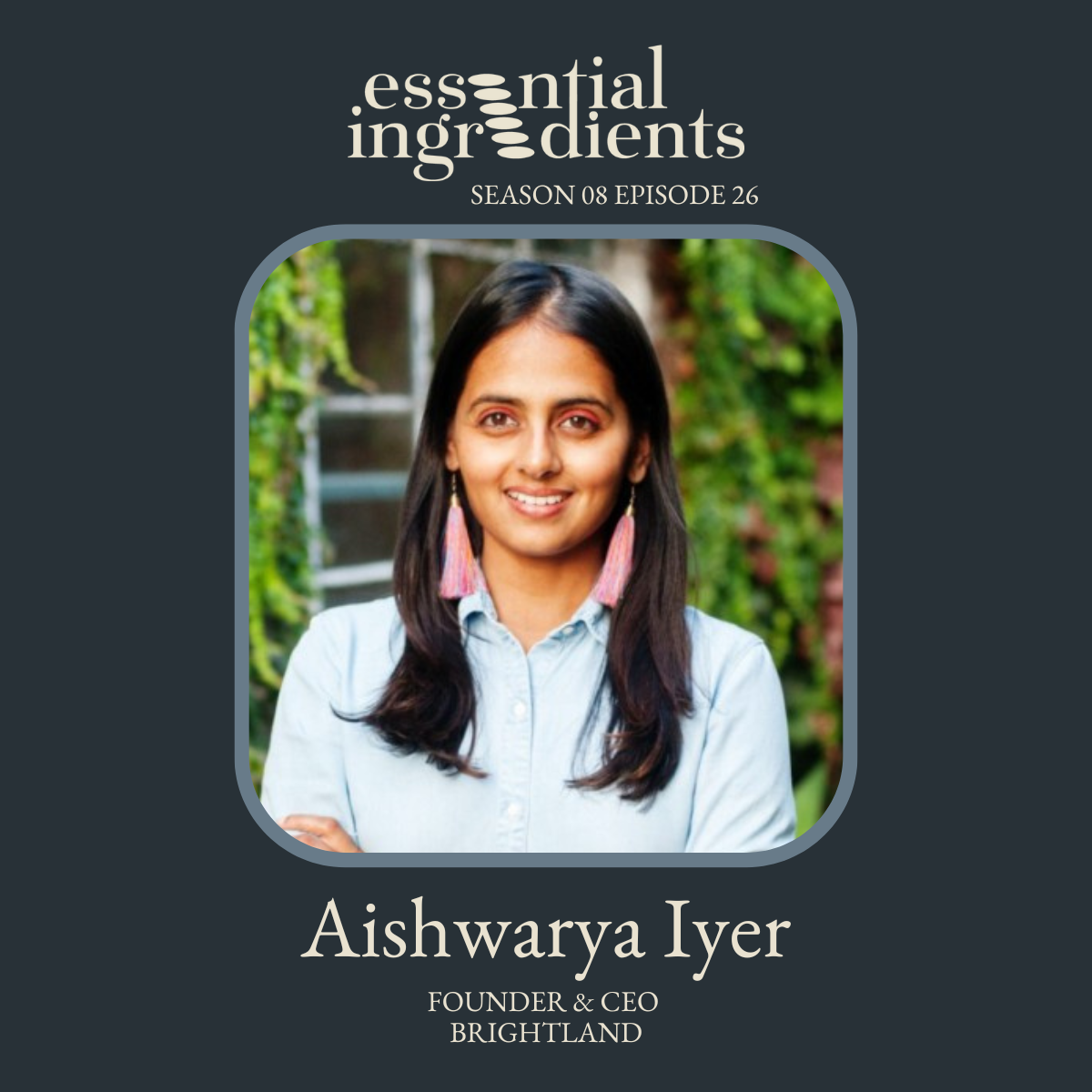
Aishwarya Iyer · Founder & CEO, Brightland
Watch on YouTube
Nourishing the Body and Soul Through Mindful Cooking
The Incorporation Method helps you turn what matters into practical changes that fit your life.
“The things that you run away from, you end up going back to as you get older. —Aishwarya Iyer”
Full Transcript
Full conversation between Justine Reichman and Aishwarya Iyer.
Hi, Justine.
Hi, how are you today?
I'm so good. I'm so excited to be on this podcast and to chat with you.
Me too. I'm excited to chat with you because there's so many things that I feel like we can talk about that relate to the people that are listening and watching, which we'll get into in a minute, your journey as an entrepreneur, all these different things. So before we kick it off, so that our listeners and our viewers know who we're talking to, would you just please introduce yourself with your name, your title, and what you do?
Yes, absolutely. So I'm Aishwarya Iyer. I go by Ash.
You could have told me that. It's very hard saying your name properly.
I love to do that to people. It's a party trick. I'm the Founder and CEO of a company called Brightland. We make beautiful, delicious, indulgent olive oils, vinegars and honey. We sourced directly from independent farmers in California. We've been around for the last four and a half years, and it's been such a whirlwind. And I love food. I love wine. I love hanging out with my dogs. I love gardens. And I love putting my phone away because I think phones are crazy. And that is really my state of mind right now.
I love that. I love that. We're gonna talk about Brightland. But first, tell me about your dogs.
Oh, yeah, I have two dogs, Madison and Crosby named after two special streets in New York City. Madison is a cockapoo, sort of old girl. And then Crosby is a half Yorkie schnauzer situation, and he's a grumpy old man. And they really are darlings. They're amazing. Do you have a dog?
I do. I have two dogs, a 12 and a 20. Mini and Misty.
Oh, my god. I love those names.
They're very cute and adopted many when we came back from Mexico City first, by way of fostering and in every sense. You're gonna keep that? No, no, it's just temporary. Anyway, long story short, it's nine years later or something? Oh, no. It's not nine years later. She's now nine. She was three when I got her. And then Tim said about a year or two later, I think you should get another one. So we've got Misty. And now, we have two lovely dogs. They're the best. That makes the family whole, they bring it all together. They give a lot of love. It's unconditional. So do you have a third child? Is it Brightland?
Yes, yes. Founded almost five years ago. It has been a whirlwind. I did not set out to become an entrepreneur. I will tell you that I wasn't one of those people that was like lemonade stands, or trading baseball cards, or whatever those people did. I really thought that I was going to be either a lawyer or a news anchor. I had dreams of becoming an optometrist. So I was all over the map world. I'm super all over the map, but entrepreneur or CEO is definitely not one of them. And I think when you care about something a lot, and when you're curious, it can lead you down lots of paths and end up changing your life. And I became really curious and interested in the world of oils, cooking oils and olive oils. And the more I dug, the more intrigued I got. And here we are.
So what were you doing before this? Is there something in your background that landed itself naturally to this?
So the short answer is no. But the longer answer is, absolutely. When I look back and can thread the dots from a short answer standpoint, I started my career at L'Oreal at Lancome, and then I pivoted into the tech world. I was working at early stage startups having a blast. But again, not thinking about entrepreneurship in any way, but the skills that I learned in those places. So at L'Oreal, I think CPG, the interest in consumer products, the interest in positioning and brand naming that also got lodged in my brain. And then when I was at the startups, I learned what it was like to be nimble to work really quickly, to be comfortable with discomfort, to be open with the gray. Not everything is black or white. And I think those things stuck with me so much that now being a part of the Brightland ship or manning the ship, it takes a lot for me to get kind of tossed in the ocean.
I can imagine. Being an entrepreneur, you have to go out of your comfort zone, you have to be able to be open to new things and not stuck on one thing. Because what you came up with originally, after you do research, or after you test the market, or after things evolve, and life changes, and things shift, so does whatever you're producing or creating employees. And I think not being scared of that and not holding on so tightly that you're not open to that really makes you a good entrepreneur. It's what entrepreneurship is about.
Thank you for saying that. And I think that goes really nicely with this kind of really firm belief that I have that two things can be true at the same time. You can be really enjoying the ride of whatever journey you're on, but also be scared about what's ahead or also have some regrets. Two things can absolutely be true. And there's no absolute, getting comfortable with that as a concept. And as a construct of how I live my life has been sort of game changing too.
I appreciate you sharing that. I think that that's really great insight for founders and people that are interested in starting businesses to hear because it can be overwhelming, it can be confusing for people. And many times, people often feel like it's not possible. I can change the narrative a little bit, so much more becomes open to you and possible.
I think there's also a lot around like the inner critic and the stories we tell ourselves about ourselves. When I was thinking about starting this, I didn't think it was possible. I didn't think it was possible. That was the big part about it. I was like, I'm not smart enough. I'm not capable enough. Why would anyone ever want to listen to me, and I had to really unravel where that was coming from. And it was like, my 7th grade self or my 10th grade self not feeling good enough. The self that was coming out so I had to almost go revisit that person and be like, you're okay, it's okay. You can go out and try something. And if it doesn't work, it's okay.
I think that that kind of sentiment is really a very important part of the whole growth because you're revisiting the things that could potentially be barriers for you, and recognising why that's a challenge for you. And if you can address that, you've got a better chance of being able to move forward in a more positive way. Similarly, when I was in third grade, I was scared of being wrong. I didn't like to raise my hand and be wrong. And now, I think I've built a backbone. I have an opinion. If you don't agree with me, you don't agree with me. If I don't agree with you, we don't agree. And that's okay. I don't think you know which was on the line about getting that answer. That make sense to you?
How have you moved past it now?
And so in third grade, I was nine. Now, I'm 51. So I got a few years, a little bit of experience. And I think the one thing is realizing what I was interested in. And when I found what I was interested in, I found that I just wanted to learn more. I found that I was open to not being right, but getting educated. Realizing what my skill set is what my superpower is. And so as a result, it gave me a place to come from strength, even if I don't always have the answers. And to me, that's a solid thing to say, I don't know all the answers. In fact, that's why I bring all these people on my podcast so that they can help you make more informed choices being the audience.
I love that so much. And I resonate with it so much because I tell my team all the time, I better be the dumbest person in the room when I'm with y'all. Hired an amazing team to exactly provide that guidance and people that I can learn from, and that we can all learn from each other, get better and build this company into something really special.
When did you realize you needed to have a team that was smarter than you or knew more than you? Because I learned it from my mother, I can tell you that.
I think I learned that when I started trying to separate my ego from what was actually the right decision for the company.
Was there something pivotal that happened that made you aware of that?
I think that it was honestly, tough lessons learned over time. And it was a mistake. And I think it was a series of them that ended up making me think, wait, why am I getting in my own way?
So what would you say to somebody else that another founder or somebody else that really wanted to go out and build their own business and kept finding reasons why they couldn't do it? Because to me, you're your own worst enemy there. You're stopping the progress. What might you say to that? What could you recommend?
I honestly think, one, exercise that I think could be really helpful is write out three or four questions that you would want people in your life like good friends, family members, people in your circle to answer about you. Like, hey, what's your biggest superpower? Why do you believe in me? Really basic questions like that, and send it around to 10 or 15 people. Ask them to answer it, and then read what they have to say. And I think starting there by saying, oh, my God, this is how other people see me. Why aren't I seeing this in myself? Because at the end of the day, we have to be our own biggest champions and best friends. And I always say, I'm the greatest love of my life. I love my husband, I love my family. But I have to also be the greatest love of my life. And I think being able to shift to that will then lead to a place of thinking that things are possible even when things are tough. And things will be tough. And things may not go in the right way. But at least, it opens up the mindset to think that things are possible rather than think that things are impossible.
I love that. I never thought about thinking of myself as the love of my life. And I think that to be able to do that is very empowering to be able to say that. To own that is really empowering.
Then you come from a place of love no matter what. If you love yourself and you've truly believed that, then you're radiating it and like it's the universe sort of shifts in that way not to get so woo woo. You're a New Yorker, and I lived there for so long. And here we are talking about this, but I firmly believe it.
I think that's amazing. It's an amazing story to tell yourself. And I don't mean a story that it's made up, but in a story to narrate to yourself and to create that narrative for you to build from. So when you decided on olive oil, what was it about olive oil and all the different things that honey, I didn't even know you made honey.
Yeah, we started with olive oil. And the reason for that was, I come from a family of very passionate, very judgmental home cooks who are very quick to ask, what are you eating for lunch? What are you eating for dinner? It better be home food. And so I totally went the other direction. Lived in New York for a decade and never cooked. I was out every night living it up, and then slowly started shifting. I always say like, the things that you run away from, you end up like going back towards as you get older. And so started going back into cooking and just being more mindful about the ingredients. I was going to the Union Square Farmers Market, I was looking at what kind of kale am I buying. Maybe I shouldn't be shocked. I love Trader Joe's, but maybe I shouldn't be buying all my produce from there. And as I got more conscious and thoughtful, I kept coming back to the foundation of all of our meals, which is olive oil or cooking oil. And I was like, hmm, am I using a good quality? I don't even know what I am using. And so I started Googling, what is good olive oil? What's bad olive oil? And when I Googled bad olive oil, there were some crazy articles about the Italian Mafia maybe being involved at one point in the olive oil trade. And I was like, what are you talking about? This is insane. I also love The Godfather, and like that whole Sopranos. So I was like, this is wild and interesting. And so it just became this pop culture meets my own personal interests, meets my family's interests. Like everything coming together and couldn't get it out of my head. I started just researching the world of olive oil more. And when I was in California, I started visiting some oil farms. And that blew me away because I was like, wait, I thought good olive oil was only found in Europe. So the fact that the United States is producing gorgeous, beautiful extra virgin olive oil right here, there's something really amazing about that. Is there a way for me to partner with any of these farmers to tell that story? And that was the genesis.
What was your next step? You realize you knew that you wanted to partner with the farmers because partnering with the farmers was going to allow you to choose going regenerative. Are you going organic? You have so many choices and things to know.
Well, I didn't know what those things meant because I was coming from the world of tech. So I was coming from like, I think naive. I think newcomers have a sort of mentality. So honestly, a lot of people didn't take my calls. I remember emailing a bunch of people and no one responded. Or I would show up and they'd be like, this is very cute that you have this project in mind, like by project. What I did was try to educate myself. I read an incredible book that I would highly recommend to people, it's called Extra Virginity by Tom Mueller. That was a big point of education, kind of like a stepping stone. And then I took classes at the UC Davis Olive Center, which there's a real place that it's the olive oil center. They research olive oil and the chemical and sensory analysis of it. And it was a really wonderful place to learn. So I got a little more educated there, and then I found a farming family that decided to take a chance on me. They had organic regenerative practices, and so I was really excited by that. And that's how we got started.
That's amazing. So what was the first store you got into?
Well, we started directly with consumers. So originally, it was from shipping from my little office. It was me and some interns packing bottles and boxes. Crazy, like we were packing thousands of boxes, which makes no sense. So we started doing that, and we were shipping directly to customers around the country. But the first or second week that we launched, we got an inquiry from a really cute lifestyle store in Brooklyn. They were like, we'd love to carry your olive oil. And I was so excited. And that was the first store that carried us.
Which store in Brooklyn?
Oh, my god, they're not open anymore. But it was called like, some really cute name and it was chic. And it was in Cobble Hill. Yeah, unfortunately, they closed during the pandemic.
I was thinking about the store Whisk.
Oh, yeah, I love that store.
I love that store. But I was like, they should sell your olive oil there. They sell all that stuff. I think whiskey would be a perfect spot, and they've got the one in Brooklyn. I think it's better for cheese.
If anyone from Bedford Cheese or Whisk is listening, please contact us.
We'll send it to them, and we'll tell them how much we liked it. My friend actually lived in the building above Whisk on Bedford when she first bought her first apartment with her husband. And so I would go to Whisk. I was on my way up, it was literally the corner store. And you opened the gate, and then they had these apartments above it. That's so sweet. Where are you sold here? I'm just curious about the Bay Area.
We are about to be sold at every Whole Foods. We're so excited about it.
That's a big deal.
It was its own journey. They reached out about a year after we launched. I had an amazing call with a former buyer there. I was like, unfortunately, we're gonna have to say no to you, which was a crazy thing because I think brands don't say no to Whole Foods. But I didn't think we were ready. Operationally infrastructure. I wanted to make sure we did it right when we did it. And so I said no. And then they reached out the next year. And I said no, again. And then they reached out again. And then finally, we were like, okay, I think we're ready. And so they've been incredible partners, and I love them so much. And yeah, we're really excited to continue growing with them.
Finally that moment to say, yeah.
We had some team members who were ready from a team member standpoint. And they also said, well, what about you launch just in one store to start to test it? And that felt really achievable. And that's how we started.
That's amazing. Because I've heard so many different stories about local Whole Foods and going to stand online these days, do you know what I'm talking about? When they look at products, I don't know if they still do that.
People have all kinds of stories. I think we've been really lucky with our retail partnerships so far. But I'm sure as our story continues, I'll have the craziest stories over time.
You've been at this now for four or five years. Did you go after raising money? Did you bootstrap this?
I bootstrapped for the first year and a half. And then we got to a place where I was saying NO more than I was saying YES to whether it was making the product, whether it was being able to hire someone, whether it was an interesting marketing partnership. And that was the sign for me of like, we are giving up growth because I'm bootstrapping it. And I've also proved out enough product market fit. There's a lot of demand from all avenues. And so I went out and raised like an angel with cool friends and family around. And then about a year and a half ago, I raised a seed round from mostly family offices and angels. And we had one amazing lead investor join. But I feel incredibly lucky. And also it was strategic of me, I guess, to bring on people who really believe in Brightland who are 100% supportive and are kind of in everything that we're doing. A lot of founders told me that their investors give them a lot of headaches. I can't say that about ours, so I feel lucky.
Was it scary bringing the investors on when everything you had done until this point was all because you made it happen?
Two things can be true at the same time. So yes, scary. But also really grateful and excited, and like jazzed to say, wow, this is going to accelerate our growth. And I can now hire that director of operations that I couldn't afford, and all of that stuff that opened up a lot of doors for us.
As you're talking to these investors and you're bringing them on board, did you look at it as wasn't just a financial investment or reserve human capital as well as part of that raise?
It was mostly financial.
Because I always think it's interesting when you bring people on, sometimes people need the resources of the knowledge, sometimes even finances. And sometimes, they need both.
Yeah. I had a couple of amazing folks who came on board as advisors to the company early on. One of the founders of Sweetgreen, a couple of really amazing people. They were really instrumental. And I think opening my eyes again, I was really naive. So which I think is the right move actually. For any entrepreneurs listening who are early in their journey, stay naive because it keeps you looking at the positive. Because if I had I knew everything I know now and how hard it all is. I don't know if I would do it. Why? I think I would, but I would go in with the sort of like, oh, my God, a lot more fear than I did.
I could see that. I can also see through, right? So let's just look at your five years, and let's look five years later, right? You could have a whole exit, you could sell to give me a big Olive Oil Company. Colavita, I'm just making it up. And you could have some other journey that you then go on. And now, because you've learned all these lessons along the way, you have more information to make more informed choices too. And you'll make new mistakes. So I think there's a balance, right? I think it can be scary. Because now, you know more. But it can also be really comforting because you know more. Like you said, two things. Two are the same.
But I'm pretty calm. I want to build this company in a calm, strategic, calm, cool, collected way. So even when we make decisions, it's calm. We got this, it's gonna be okay. And if it's not, we'll figure it out one step at a time. I've been a part of companies where it's really chaotic. People are making a lot of decisions rooted in fear and scarcity.
I started a conversation earlier where I was talking to somebody and I said, I think when we make these decisions, sometimes you have to take a minute and not react. But rather yet, give that moment to reflect and then respond. Yes, it may seem scary if you surround yourself with more knowledgeable people that can help guide you and create the resources or provide the resources for you to better understand what the challenges are. As a result, you come from a better place of strength, less fear, and you can handle it.
You said it beautifully. Exactly.
I want to go back to your olive oil for a second because I want to know how you perceive it's different and more revolutionary than some of the other olive oils out there.
When I was looking at the market, I think I was looking at two things, the outside and what's the packaging, the outside and what's inside. And for the most part, grocery stores, olive oils, the word on the street is that a lot of them are kind of old. We don't know when they were made. We don't know who made them. It doesn't really say like harvest day. It doesn't really talk about all of the varieties, there isn't much going on. And so those were the things that I wanted to change up and say, hey, you know what? For this kind of olive oil, we use arbequina and elbasan olives. Here's what that means. Here's what it's gonna taste like. Here's when it was made. Here's where it was made. Here's how it was made, milled within 90 minutes and stored in stainless steel temperature controlled rooms. We share that because I think most people don't. And then I think from an outside perspective, I used to walk the Whole Foods and grocery store aisles and I just noticed people looked very confused when they were in the olive oil set. They were just like, I don't know what to buy. And I thought, why not build something or create something that is so beautiful that you're like, oh, my God, I want this on my kitchen countertop. I want to give this to somebody. I want this for myself, and make it something really covetable and exciting. So that way, you're also more present and aware when you try what's inside rather than being like, it's the same old oil. Doesn't matter. I'm just gonna add it to whatever and keep moving on. So we love to tell our customers like, yes, it's pretty and that's great. But open up a bottle and really taste the oil on its own. Think about what the flavor profile and the tasting notes are and you should taste green herbaceous grassy, maybe fruity, like you should taste nuanced things because it basically is a fruit juice.
How many flavors do you have? Do you call them flavors?
We have two oils. One is really robust, peppery. The other one's a little milder, a little more buttery. And then we have infused flavored oils. So garlic is infused with basil flavor, lemon, chili, and rosemary. And then we even came out with something called a pizza oil where we blended jalapeno, basil, garlic, rosemary, oregano together to make this, and it's so fun on pizza.
I love garlic and rosemary olive oils because it can change the dynamic of a very simple salad in a heartbeat.
Exactly. It adds so much magic. I always tell people, you don't even need to mince garlic. You can use our garlic oil, or you don't need to add pesto because you can use the basil oil. So it really works, and an amazing hack tool.
I love that. I know you mentioned that you have these olive oils, you have honey, you mentioned a few other things. Can you just remind me?
We have vinegars as well. So we have a Blackberry Balsamic Vinegar and a Citrus Champagne Vinegar. The blackberries are triple crown blackberries that are double fermented with California Chardonnay Grapes. And then the citrus champagne vinegar is made with navel and Valencia oranges that are double fermented with Zinfandel grapes, and they are so punchy and zesty. Zingy is what I like to say. And also grown, all made in a regenerative organic family run farm. It's a husband and wife in the Central Coast, and they're really standouts. I highly recommend them. And then we have two honeys as well.
That's a lot of skews for a short amount of time.
We've been cranking them out. But you know what's funny? It is a lot, but it's also not a lot when I look at the grand scheme of so many consumer product brands. People come out with products every other month. You look at other categories, and even in food, I've seen a lot of folks like they suddenly have 50, 60 skews of products. But we've been, I think, methodical and intentional. But I also want to make sure that our customers are delighted.
I bet. I'm excited. I want to try the olive oil, and I want to try the vinegar. I'm very curious about honey. Do you filter your honey? Is it unfiltered? I love unfiltered raw honey.
It's unfiltered raw honey. One is like a wildflower, and the other one is an orange blossom. Really delicious.
Well, that's true. What was the first item you had that you kicked it off with?
We kicked off with two flagship olive oils.
So those are the ones with the difference, you said they were green and grassy, and one was more bright, right?
Yep, exactly. So we launched with those two.
Such an amazing line of beautiful products that are built with farmers, and that use organic and regenerative practices, which I think is just the epitome of what we're trying to support here in terms of building a more regenerative and sustainable future. And so you share that story and the fact that you didn't even know about it, but then learned about an amazing choice to work with somebody like that, I think is really important.
Thank you. I think that at the end of the day, every single choice we make matters so much. And if we can inspire and delight people to be more mindful about their cooking basics, like an olive oil, then we've done our jobs.
I think that that's super important. Because I think as you're talking about this, and I'm learning about all these things, you mentioned people go to the grocery store and they look really confused. What's one thing you might tell them when they go to the grocery store to help them in their journey to choose the right olive oil?
A couple things. One, don't buy olive oil that is in an open glass where you can see through. It should not be seen through. One of olive oil's biggest enemies is light. So never buy an olive oil that is see through. And then the second is to always look for a harvest date, not just a Best Buy date, because a harvest date truly tells you when an olive oil was made. And that's important because you want to make sure that it was made maybe like max a couple years before. Because otherwise, if you don't know when it was made, it could be three, four or five years old. And at that point, the oils, definitely rancid.
Thank you so much for this great conversation, all the information. I love following your journey, and I can't wait to try more products. So for those guests and folks watching, and if they wanted to learn more about Brightland, where would you send them to?
I would send them to brightland.co, our website. I would also send them to check out our Instagram, it's @wearebrightland. You can start there.
I was looking to partner with you, get in touch to maybe carry the product, who would they reach out to? And how would they do that?
Just DM us on Instagram, and someone will definitely reach you in the right direction.
Awesome. Thank you so much for joining me today.
Thanks, Justine. This was wonderful. It was great.
Share This Episode
Enjoyed this conversation? Share it and tag @nextgenpurpose
Listen on Apple ▶Listen on Spotify ▶Your Host
Justine Reichman
Founder & CEO of NextGen Purpose. Host and Executive Producer of Essential Ingredients — 11 seasons, 330+ episodes, and a growing movement.
About Justine →