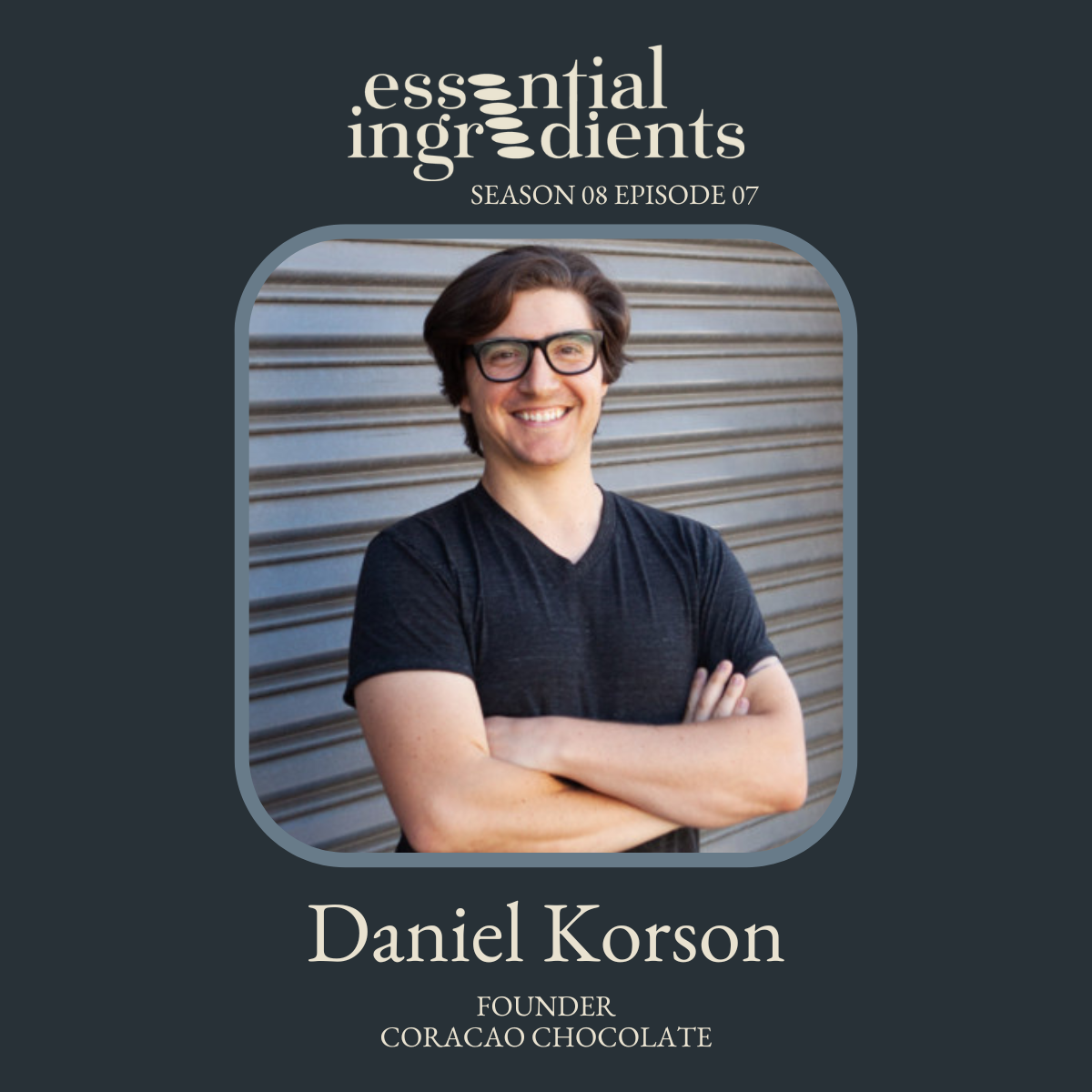
Daniel Korson · Founder, Coracao Chocolate
Watch on YouTube
Vegan Valentines: Crafting Ethical Artisan Chocolates from Bean to Bar
The Incorporation Method helps you turn what matters into practical changes that fit your life.
“My goal and still is, is to be able to create a business that's ethical from the farm to the end. —Daniel Korson”
Full Transcript
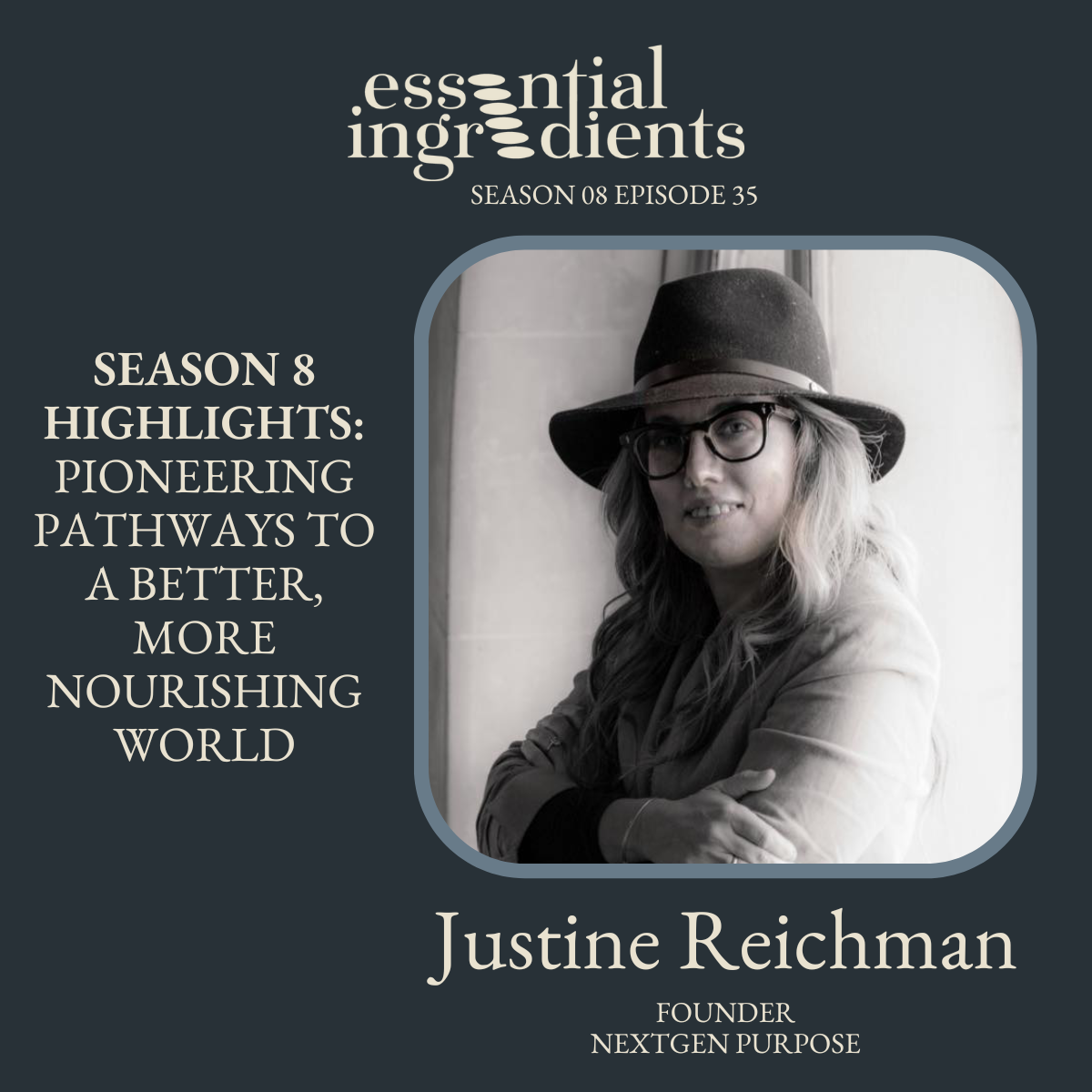
Full conversation between Justine Reichman and Daniel Korson.
Thank you. I will step in as you say, it's Korson, K-O-R-S-O-N. and it's pronounced Coracao Chocolate.
Okay. So Coracao. I call it Coracao, can you tell me, I'm sort of leaning towards the Portuguese sound?
So it's based off of the Portuguese word coracao, which means heart, because chocolate is a nourishing food for the heart. And it's blended with cacao, which comes from the Theobroma cacao tree, which is the seed of all chocolate. So we blended them together to make Coracao through the hard seed.
Okay, I like that name. I liked the whole idea behind it too. Do you talk a lot about that when you talk about the brand?
Not too much. We do have it on the inside of the packaging, like a little exclamation, but we don't talk about that much. So a lot of people have a hard time pronouncing it though. They don't quite get it.
Like me, I mispronounced it.
Yeah. Well, we have another brand called Cacoco, which is the drinking chocolate. So when we answer the phone, we kind of joke like, hey, hello, Corcacoco.
I like to drink chocolate. And I did like that at the sipping station you had there too. So many takeaways I'm taking away from this conversation. And the tour that we had today here at Coracao. For those that are not familiar with you, could you just introduce yourself with your name, your title, and what you do?
My name is Daniel. I am the Founder of Coracao Chocolate. We started in 2008. We're better for you chocolate company, all organic, fairtrade ethically sourced. I wear a lot of hats here. But primarily, I do R&D. I help create contract manufacturing relationships with people just to make fires out.
Literally, or figurative?
Fires and floods, I work on both of those and a lot of other things in between.
How come chocolate?
Oh, man, that's a good question. Well, I've loved chocolate since I was a kid. As we talked about earlier, like Snickers, Reese's Pieces, like Nestle Crunch, Peanut Butter Cups, all of those. I used to love chocolate. And then when I was a teenager, when I was 16, I went to Thailand. I went to this little village in Cuba and Russia, and you're not supposed to drink the water. And I knew that, but I got a shaved ice rink with coconut. And the ice was untreated and so I actually ended up getting stomach parasites, totally screwing up my digestive system. So I couldn't eat dairy, wheat, gluten, refined sugar, all the fun stuff anymore.
Forever? Or for the short for the short term?
It actually changed my digestive system. I couldn't eat that stuff before and then after. So today, I do feel horrible.
Okay, so no pizza. No, chocolate ice cream that has milk. Okay, got it.
Maybe like once or twice a year. I'll do it just for fun. But I know I'm going to be messed up.
I know, I have similar digestive systems. But I was just wondering, so this stayed with you forever. Okay, let's continue.
I was kind of resigned to the fact that I probably never eat those kinds of chocolates again. And then in 2006, I was working as a pastry chef and I got exposed to cacao. The raw ingredients of cacao, and the vanilla bean and all that stuff. And we started recreating some of those nostalgic treats they loved as a kid. And basically, at that point in 2006, 7, 8, there wasn't really anyone else doing anything like it. So first, it was just kind of selfish to try to make those treats that I loved as a kid, and then basically discovered that there was a market for it. And when we first started, we proposed it to Whole Foods, and we were the first recipient of their liquid loan for a startup company, which is kind of cool.
So when you just said this, I know that you're now run by you. So when you first kicked this off, you had a Co-Founder, how did that dynamic work in creating this product? Because it was your idea clearly.
Yeah. Well, we were working in a cafe, Cafe Gratitude.
Oh, I love it, it's in LA.
When they were here in the Bay Area. I started in Berkeley. I was at the first straight mail to work at Berkeley. So I was breaking some ice, I guess, and it was the expression. Forget the expression, shattering the glass ceiling. I started working as a pastry chef there. I worked on the line, and then my original business partner, Matthew, made chocolates in the central kitchen. So they had four satellite cafes around the bay, and they would make all the stuff in the central kitchen, and he was making the chocolates there. So that department was expanding. He put out a call for someone to come help, I answered it, and we started working together. And back then, the chocolate was not tempered. So the fillings are not stable.
So before you go on, though, for those that are not familiar with what tempered is, can you just clarify and tell us a little bit about what tempered is?
You can use it like tempering steel, it's like a hardening process. So if you've ever had a chocolate bar that's maybe just hitting your car or like your pocket, and it melts, re solidifies, kind of crumbly and weird or white. Basically, that's the cacao butters to cacao butter crystals solidifying at a non optimal stage. So there are six stages, and you want five or six. So all commercial chocolate goes through tempering, and that gives that gloss in that snap.
Thank you for sharing that. I just always like to make sure that I give a level playing field to everyone listening. I didn't mean to stop you on your journey. You want to continue?
Sure. We're on this journey.
You were making chocolate, you had a central kitchen.
Okay, thank you
To the central kitchen, you are a Cafe Gratitude shattering the glass ceiling.
Then he called me into the central kitchen, then we talked about the fillings and stuff. So basically, you had to put the chocolate in the fridge. And if it was in the fridge or because you melted into a puddle, it was doing really well. We were selling about $12,000 a month of this chocolate that wasn't tempered.
Making these chocolates, was this a side hustle?
No, no. We were doing it for Cafe Gratitude, but we ran the department. And it was growing. I saw that there was opportunity and that people wanted to, and this is where I got exposed to all the cool ingredients. It was kind of like a test market. I was like, oh, people like this. And so I proposed to him, and then we proposed it to Whole Foods, that's when they said to get a loan. So we started just with a tiny tempering machine that we bought on a credit card and just kind of bootstrapped it all the way from there.
I now know that you're running the company on your own. How has it changed for you when you had this partner before and now? You're at the helm running, leading, creating the vision.
Yeah, good question. Well, there's a lot of differences. Having a partnership, it's like marriage, so it's difficult. And there's always challenges, and there's good things as well. So in my opinion, he was a creative genius. So he came up with a lot of the recipes originally, and I ran more of the business side even though I have a background as a chef and love that part of it as well. He was just so good at it to kind of let him run with that. But he didn't really want to grow the business. That part was stressful for him scaling it, consistency and things like that, and getting new machinery, and growing the team. So since he left, that part of the business has gotten a lot smoother. And as you grow, as companies get bigger, the innovation gets a bit slower. Because when you're smaller, you can make things really quickly. And when you get bigger, launching new packaging, it takes a long time. There's more processes, process controls for safety and all different kinds of stuff. So yeah, it's definitely running a lot smoother now. And there's a lot of benefits to that, but it's a little less wild and adventurous than it used to be in terms of R&D.
I've been a solo founder, and I've always wanted to co-found something because I always thought it'd be more fun to do it together. I don't know if that's a true statement. In some story, I told myself in my head that it would be fun because it's always nice to have people to bounce ideas off of. But equally, you've grown so much that you now have those people.
We're now partially employee owned. So a lot of the people on the team have been here seven or eight years, and have grown with us. I would say, it can be awesome to have a co-founder partnership, but it really is like a marriage. So you really want to vet that person and know them well, go through some challenging scenarios to see what they're really like, and if you guys work together.
I can imagine because in any relationship, whether it's your marriage, whether it's your business partner, it takes a long time to get to know people and understand what makes them tick, what they find frustrating and annoying. And how to co parent, co pilot, co anything with them.
And help people handle stress. That's a good thing to find out early on.
Oh, my God, I could tell you my partner thinks that I'm high anxiety. And he is not high anxiety. He's from the West Coast. He's very low key. I run on adrenaline, but maybe it's because I grew up in New York City. Like it's just part of my DNA. I'm very fast. I can totally understand what you're saying. I want to go back to something that you also said that your employee owned. Talk to me about your decision to become employee owned, and the response you got from your employees.
There's multiple benefits to it. One of which is that it is challenging to retain good employees, especially in the Bay Area. Especially as a food company when you're not that large, because you're only bringing in so much income, you can only pay people so much when you're getting into tech jobs. And the cost of living here, it's kind of crazy. So one of the benefits to this is instead of paying someone a higher salary that they're able to get at a tech company or somewhere else, you can actually give them equity in the company. So you're kind of making people owners. Because there's a lot of founders who say, I want people, employees that treat my business like they're the owner, but they're not the owner. They're not going to, but you actually make them an owner, then they will. And there'll be more committed. So I think there's a lot of benefits to it. But as a Founder, we also just have to let go. You're letting go of some of your equity, as well.
That makes sense. How does that translate for the employee? So yes, it's become employee owned. Or can you walk me through what that looks like? If they're not getting a raise in their salary, how do they see the revenue of the additional revenue as an owner?
Basically, how we did it is, now we're a C Corp, but we were S Corp previously. So we would just directly issue people shares. Technically, they would buy it, and we give them a bonus to buy the shares. And we'd issue them the shares, just kind of walk them through and say, hey, we're a small business. Once we go to a certain level, you may get distributions. But if the business ever sells, you'll be a part of it. Basically all the growth that happens, and all the hard work you put in assuming things go well with the company, it'd be a win for you at the end of the day.
Let's just say they saved 15 years, but then move because their partner, their husband, their wife moved somewhere else, can they retain their shares? Or do they have to sell them? What does that look like?
Yeah. So basically, we have the option to buy it back. So generally, it's a vesting schedule. So we've usually done it for three to four years. Some will get like, let's say that we give someone a hundred shares, so 25 shares, they'll get upfront. Year two, they'll get 25 shares. So we have 50% here, and so on and so forth. So if they left before that four year period, they wouldn't get their full vesting schedule. If they stay those four years, then they own it fully. So even if they leave, they still own those shares.
Because I would imagine, people do leave. Life changes, and family can dictate sometimes where you live. So I think that that's interesting. So when you approached your employees, they didn't not all know this when you first started, right? You were not always employee owned.
No, until about like, maybe 9 or 10 years in.
So you're 9 or 10 years in, and you've had these employees. And now, you want to approach them and say, hey, instead of giving you a raise, we want to make you part of the company. We want to make you part of the family. What was their immediate reaction?
It varies. We don't make people take it. We offer this as a benefit. So some people chose to just take the bonus instead. And some people chose to take the shares. And we're really excited about just feeling that ownership of a company. And for a lot of them, it was their first time ever having that happen. It was really inspiring for them. And some people just wanted one of the bonuses. So we just let people choose what they wanted to do.
It's great to tell me about CareCo and your chocolate and you seem to have a variety of products. Yeah. Okay, so where should we start? Who do you want? What do you want to start with?
Do you want to talk about sourcing, or the products and sales?
Talk about the sourcing products. Let's talk about your sipping chocolate. We start there. I think I'm intrigued by it not only because you have a sipping station that I really want to recreate in my house. Can you show it to everybody? We have the sipping chocolate in the nice pink box, which is perfect for Valentine's Day, by the way, which is coming up on your daughter's birthday.
Yes.
So for those people that are not familiar with your branding and your packaging, can you just show that to them too so that they know.
This is Cacoco Drinking Chocolate. It's in Whole Foods in Northern California. So basically, it's in a compostable bag, it looks like this. And this is actually chocolate crumbles, so it's not powder. So there's an interesting difference. Do you know the difference between drinking chocolate and hot cocoa, or hot chocolate cacao? So they're both cacao, they are both. The difference is that hot chocolate has sugar in it. This actually does too. The main difference is that hot cocoa is made from the powder. So they're both from cacao. But basically, when you take a cacao bean and you crush it in a lot of force, it'll push all the fat. So cacao beans are about 50% fat depending on the variety. So when you push out all the fat, that's cocoa butter, and then you're left with the fiber which is just cocoa powder. So basically, that's why you add milk back into hot cocoa because the fats have been taken out of the cacao that makes it creamy again. So what we're doing here is we're actually grinding down the whole chocolate itself. So if you took a chocolate bar and rounded down, that's basically what this is. So you can add water. It's super rich, creamy and frothy.
And how many tablespoons did you take to make one cup of hot cocoa?
One cup would be a lot. It's really potent. So we usually make a cup, it's like three ounces to make that much. It's like three to four tablespoons, but it's what that's for us. It's super thick, creamy and rich. You can actually put that in the fridge and return it to chocolate mousse.
Have you ever been sipping, like chocolate sipping bars? I went to one in Seattle once, and they offer something like a sip. You have it here, you have it in your office. I went to a venue, and it was sipping chocolate. And they give you like a socket cup size, or if you want a shot glass size, whatever. And that's how you get it. It was amazing.
It's definitely very decadent. Rich and decadent.
So talk to me about where your chocolate comes from? Where does your cacao come from?
Right now, the majority of our chocolate comes from Fairtrade Organic Cooperatives in Peru. Why Peru? So generally, we've chosen to source from South America. Most of the world's cacao comes from West Africa, about 70%. And the conditions in West Africa are quite bad, for the most part. So it's treated as a commodity. So the price is pushed down. Farmers are not paid enough. There's child labour issues going on. So generally in South America, the conditions are a lot better. It's easier to source really good chocolate, and it's closer, there's really nice varieties. So there's a lot of benefits for us to source from South America.
When you first got into this, you obviously were not that knowledgeable. Didn't know about all that. So did you go straight to Peru? Or was it a bit of a process, a learning curve until you learned where you wanted to get it from?
When we first started, we actually met a supplier through Cafe Gratitude who was bringing chocolate, I believe from Ecuador.
You're still down south. Talk to me about some of the other products you have to get to learn a little bit more about the line itself.
I have a box of chocolate truffles here, so you can think of it like a healthy version of See's. So we're one of the only companies aside from See's Candy that I know of, we can actually build your own box of truffles. We have all these organic dairy, free gluten, free coconut sugar sweetened truffles. We can build your own Valentine's Day box, actually. So we do that for all the holidays. But it's quite fun.
So Easter is coming up.
Yeah, the dark chocolate Easter bunnies.
Do you do anything for Passover?
We don't. We are certified kosher, but we're not certified for Passover, which I think is different.
I really don't know that much about it, but it's a big deal. Then you have these bunnies. So what else is part of the line that you have? I was lucky enough to get a box of your chocolates with, what was it? Sea salted caramel, and I think it was a cherry or some sort of fruit. It was a super, super very sort of fruit.
So that's the core account line of candy bars, which are some of our best sellers.
I love them. And there was a hazelnut, those are very good. Where are they sold?
We sell online. We do a lot of independent natural organic grocery stores. So if you're in the Bay Area, Berkeley, Double Rainbow, Good Earth, places like that.
They're organic too.
Certified organic. They're one of our best customers. We've sold them for a lot of years.
I used to go there every day when we lived in Wellington. But now we're in Larkspur so we're not quite as close. Are you in Woodland? We're gonna have to work on that. In the meantime, when we leave the Bay Area, where else can we find your product?
We have a store finder and a website. The easiest way to find the website is feelgreatchocolate.com because Coracao is kind of hard to spell, especially when you're hearing it. But feelgreatchocolate.com, we have a store finder, and then we ship all over the US so even to Florida, which is really, really hard. From California to Florida, that's the hardest place to ship? It's far, and it's hot.
It's hot. It's hot all year long. What is the most revolutionary part of your business?
I would say for the chocolate itself as a product, for Coracao would be the fillings. There's not really anyone else I know that is doing such decadent, gooey creamy fillings with the quality ingredients that we have and that are dairy free. My goal with starting Coracao really, especially back in 2008, you could count the number of chocolate companies on one hand, there wasn't a lot. And now it's kind of exploded. There's a bunch similar in the wine industry, coffee, the list goes on. It just exploded everywhere. But back then, my goal still was to be able to create a business that's ethical from the farm to the end. So by sourcing ethically, all fair trade, having good relationships with our suppliers, paying our team well, treating people right, making our customers happy, and just trying to get it right and be fair, and be ethical the whole way through. And also be profitable so that we can kick the tires, or be an example for other businesses, or some of the bigger tech companies be like, hey, you don't have to buy slave labor chocolate. You can actually pay people well, and it can be profitable. So that's really been one of my goals is to pioneer that kind of model in this industry.
You've talked a lot about the chocolate, and I'm also curious about the packaging. Because when we took the tour, we got to see some of your new packaging, which is really sustainable. You're using it with clients. Can you talk to us a little bit about that? Because I think when people are making a choice these days, while taste is always the king, they do like to choose a sustainable product. And I think in addition to your better for your chocolate, the idea that you're now using this kind of packaging also adds up to a notch, especially in this world that we live in when people are trying to create a better world for their families, their children and the future.
Yeah. It's important to us. Some people care, some people don't. For example, this bag is actually made from wood cellulose. It's cool because it will actually biodegrade in your backyard. Which is very unusual. The drawbacks of it are, it's probably four to five times the price of a regular bag. It also tears more easily and doesn't have a shelf life. So the shelf life on the string chocolate is a year. The reason that it's a year, the chocolate itself or less to the reason, the shelf life here is because the bag will start to biodegrade. It creates holes so the chocolate will fall out. It's more just a kind of break. They will rip and tear, and it gets a little bit brittle. So there's definitely drawbacks to it. It's more expensive, but it's evolving. And for us, it's always just been really important to support that even though it's more challenging. You have to be more creative with your machines to get it to work. And it takes more R&D and expense on a lot of levels. But yeah, we support packaging moving in a more eco friendly direction, for sure.
I think it's important. It is important why people get on board with us. Obviously I know that we need to think about accessible pricing for people because we don't want to price ourselves out. We want to make it so that everybody makes a living. But I think that the more people get on board with this, the more we're gonna be able to drive that in the right direction. So everything I've heard is all about a better for you food business, everything for your product to your packaging. I'm curious as to why you decided to be reviving a C Corp versus a B Corp. Wasn't even a consideration for you?
When we first started B Corp, I don't even know if it was an option. It might not have been an option. And then we've thought about becoming a B Corp, but we already do all the things anyway. And it's just an extra expense. I think B Corp, as far as I understand, has a very small number of shareholders, and all of them are employees so we don't have to please the marketplace. As long as most of our team supports something, and we want to pay five times more for a compostable bag, we'll just do it. Whereas if you're some large corporation and you to make money for your shareholders, being a B Corp gives you basically that--
You say that you set forth your objectives. And for me, I guess an example of this would be that this is important to our money as it is to have an impact.
Being a B Corp for a bigger company, it gives you permission to spend money, energy and time on that. And not just with the sole purpose of making money for your shareholders. And that's built into the system of a B Corp. For us, because we're smaller, mostly our investors are on board and our employees. Employee owners are on board already, but that didn't really make sense for the extra cost.
I understand that. And you guys really do build better for your product and better for your business, and you support it with everything that I've learned today. So before we head off, I really appreciate your time and chatting with you. I'd really want to just make sure that we let everybody know, where can they get your product? How can they learn more? What is the first point of contact they should have? You want to just share with us the website?
feelgreatchocolate.com.
I just love that. feelgreatchocolate.com, awesome. Okay, Daniel, thank you so much for joining me today. It's great to meet you. Great to try your chocolate. And great to get the tour.
Wonderful having you. Great to meet you as well.
Share This Episode
Enjoyed this conversation? Share it and tag @nextgenpurpose
Listen on Apple ▶Listen on Spotify ▶Your Host
Justine Reichman
Founder & CEO of NextGen Purpose. Host and Executive Producer of Essential Ingredients — 11 seasons, 330+ episodes, and a growing movement.
About Justine →