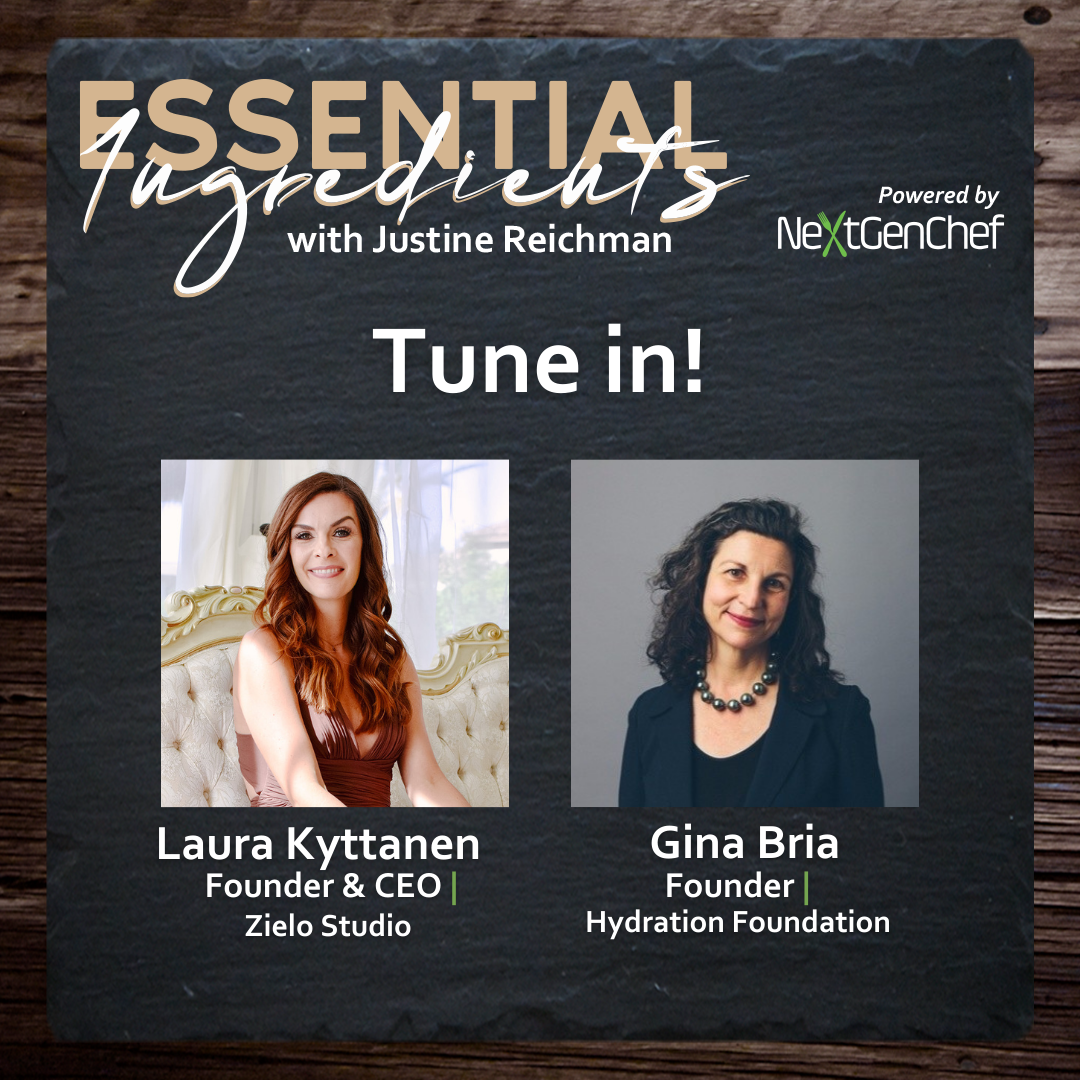
Laura Kyttanen and Gina Bria · NextGen Purpose
Watch on YouTube
Special Series: EI For the Mind — Hydrate Your Mind Properly and Soak Up More of Life with Laura Kyttanen and Gina Bria
The Incorporation Method helps you turn what matters into practical changes that fit your life.
“Welcome to the first episode in our special series: Essential Ingredients For the Mind!”
Full Transcript
Full conversation between Justine Reichman and Laura Kyttanen and Gina Bria.
Hi, welcome to Essential Ingredients. I'm Justine Reichman, an entrepreneur and host of Essential Ingredients. Today, we are kicking off Essential Ingredients from the mind, a special series that is co-hosted by Laura Kyttanen. Welcome, Laura. I'm so pleased to have you here with me.
Thank you.
Today, we have with us Gina Bria, the founder of the Hydration Foundation.
This conversation is gonna be good, can't wait.
Thank you Gina for joining us. Gina, do you want to just introduce yourself for our listeners here today?
Yes, I love to. So yes, I am the founder of the Hydration Foundation. I come to you as an anthropologist and a writer, looking at big picture ways to approach our future.
Wow. Okay. Well, we are so pleased to have you here today. Laura, I know our listeners, you are the first time to co-host with me here today. I just want to make sure that our listeners get to know a little bit more about you. Would you maybe give them a little intro to yourself?
Absolutely. I'm an intuitive business and mindset coach, also known as an entrepreneur, as Justine would like to say. But my big dream is to help people unleash their unlimited potential through really mindset changes and sort of reinventing themselves, I guess you could say. So I'm very excited to be here with you. Because as part of this, somebody who's made a lot of changes to their own nutrition and wellness through my own journey, I know how important it is. So I'm really excited to talk today with Gina about hydration in particular, and how that can really affect your mindset.
So before we kick this off and get the conversation going, for our listeners, for me, for Gina, I just want to understand, what would your definition be of mindset? Just so we're all on the same page. Laura, could you give us a little definition?
Absolutely. So mindset really boils down to your values and your beliefs. But these values and beliefs are very unconscious most of the time, and they're usually stemming from decisions that you've made, especially early on in childhood. And so a lot of the time, our mindset is kind of going on. Like if you go to a restaurant and you only order two courses instead of five, usually our mindset is more on just the habit of like the things that you already know. And when you're able to expand your mindset, you can have five courses or more because you're able to see more things and be able to taste more things in life. So it's really about understanding your values and beliefs, and why they're there opening up and expanding.
Okay, so tell me, why does hydration resonate so much for you with regards to mindset?
Well, Gina, this was actually a good segue. Because one of my first questions for you was, there's a lot of performance trainers and people in peak performance that talk about what you should do the first thing you wake up for your brain health, and they always talk about drinking a bunch of water. I'm really curious about your thoughts on this. I'm a neuroscience geek, so how you see this really helping with our brain power and our performance?
Oh, boy. Laura, there's so much to unpack there. I'm going to do it maybe in a few stages. I'd like to go back to think about what mindset, what the container, the concept can be. I like to say, I'm speaking as an anthropologist not only looking at Hydration strategies around the world, but the first 25 years of my career was looking at ritual and ritual around the world. So the occupation of oneself how one occupies yourself inside, I think is a very important conversation. And looking at how identity is shaped and held through the lifecycle, and that comes out of my studies. In ritual, looking at the life cycle of ritual. So you have the birth ritual, you have the initiation into adulthood, you have the graduation from high school, you have the you get married, you have the first baby, you have the next baby, you have the new house, all of these passages of life that we go through are about accumulating more of ourselves. Actually growing ourselves to become more than we were an hour ago, a day ago, a year ago. And this is so important that we have in our cultural conversation, which I think is not emphasized or is missing. That there is no way to stop growing. Even past death, that whole quantum physics field and so much has opened up to us. Of course, our wisdom traditions and ancient ancestors all identified the infinite potential of our self to even pass our body life. So I'd like to hold that as a huge thing. I just copped out, what can that have to do with water and Hydration?
No doubt you're gonna doubt.
Well, to me, it's super exciting. By the way, there's no ritual that happens in cultures around the world without water present. Super important. Symbolic, but maybe more than symbolic. And this is where we're going to go with a new water science and Hydration. So the world scientists that I work with who are the foremost in water research have looked at the amount of molecules in the body, and they have identified that 99% of the molecules inside of us are water molecules. And that's because water molecules are so tiny that only hydrogen is smaller, that the volume you need inside of you to make yourself up is a massive amount. So if we understand and we switch the concept of how much we are made of water by where, when you do the Thanksgiving turkey and you poke it in certain places, you get a different temperature, that's how people take measurements of water. The heart is 70, the brain is 80, the muscles are 42.5. All of these conversations are those kind of silly, where's the elephant? Is it the tail is, it the trunk time conversation? The conversation about water should be, we are made out of water. We literally are water, we are water beings, we are complete water beings. All of our tissues now have been identified in this gel state. So as much I can say this, and I'll get the picture for you. We are as much water as a jellyfish. It's the same kind of tissue, biological tissue that makes up us, that makes up them. So switch your concept of what we really are in terms of the amount of water and what we are. We're water beings, we're walking water beings. Most other beings from the sea are still in the water, but we are walking water beings. And therefore, how we are in flow with our water, and the fluid system that we are going through. Runs our neural networks. It runs our digestive networks. It runs our, literally, flexibility or mobility. The precision of your eyesight depends on how much hydration you have in your liquid crystalline gel inside of your eye socket. Even your perception of the world depends literally on how many water molecules you are replacing as they flow in and out. So I'll stop there so we can collect some that have a lot to say. Well, I think it really shifts the conversation now instead of, should I be drinking eight glasses a day to, wait a minute, is a whole better conversation and be happy.
I love the nuggets of wisdom that you dropped one thing in particular water rituals. So a lot of work I do with my clients, especially when we're trying to let go of things, is a lot of water work. I find it to be such a beautiful element to work with when you're dealing with mindset and letting go of things that are holding you back. But even in the respect that you're talking about, it's just fascinating. And you talk about digestive issues and all of that. I mean, health is directly related to it as well. But Gina, I wanted to ask you if you're aware of Dr. Emoto's works with the water?
Yes, it's delightful. I do believe Dr. Emoto cracked open an entire new field of water research. And the next generation after his work, of course, he identifies the states of water, and the effect of vibration on water. And whether the conversations around, whether this is real science or not, we're way past that conversation. It isn't even interesting anymore. Of course, we're now discovering and we didn't really know that there's chemical properties to water, but there's also properties that involve physics and quantum physics, energetics, wavefunction wave form that are all deeply informed the conversation that water is able to have with every other molecule.
So that brings me to my question. So for anybody listening, and I'm familiar with Dr. Emoto, he was doing research on the molecular level of, if you're talking or sharing certain music to water, what will happen to the molecules will become fragmented, or crystallized, or things like that. So basically, my question for you is, could we be drinking the water first thing in the morning or having all the right hydration methods, but if we're not doing it in a mindful way, we're not grateful for the water that we're in taking, we're doing it without any mindfulness, can it impact the benefits?
Yes. I want to back that up and sort of set the environmental framework for why we would even be having this conversation.
I also want to, just for those listeners that are not familiar with this study, if you could just maybe give a little bit more background on it so those that are not familiar with it maybe have a little bit more information, follow along a little bit more thoughtfully.
Yes. I'll set it up so that it fits exactly into what I want to say next, which is, Dr. Emoto took photographs of water that was polluted and water that was pristine. And he did it in such a way that he froze the water and took photographs of the frozen crystals. And the crystals that were polluted were not able to shape well, they didn't have symmetry, they didn't have clarity. And the water that was pristine was exquisitely symmetrical and pure, but very pure in its dimensions. And most especially important to this conversation, you could see that it had crystalline properties that transmit information. So we're going to pick up that conversation as we go through. But he took these photographs and invited people to see if they, through thought, or through song, or through speaking could also shape the liquid crystalline structure of the molecules. And he took photographs of the what that look like when people would sing to water or they would play it to water. All of this in 1984 looked way off the charts, like you can get crazier than that. And he became very well known through a movie called, What the Bleep Do We Know!? The premise was, can our thoughts be affecting reality? The conversation has grown so deeply since then that we can almost walk through the conversation without even bothering to talk about Dr. Emoto. But he was a seminal sort of person who set up the first physical evidence that there's something going on that we didn't understand. Now, if we go back to the fuller conversation, and we talk about pollution, we talk about the environment that we live in, we talk about water in the environment that we live in nowadays, we're going to have to acknowledge that the way that we treat water with chemical processing, the intentions were very good, we wanted to get rid of bacteria. But in the meantime, a lot of the chemical treatments we do to water change the molecular structure of the water. They help disorganize it. And water from your bottle, and water from your tap basically are coming to you as disorganized water unless we have done something to regroup water and help it forward. And that may be just getting into nature where water hasn't been quite interfered with or disorganized in the way that we as moderns have attempted to change the structure of water for the better. We thought it was for the better, but unintentionally, there's been some profound consequences. And the most important one is that disorganized water is not able to do the labor that water does in its full natural state. Which means beautifully disassembling the molecules of nutrition, for example. So that they're bioavailable, or saturating our tissues in a way that fits with our cellular structure. So we may be using a lot of water, but we're not getting hydrated. So water is broken, and that's an important conversation to have. Before we talked about, how can we restore water? Can we do it through our thoughts?
Wow. Right. Your head have to be at to make that possible. What's the mindset needed to actually believe that? Because not everybody is going to be in that mindset to think that that's possible.
Well, let's do it from the chemical side of you. So now I'm going to remind everybody that we're holding many disciplines of science conversation, and not every discipline has the complete picture. In fact, not each discipline can only bring a certain aspect to the story. But as we now are accumulating more and more disciplines, we're getting to have a fuller conversation. And one of the conversations that can appeal to people that really help them right now is to talk about brain chemistry, to talk about things like cortisol, for example. We recognize the cortisol is a purposeful chemical in our body that our brain makes when we need to pay attention, and it ignites a whole series of alertness in us. And it's a great chemical. It's necessary for survival, but we also need to release it when the need is passed. So you don't want that stuff accumulating in your system. Unfortunately, because of the modern life that we lead, we are subject to stresses at whatever direction returning throughout the day, so the cortisol don't leave. And those chemicals inside of us need hydration to flush them out, and they need hydration to process. I'll put it the funny way, we're not drinking enough. I don't mean alcohol, not drinking enough to flush out the level of anxiety that we're exposed to everyday, just as normal beings. This isn't even adding Alzheimer care for your mother, this isn't even adding your child now is having issues at school with bullying, just pick.
Wait a sec, can I just touch on something first? We're not drinking enough to deal with the anxieties. So if we drank more water, it would minimize our anxiety, which would change our mindsets.
Yes. Thank you for following that through.
Not disorganized water.
I also want to talk too, then I want Laura to follow up if we can on, how she works with her entrepreneurs on making sure to change, on how she integrates this with them? Because I think you have to be really mindful. I can go through a day, I don't drink anything and I run with anxiety. Just so I'm clear. That is why I picked up on that. So immediately, as an entrepreneur, I forget to eat, drink and do all sorts of things.
Let's get right down to business here, we're gonna get right down to business. So sources of water that are recovered, they're not going to come out of your tap. So first of all, I'm going to put an image in your head, going to stick there. Never drink a glass of naked water again, don't do it. We are too far down the pollution chain and you're going to have to do personal recovery. It's so simple, however. All I'm asking you to do is drop a pinch of sea salt in your glass, that starts in an electrical chain in the water. The water starts talking to the salt, and they have this whole conversation, and they start releasing electrons back and forth in this happy beautiful dance. And that changes the molecular structure of that water, and it helps when you drink it now to be getting the kind of water that will saturate your tissues and disassemble cortisol. Not do it from the tap, it just doesn't have enough energy. And if you think about adding a little bit of salt to your water, all you're really doing is creating an extremely diluted version of sailing, which is what they would give you in the hospital if you went in for chronic dehydration anyway.
I want to just ask because there's been a lot of people that don't say salt, there's so many different views. I'd love to know your view on these differences. So salt, then there's people that say to put lemon in it. And now, there's a new trend of cinnamon.
I'm going to set all of why all those things work. And please pick a bunch of those as you move through your day. You've got a menu to help you get through your day. So when water touches organic matter, it starts a conversation. They start an electrical conversation, and that water becomes different. That's why I don't want you drinking plain water anymore. I wish I could tell you that we could do that, but we can't anymore. It used to be okay. It's no longer okay. Lots of things are not okay anymore, but we are going to be the recovery generation. So it's okay that you've been born at this hour in this moment and given this particular task. This is your life purpose to be part of the recovery generation and heal mother, thank you for being here. You sent by life to this hour so I don't want to hear any complaining about why it's all broken and why do I have to fix it? No, this is gonna make your skin beautiful to put on this purpose. You're going to have gorgeous skin, you're going to be a happy person because you're the recovery generation. Okay, got that out of the way. So what happens when you put organic matter in water, or you use organic matter to get the water out of it. So for example, if you're juicing greens, this is a superb form of hydration, or even just go to the real thing and have a huge salad.. Leafy greens are 96% water, structured water, water that has been organized by the sun and the soil to do the work that nature intended water to be doing for us. So the real water bottle of nature is an apple, or a pear, or a melon, or a tuber, for example. In desert communities, they dig their water out of the ground in root systems. And those are like underground thermoses, like how clever is that? It's super cool. Or reorganizing our water is going to be an extremely important part of our mission and our journey. And also our smarts for getting work done during the day, getting forward our own innovations and buried to what our particular purpose could be as entrepreneurs or leaders in the world leading people towards. Taking care of your hydration is nothing but upping your own capacities, your brain capacity, your smarts, your creativity, your freedom. And getting that as part of your mission of your day really changes the conversation about, oh, it's another health task. It's a, no, this is how I get my shit. This is how I get my shit done. Is my fuel right here. If my tank is low, I go get a green juice, or I have beautiful foods, melon with blueberries and lime squeezed on it, and basil chopped up and thrown on top of that, oh, my God.
Every day, and I don't know Laura if you would go so far as to say this, and I'll let you pick up there. But I think this all comes to the mindset because you're saying that this is how you get your stuff down. This is how you stay focused. This is directly affecting the mindset. Laura, I'll let you pick it up there.
Well, absolutely. This is the biggest message that I have with my clients. We talk about nourishing your body to help nourish your mind and the direct link. But what I like that Gina's saying is, a lot of people will say, well, I just don't love water that much. But what Gina is saying, and this is great, you can get it through your plant based lifestyle, or fruits, vegetables and all of this stuff. Just to think through before you make choices, is this choice going to help my brain operate at maximum capacity, or is it going to deplete me? So which do you choose? We all have choices. And when you look at it that way, that's the game changer from not even just clients in my coaching business, but just anyone who's nourishing their bodies or nourishing their families. I mean, I'm a mom and I'm always on my kids' case about eating their greens and having fruits before they have one more piece of bread. How do we hydrate and just give good nutrition to our brain and our minds? So this is such an important conversation to me.
And I think for our founders that are listening, and for the entrepreneurs that are listening, we developed this series to also help them build more sustainable and regenerative businesses and lives. So this is a way for us to give them a resource, not just in building their business, but to build a sustainable life for themselves. So this is a resource for every individual building a business, for every founder. Would you agree Laura?
Yes. So Gina, that's a question I have for you, for those that are going to be pioneering in the food industry, what could they think about to really switch their mindset in terms of Hydration and the work that they're doing? How they're creating their business around food?
Yeah. Well, we're going to hand them a huge new benefit to their work, which they get to brag about all day long, which is food is hydration. They're bringing new levels and new kinds of hydration, and saving people from guzzling eight glasses a day, saving our planet from wasting all that water and finding a whole nother level of cognitive power. And by the way, PS, playfulness because water and plants are very playful, it is their nature. They just love twirling, and swirling, and bubbling and everything about what it is to be alive. And happy and joyful is found in our relationships with plants, with water, with the natural world. So people in the food industry are bringing all of that to their customers and opening brand new doors. We have the only conversation we have on food is nutrition, it's a very limited and limiting conversation because food is so much more than nutrition. One is hydration. So big message I want you to take home, every time you get to talk about your food, you get to talk about how well you're hydrating people. But also the understanding that all of that, the hydration and the plant life is an information exchange going on. And we are so in need of a different kind of information today than eating captured beef and stressed animal tissue. And I'm not saying that you can't eat any of that. I'm just saying in the adaptive, we're the bridge generation. So we're going to have to do a lot of adapting. So if you were a meat eater, you got to have some greens in your life. If you're going to eat a pizza, it's very dehydrating. Go have an apple or have a side apple compensate. Start thinking how we're going to be compensatory people in our world and help people get from A to B. We're just not going to turn them into B's immediately. We're going to move them along. Can I just give you kind of an answer from a different way, which is just to talk about what a day could look like as a leader. You get up, you have your coffee, just don't even get between me and my coffee first thing in the morning. But you could add butter to that coffee. Those fats are an incredibly important part of the hydration chain, which was another conversation we'll have about fats. You can't have hydration without good solid fats. That's how the cell membrane works. When you're done having your, don't just hydrate with coffee, and coffee again, and over and over, and coffee. Get a beautiful glass of water and squeeze some lemon in it. Maybe throw apple cider vinegar, cut up a pair, squeeze a lemon, put some salt and just start thinking about yourself as a water being fueling up for the day. And from the anthropology side, the Bedouins who would go through these long journeys on their camels through the desert, that's how they hydrated. They would fuel up for the day and knock back a liter, at least a liter of water to go through an entire day like that. So you're also going to expose yourself to a lot of fresh food, just get it around you. Get it around you. If you're not a big salad eater and you hate all that chewing by sprouts, this is a simple substitution. You get some sprouts and you're like, I don't want to even hear about how you don't like them, just stuck them in your mouth. They have unbelievable amounts of nutrition in them, and they're super hydrating, and you're taking care of yourself without even thinking about it.
So it was super simple to me. But I gotta tell you, there's a lot of people that have their own routine that are not open. So I want to ask Laura, for those people that are setting routine points, don't like change and don't want to do that, and are stuck on sugar, cereals and bad habits, how can we encourage them to change their mindset on this?
It's about one small incremental change. Because when you do one small thing and you'll see the benefit of it, it will create a chain reaction of other changes that are going to continue to benefit you in a positive way. Gina just mentioned what a whole day could look like and that sounded overwhelming to you, but you think, okay, I can add butter to my coffee. Great, start there. Do it for 21 days, and then add something else. Or if you want to go faster, do it for a week and then add something else. But this incremental, I can't talk right now, it's about habit stacking and how it produces a domino effect. And when we become overwhelmed, then we say, no, I don't want to do anything at all because you're kind of comfortable in your discomfort. But when you say, I can do one thing and it seems manageable in your day, then it becomes easier. Gina, I don't know. What do you think?
I think an incremental change is called change course correction. It's how we actually got to the moon. They never had a perfect straight line. They just move a little and course correct them. And it's also a fun way to live. I mean, this is where delight, surprise come in. If we're so stressed, whatever we put in the world will carry that stress. So do you want to do business that way? We don't have to anymore. We just don't have to do it this way anymore. There's a lot more freedom, let the water carry you. There's a buoyancy to going about our businesses now. I mean, we've just been through a world wide global stop. And now, we're picking up the threads again, and the rains again. And I will be first to tell you that so many people have changed during this time. And now, we can collaborate. And when you're not out there as an entrepreneur doing this alone anymore, people are looking to help you.
I would even venture to say that people's mindsets have changed. They have changed. I think the way people do business has changed, the way people think has changed. And I'm excited that we've had this opportunity to talk about this. Gina, I want to thank you for joining us today.
Yeah, love it.
Laura, thank you so much for co-hosting with me. This was a lot of fun.
Thank you. It was a lot of fun. And just wanted to highlight one thing Gina said that I think is really important, just knowing your reason why. So like Gina is talking about giving yourself permission to know that it's not a linear path, but it becomes easier when you know why you're doing it. And Gina pointed out in the very beginning, Hydration is key for our mindset, for our lives, for optimal performance. So when you stay with your WHY, change becomes easier. So thank you, Gina. That was a brilliant way you kind of wrap that all up.
Laura, I love your work, and I love being collaborators. Let's all do things together. Now, let's not try to get in there alone anymore.
Yeah, both in every way. So if you have a business, start looking for, I'm not saying go get partners, you have to have an investor. I was saying that it's way more fun to think up new things and approach things together.
I always say, let's do it to be much more fun together.
It is more fun.
And who you get a party with when you succeed anyway, you really need a crew.
I just want to thank our listeners for joining us today. And if you haven't subscribed to the Essential Ingredients Podcast, I hope you do. You can find us on all the regular channels, iTunes, iHeartRadio, all of them so please subscribe if you haven't already. And you can find us here every week. This is again a special series of Essential Ingredients for the mind, co-hosted with Laura Kyttanen. And we are here every week. Again if you want to find Gina Bria, Gina, where can they connect with you?
Oh, yeah, awesome. Our Instagram is @hydrationdaily, and we love to post new approaches there. hydrationfoundation.org is our website, and we have a unique program that we're trying right now to rehydrate mother earth through giving farmers spin devices that help structure the water so that soil microbes and plants actually get hydrated along with us. So you'll see that pop up if you want to help us spread that or share that with us. And then on our website are tons of recipes, lots of science, lots of grounding approaches to how to do our work together in this world.
And if you want to connect with my fabulous co-host, where can they find you Laura?
Yes. So my company is called Zielo Studio. So you can find me on Instagram under that name, Facebook, you can go to my website zielostudio.com.
Wonderful. Again, thank you folks for listening. Thank you for joining in today, we will be back. Again, thank you guys for joining me.
Thank you.
Share This Episode
Enjoyed this conversation? Share it and tag @nextgenpurpose
Listen on Apple ▶Listen on Spotify ▶Your Host
Justine Reichman
Founder & CEO of NextGen Purpose. Host and Executive Producer of Essential Ingredients — 11 seasons, 330+ episodes, and a growing movement.
About Justine →