Gina Bria, Nisha and Bhoomi · NextGen Purpose
Watch on YouTube
Why You Should Choose Sustainable Product Goods and Practices: No Crash Sugarcane Hydrating Energy Drink and Wonder Herbs You Should Try Today For Better Health and Balanced Body with Gina Bria, Nisha and Bhoomi
The Incorporation Method helps you turn what matters into practical changes that fit your life.
“”
Full Transcript
Full conversation between Justine Reichman and Gina Bria, Nisha and Bhoomi.
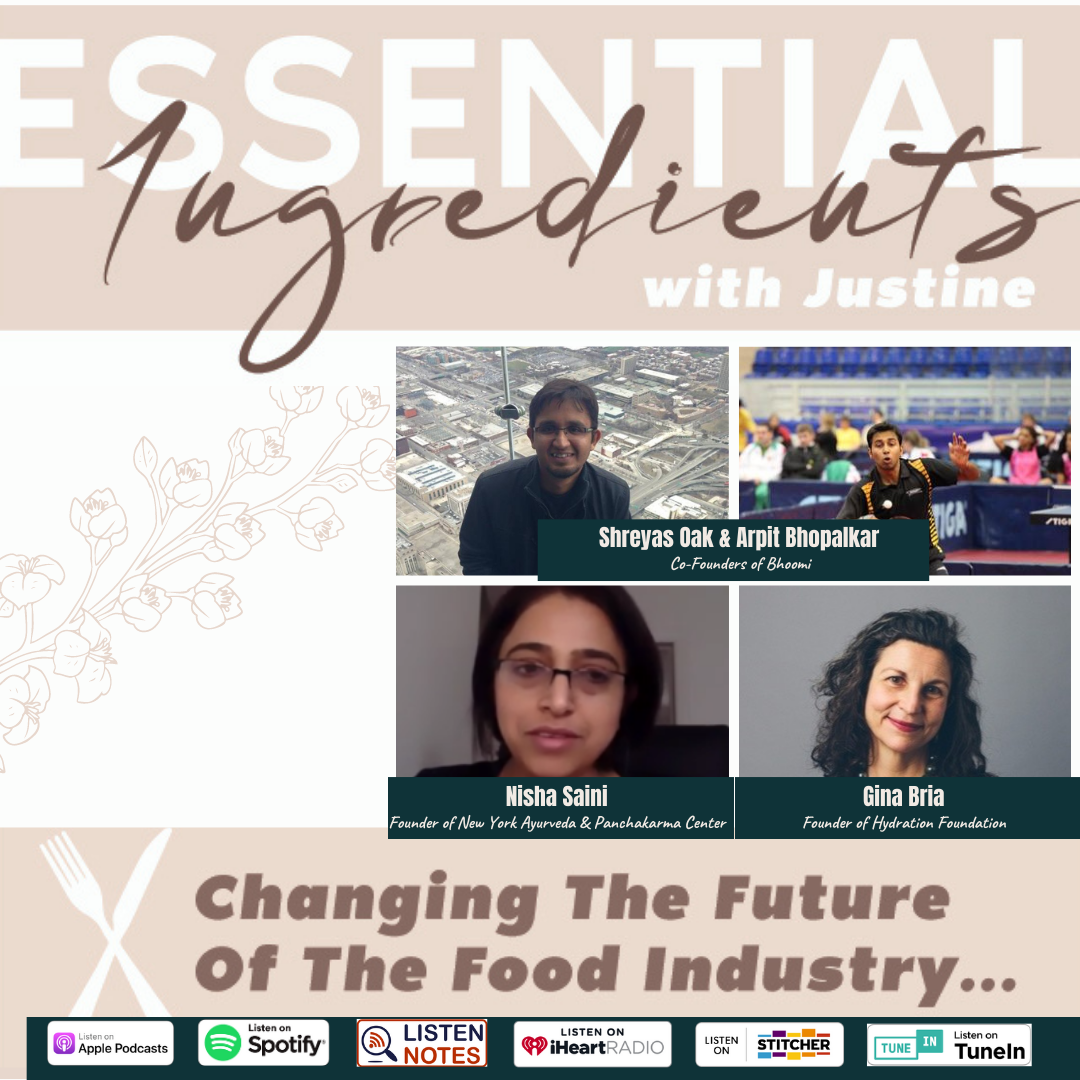
Hi, good morning, good afternoon. Welcome to Essential Ingredients, I'm your host, Justine Reichman. Today, I'm super excited to bring to you this talk that introduces a new product, innovative product Bhoomi, made from sugar cane. I have with me today, Gina Bria from the HYDRATION FOUNDATION, who's going to talk about the impact of integrating plants in your diet for hydration and how that can actually be more hydrating than drinking glasses of water. And to discuss and talk about some of them, to demystify some of this for us, I brought the founders of Bhoomi here, Shreyas and Arpit, as well as Nisha from New York Ayurveda, because her background is in Ayurveda. Bhoomi is a company that is rooted in Ayurveda and has built a beverage company that is made of sugar cane and brings together different supplements. Additions to this, to be able to integrate Ayurveda philosophy and benefits into their drinks. But I don't know that much about it, which is why I have you guys here to help me understand this and demystify some of these new innovative things that we're doing with the products. I'm super excited, and I just want to start the call, I thank you all for joining me here and being part of this conversation. So Shreyas and Arpit, can you tell us a little bit about Bhoomi?
Sure, Shreyas, do you want me to go?
Yes, go ahead? Yeah.
So first of all, this is how I look. I'm at Whole Foods Market Manhattan West, and there's a mandatory mask policy so I have to wear it. So yeah, the backstory of Bhoomi is basically, I used to be a table tennis ping pong athlete, international athlete for Indian team before I came here, and my coaches and trainers recommended cane water. So after a hard day's play in summer or during, it's very humid in India so cane water was one of the most hydrating beverages that my coaches recommended to me. Even doctors, this cane water was recommended for a healthy liver. So this is what I grew up on. I saw millions of people consuming and benefiting from cane water because of its roots in Ayurveda, the benefit it has. So yeah, I was very aware of how it provided benefits as compared to artificially made beverages. In 2013, I came to New Orleans to study at Tulane to do my MBA and [inaudible], we are over game of cricket and few table tennis games. At Tulane, we discussed, it is so humid in New Orleans, the weather reminded us of Bombay, Mumbai. It is a very comparable weather and we were like, okay, where is clean water? There are a lot of coconut waters here. It was growing, but coconuts are not grown here. Sugar canes are grown in Louisiana. So that is how the baby steps and the idea of Bhoomi how it was done. Shreyas will add more to it.
Yes, definitely. Thank you for giving a quick introduction. So yeah, as Arpit said, we met actively while we're both in grad school, we started frankly Bhoomi as a hobby, just going to local farmer's markets over the weekend, just waking up super early. After a few months of doing that, we realized that people are actually looking for us. They would call us, message us on Facebook and try to find where we were. So that's when we decided to have a package product so that we can reach more people and that's how we started selling different flavors. And currently, as Arpit said, we launch into this market.
Wonderful, thank you. We're going to go more, don't worry, we have a little bit more time. I just want to get everyone to do a quick little intro. To have this conversation, our listeners will have an idea of where this information comes from. So Nisha, maybe you can make a quick intro on yourself and what you're doing.
Sure. I started Ayurveda, New York Ayurveda center in 2006. Before that, I was already bringing some Ayurvedic products. I started with some herbal teas which I started in 2000. But before that, I grew up in a village in India in Himachal, that's like a Northern Himalayan Region there. So it was just natural, even if you don't know the word Ayurveda there, you're naturally living the lifestyle. People have sugar cane, even their own rice, or vegetables, or anything, we did make trips to the market to do our shopping. In the villages, everybody was exchanging the things, and it was a very natural lifestyle. At the most, we will go to some for a picnic. We will climb some mountains and hills and pass small rivers. That was a very interesting childhood story for me, and I really miss it. But I came to New York, I met some friends and they were, I just like when you meet your own kind of people. So they were all into yoga, and very holistic foods, and they will listen to me like, what kind of weird childhood I had. I grew up there. And they would say, Oh, you are the real example, you should do something. I think that's where it started. I was doing import, export, that's part of my background before I started Ayurvedic business, and that's how it started.
Awesome. Thank you so much. Gina, talk to us about Hydration, better hydration.
Well, I'm loving the panel, I'm loving who I'm with. I'm a cultural anthropologist, and Nisha, I just love that you're bringing these extraordinarily informed traditions forward. So with my work, I was looking at desert communities, how they survive drought and how they also were hydrating without eight glasses of water a day, which is the typical prescription. So the big breakthrough moment in my research was discovering the use of plants to hydrate, particularly cactus and Aloe. But then further studying the molecular science of water and the molecule discovering that water in every kind of plant is more hydrating than it is in its liquid form. So the message of the Hydration Foundation is helping people use plants and plant materials knowing that these plants are full of water that's been organized by nature to be more hydrating for us.
Thank you for sharing that Gina. This conversation, just at the core, just wants me to ask Gina because her expertise is in ritual, she studied and I let her talk about it. But ritual, that led her to figure out all these different ways for people to hydrate through plants. So maybe you can just touch on that, Gina, just because I think that that's a good entree into cane water.
Yes.
In your perspective on hydration through cane water, and then we can have the conversation go from there.
Well, Bhoomi team, I'm shouting out to you right off the bat because, of course from my research, I can affirm that cane is, of course a grass, the American audience would think like wheat grass. These materials carry natural electrolyte, and a lot of the hydrating beverages on the market are about synthetic electrolytes. People are now becoming alert to the idea that it's the combination of liquid and electrolytes that leap that hydration to another level that make it almost two thirds more effective. We have the science study about that, to show that minerals and electrolytes change the way the body hydrates keeps it more hydrated, it isn't the volume of water. So your product right off the bat, I'm like, Oh, that's going to be a great product because they're using natural principles that are coming from a long indigenous tradition, and kudos to you for bringing it right into people's grocery shelves, whole foods where they're walking by. And if educated, they can understand picking your drink or picking these traditions, which are literally just uninterrupted flows of information from nature that we've disjointed from within hooked from, unplugged from in our modern cultures.
It's definitely, Gina, you use the exact words that we use while doing a demo in stores.
Oh, I like that.
I'm curious, can I ask you? She talks about how hydrating it is, these plants in a liquid form. I know that you always said it was the most hydrating thing when you guys played table tennis, I think. But did you understand why it was more hydrated?
Yes, definitely. Gina said the crop of sugar cane or sugar cane stocks, they are 70 to 80% water. Once you extract the juice out of the stocks, usually in the sugar making process, the table sugar, all of these nutrients are stripped away and you end up getting just crystallized sugar. So the idea is if you do not process or do minimal processes, you are still retaining all the nutrients, electrolytes, you know, really hydrating. So basically, that is what the idea was. Arpit, do you want to add anything to this?
No, no, no. You covered it. Well, yeah, we knew about this. It's a tradition in India. My dad or my coach, they spoke about why cane water will give you a boost of energy and will not spike up your blood sugar because it is low-glycemic, it has fiber and things like that. So, yeah, it came as a tradition. And I think what Nisha said previously that we did not know that, Oh, this is Ayurveda, that is Ayurveda, it was just part of our life. And as we delve more deeper into what we are doing, we realize, okay, we have been doing all these things all our life. Consuming turmeric, moringa and things like that in our daily diet.
Arpit, can you just repeat that? It was a little bit hard to understand what you said. I know it's difficult with the mask.
Yeah, yeah, yeah. So what I was saying is that in India, when we were growing up, it was just a part of life. Coaches and trainers taught us. My dad taught me why cane water is beneficial. Why coconut water is beneficial because we consume it in our daily lives, it's not a special beverage to us. Millions of people consume it everyday.
Thank you for that.
Justin, I would like to add to that. When I was going to college, I was in Chandigarh. I was in a [inaudible], and before we will come to our hospital for lunch, there will be a guy standing, a cart guy, and he'll bring a lot of sugar cane stock there and make the juices. He will not be able to sell much, he was just standing there, and I started drinking it every time I'll come to the hospital in the afternoon. I will take a glass or two, and I'm telling him to add some ginger or mint, which I see in your drinks also, you have added some herbs. And this is just so natural that you'll have some like a whole spice leaves around him so you can tell him what you want to add. You drink it and you feel like, Oh, you have the whole meal. You feel so hydrated. You feel so energetic. Like even if you're hungry, headache or whatever. I was very prone to headaches if I didn't eat my meal. And I'll feel a hundred percent fine after that. Seeing me, so many people started flocking around him. I used to tell them, you should start discounting my price now. It's very natural. Especially in Northern India, the sugar cane beverage is very, very common, you squeeze it fresh.
It all sounds from what you guys are saying is that it's part of your lifestyle, that you're going out to seek something that is rooted in Ayurveda. It's just part of your culture, which is really good to me because it really connects with what Gina was talking about in terms of studying ritual and how, we, as a community here, locally, haven't really reached that level yet to be able to live in that way, here in the US, we're a little bit behind. Maybe we think, as Gina said, from the top of our head, as opposed to from the environment around us. I really appreciate that way of looking at that. Of course, I'm going to go straight to the head, and I'm going to ask you Nisha a little bit if you can explain a little bit about Ayurveda, and why this, and how they've incorporated this in the impact it can have.
Sure. I looked at their little picture and they have three different drinks, I think they made, that's what I saw. And they all are beautifully done. They have moringa, let me talk about moringa. I grew up in [inaudible]. There was some moringa kind of Bush in every backyard. People were making their own chutneys everyday, mix of spinach and moringa or something else, or some garlic, turmeric, ginger or whatever, they like fresh. When I study Ayurveda, moringa leaf, the fresh leaf has the maximum benefits than the powder or the beans that they have. Apart from that, you have ginger there, you have turmeric. So let me finish with moringa.
Yeah, you can finish and you can go back and tell us some of the impact or the benefits of moringa.
So antioxidant. And for any inflammation in the body, it's a very good, sugar regulating herb in the body. These are the main, then the energy levels. I think if you take a moringa, you don't even need anything else. You have vitamin B, B6, C, anti-inflammatory, then it has all the energy that you get from it, it's a great herb. Especially for the people suffering from diabetes, cholesterol and cancer, a lot of benefits from this, from moringa.
Okay. I want to buy that.
I have seen so many people coming in our center, they literally come to pick moringa.
Really, wow.
And recently, I saw an Indian store selling fresh moringa leaves.
Wow. So maybe you can share with us, and you don't have to do it now, but if you have a little recipe with moringa that we can share with the community, and maybe it's Bhoomi water who knows. I want to make it. So you mentioned after moringa that there were two more flavors that you saw, Arpit, that you guys have, it was ginger and tumeric, is that right? Okay. Nisha, can you talk a little bit about ginger and tumeric? I mean, I know that they're all anti inflammatory. If we can connect that again to Ayurveda and the impact it can have, I think it would really be impactful for our listeners because some of this, we know that it's just that, that it's anti-inflammatory and we should drink it, but why? Tell us a little bit more.
Sure. When we talk about ginger, best spice, herb, food, whatever you want to call it for your digestion. Anybody suffering from any kind of digestive problem, ginger is the first thing I recommend to my clients. I have made a ginger lemon pickle recipe which I put on social media. I send out literally the whole recipe to all to make so that there's not a single person who comes for a consultation and doesn't get this recipe. I said, if you want to take care of your health, whether it's a headache, or a stomach ache, or it's a back pain, or whatever pain, you have to take this food, this pickle in your diet. I mean, it's not even a pickle, it takes like two minutes to make it. So ginger, anti-inflammatory, any blood regulating, it's very good to increase the pitta energy in the body. Pitta energy is totally responsible for our digestive fire in the body. Anybody who is having more weight issues, ginger is the best herb for that. If anybody is having nausea or any kind of pace problems, ginger is the herb to go for. When you are talking about ginger, it's too sharp to eat by itself. You have to balance it with some cane sugar, with some lemon juice, salt and pepper as needed. So the whole recipe can be adjusted for everybody as needed, but you cannot take ginger just plain, it's too sharp to have. We always balance it with some brown sugar.
Before you go on turmeric, can we just back up for just a second and give people an idea about, so they understand, what does Ayurveda mean?
Oh, sure. Ayurveda is a combo word. Two words put in one word, ayur, veda. AYUR means life, VEDA means science or wisdom. The literal meaning of Ayurveda is science of life. And it originated more than 5,000 years ago, that's what I know for record, maybe more than that. And it's an ancient Indian healing system, it's like a complete science. There are different branches for digestion, for gynecology, for surgery which is not used right now because medical modern science is much more advanced in surgery. But talk about any branch of medical science, you have it in Ayurveda. And even our doctors who work with us, we have three doctors on our staff and they all have different specializations. They're MD and aerobic medicines, and the science works so beautifully for everything. Food, herb's, exercise, lifestyle changes, these are the main things we think people need to do. Not so many medicines are needed. Let's say somebody came to us suffering from hypertension, we do not take anybody off with medicines, with Ayurvedic doctor's advice, we incorporate the herbs, foods and lifestyle changes. People are sleeping late at night, which is another addition to a bad lifestyle and all the chronic problems we get. It literally brings inflammation in our body when we are sleeping late at night. And most of the chronic diseases are coming from inflammation in the body. When we go deeper in the problem, that's what we find out. So lifestyle changes are very, very important. And when people start falling, whatever changes our practitioners tell them, we hear most of the time, Oh, I went to my doctor last week and he says, whatever you're doing, continue it. You're doing great. That's what we hear many times.
I love that. That's great. It's nice to see that people can balance a value system other than just what's here, the Western and Eastern, how they can compliment and be interdependent together, because there's value in both. I really appreciate you all coming on to demystify this a little bit for everybody because it sounds to me like part of the choices that we're making to live healthy are to look at some of these innovative products, and these products are being built based on different traditions, findings and science which allow us to change our lifestyle. Not in lieu of going to the doctor, but maybe in a preventative and proactive way to have a healthier life and to be more thoughtful about what we're putting in our diet and in our body. So I appreciate you guys building a product that is so thoughtfully creative, and I really appreciate, Nisha, you sharing with us the philosophy behind Ayurveda. I don't want to lose where you are, you are then going to talk about turmeric. Now that we understand what Ayurveda means, I would really just love to just finish that up so that we could better understand the products that Bhoomi has, and just understand each one. So we talked about ginger and we talked about moringa, the last one is turmeric.
Turmeric, and I think amla. You're using amla also in your drink?
We mix ginger with amla, and turmeric is blended with ashwagandha.
Oh, wow, ashwagandha. Let's talk about ashwagandha first. I know for sure, anybody who goes to yoga studio or anybody has any connection with wellness, they can say ashwagandha, they have learned it. How do you say ashwagandha? If you're listening to it for the first time, I don't know, you might find it a complicated word. But anybody who follows wellness, they can say the word ashwagandha. You go to any health food store, any salesperson, cashier, register guy, they know this word, how do you say that? I was really astonished how these people [inaudible]. So ashwagandha is one of the major herbs in Ayurveda. And ashwagandha literally means the smell of horse, that's what it means.
Horse?
Horse. But whatever it means, this herb is a rejuvenating herb, herb to balance the energy, it's to balance your sleep, it's an antioxidant. It's a [inaudible], it can be taken by all those in Ayurveda. I missed one part, what is the basis of Ayurveda? I'll come back there. So there are three body types in Ayurveda, Vata, pitta and kapha. So it's like an adaptogen, it adapts your body whatever is needed, energy or whatever it needs to be, it really balances the whole system. Instead of taking a multivitamin, if you're taking only ashwagandha, that works.
So ashwagandha and some plants then we're good?
We're good. I mean, they're very smart in picking the herb that they have added in the drink. Ashwagandha, moringa, turmeric, amla, you're all set.
Guys, was there a lot of research done to pick those specific herbs? What inspired that? Arpit? Shreyas? Anybody?
Yes, Justine. So we started the company five years back and it took us, I would say at least a year and a half to two years to optimize the recipes. We see a lot of feedback, just studied what trends are currently going on in the food and beverage industry. So based on all those feedbacks, we were able to modify these recipes. Apart from that, just studying what flavors are used globally that go well with sugar cane or cane water is what helped us to come up with the recipes that we have. And also being part of a panel like these is when you learn a lot as well.
In the meantime, I'm curious, so you picked these supplements or these additions that you added to the water. I'm curious, as you were doing your research, testing them out and getting people to taste them, what was the feedback that you got.
Definitely, I would also like to add to this as well, the number one thing is people have not heard about drinking cane water people don't know how it is made, how the juice is extracted. Usually people's reaction is like, it is just a spoonful of sugar dissolved in water, that's the common reaction. Doing a lot of demos, going in front of people definitely helps. But apart from that, when we tell people all the benefits of cane water, people are always surprised. Coconut water which I would say is a foreign concept, similar to sugar cane water, it is a really big industry now, it is an industry by itself. The people did not know that coconuts are not grown in this country, but after hearing all the benefits of cane water and the benefit it has to provide, people are really surprised and they want to learn more.
So Shreyas and Arpit, I'm curious, I know that people are excited about it, I know that people liked the taste. My question to you is, have you had any feedback about the impact it's had? Has anybody come to you and said, Oh, my God, I drank this and I felt amazing after. Whatever the story is, but I'm just curious if you can give some sort of feedback, share some feedback or stories from some of your customers.
Yeah, the feedback that we got, there's a person in Austin, she was pregnant, she was using our moringa and she did not stopped, literally not stopped that product because it was helpful during her pregnancy, she felt really well balanced. The best part about our beverages is that you don't get a spike of blood sugar, it is a low glycemic beverage. So when you consume it, you really feel well, you are not bloated, neither are you going on how you drink soda or simple sugars. You feel really energetic for [inaudible]. But without beverages, you get that sustainable energy over a longer period of time. And that is very consistent feedback that we keep on getting from our customers. Hey, I'm using this and I do you feel good. As for turmeric? It felt, it is an adaptogen as Nisha was talking about, it helped people to not be stressed. During colder months, people would eat and drink it. So it is beneficial in that way as well. For amla, it's a great antioxidant. So amla has the highest levels of antioxidants on any herb on the planet.
Shreyas, can you just maybe pick up where Arpit left off?
Yes, definitely Justine. So I think Arpit covered most of the good benefits for our drinks. I think he was talking about turmeric along with ashwagandha and a black pepper. So in the literature, people have done a lot of research on turmeric which is rich in antioxidants. If it is consumed along with presence of black pepper, the absorptions of antioxidants is multi-fold. A lot of people drink tumeric, the flavor that we have to offer, they come back to us saying, Hey, it was a sustained energy, I feel refreshed.. these are some of the feedbacks that we get along with what Arpit mentioned.
So maybe you can just reiterate, Arpit had mentioned that somebody was pregnant and drinking it. I couldn't really hear the impact it had for them on a personal level. If you know that story, maybe you could share it as well, just so that we could share that with our listeners.
Definitely. So cane water is known to be low-glycemic. That means that once you consume cane water, it is a sustained source of energy. You can compare that, a very crude example would be brown rice versus white rice. With white rice, you feel really good for a few minutes and then you'll get a sugar crash. But cane water is a sustained energy source. I think what Arpit was mentioning, one of their friends who was expecting, she stopped up on our ginger flavor and it just provided the sustained source of energy that she was looking for.
Wonderful, that's great to hear. I love to hear those stories. I'd love to bring Gina into this conversation, just connect the dots from plants to hydration, and everything we're talking about is rooted at plants, from cane to ginger, from ritual to Ayurveda, it's all connected. Gina, I'd love to hear your perspective on this.
Thank you. I'm excited to be here to listen to what I'm listening to because what I'm hearing is the bringing in traditions around the world that are sustained, let's call them longterm clinical studies because they've been going on for thousands of years, right? What we're coming up against, Justine, what you're trying to accomplish is to get people over that line where they feel like that's something different and something they don't know about or something alien.
For people to not think it's a fad, right?
Exactly. It's not a fad. This is the problem we're living with that we don't realize because we're swimming in the problem. We live an abnormal life as moderns, which is divorced from nature, which drives us biologically. We are biologically driven. We're better biologically driven by how much nature we're exposed to. How much of our environment we're exposed to because we're meant to live in a natural environment. I'm speaking as a cultural anthropologist, doing an ethnography on us, recognizing that the indoor life, driving of cars, the high computer use, the prescription medications, the process pick drywall, we live in drywall, cubicle environments, it doesn't matter where you turn, what we recognize overall is all of these are separations from living in a natural environment. Now, we're not going to give that up. What we have to do is figure out how to get nature into our lives, because what nature is carrying is information that drives our biological system. So when you go to whole foods and you pick Bhoomi off the shelf, what you've just done is brought nature and it's informational power into your system and into your day. So you're literally opening the door and letting nature in by opening that bottle and knocking it back. Now, why Hydration is connected to that? The water molecule is the conductor of that information. It literally conducts the information in turmeric, in moringa, in the ginger, into your system in a cohesive way. That water molecule is made to pass on the electrical digital information that's in the tumor. So when you couple now, hydration with nutrition, or plant information, let's stop calling it nutrition just for the sake of this confirmation, call it plant wisdom. Plant adaptation, the more you get that into your life, the more you're able to function well in the artificial environment that we live in. And the wisdom of plants, I can't say it enough, they are our allies, they have information that we're missing in our lives. So the more plants you include in your life, the more biological information is going to turn on in your system. And hydration, the water molecules actually conduct, or let's put it in a slightly different way so the science people can get it. The water molecule is what disassembled the nutritional molecules to be able for you to absorb them. It's the conductor, it's the orchestrator. And why do we need hydration so much? The water molecule is the one that takes all that information and turns it into availability in our body, but we're missing plant information. So any product, any food, any lifestyle that brings that plant wisdom into our life is going to be invaluable.
Gina, that was amazing. Thank you so much for sharing that. I think that it really gives us a new way of looking at things and thinking about what we're doing. I think whether you're an entrepreneur and consumer, it's really palatable and to really be part of a new way of thinking and changing the future of food. I'd love to hear from Shreyas and Arpit, what you hope to achieve with Bhoomi going forward as part of the food system.
Yes, definitely. So at Bhoomi, we all believe in having full transparency, a hundred percent transparency of all the packaging, all the labels, all the ingredients that we have chosen. We want to be upfront about them, even including our nutritional label that you see, it is the entire nutrient that is available in the bottle. It is not half serving, one serving. We believe in full transparency, we want customers to understand what the product that we are offering and we want customers to go find us in different grocery stores. Apart from that, we also believe in sustainability. I don't think we have talked about our sustainable practices, but we compost all the organic material that is produced during our production runs. And we have actually recently launched a bottle that is made from a hundred percent plants, so the bottle actually is made from sugar canes. By doing so, we can reduce energy use by 60%, we can reduce carbon emissions by over 80% and water used by over 20%. I would say that these are the two big things that we want to continue achieving, continue doing as we go along in our journey.
Wonderful. I am really excited for you. I'm excited to be part of this conversation at an early stage, and to see where you're going to be next year at this time, in three years from now. Are you guys planning to expand your line or come up with other products?
Yes. We are always looking to innovate new flavors, we want to hear customers' feedback. So if you guys have any suggestions or you know anything different than we can do, we are more than happy to listen to that.
Gina, had you heard of cane water before, in this form?
Well, I knew it was a common drink in India. And I'm always looking at indigenous traditions, what are they hydrated with? What are they looking for? So I'd like to say that I love what you're doing. I appreciate the sustainability. If somebody buys Bhoomi instead of a plastic bottle of water, they're going to get so much more, and they're going to be giving more back to the planet. This is really powerful. We will love to support you and be behind you because you're practicing all the different ways we're trying to have impact in the world. And I want to say something about coconut, coconut water compared to Bhoomi, for example because coconuts are a problem. They are beautiful impact products for hydration, but right now in the sustainability conversation, what's going on with creating coconut plantations, waiting for that coconut to grow, it's taking a lot of resources out of the earth and it's interrupting natural environments. Whereas sugar cane grows in marshlands, in large fields, it's a natural plant that has a sustainable and filtering effect on our planet. We really need smartest solutions right now, not like these three products hydrate. Well, what else are they doing? So grasses and canes are a very important part of our ecosystem that's disappearing right now in terms of water filtration on the planet. So from the larger picture, you want to make that choice. Like I want a hydrating drink, coconut versus cane water, this is a really important product to help us get forward on our quest to support mother earth, which is what we're all on.
And just to add to that, my question, Shreyas as you mentioned, where are you getting the cane from again?
Yes. Thank you so much, Justin, for bringing that topic up. So we exclusively work with minority sugar cane farmers in Louisiana.
This is local is what we're talking about too, [inaudible] which is not local.
Yes, definitely. So frankly, when we first started the company, the only aim was to sell as much product as we can. We both started the company in New Orleans and in Louisiana, there is a lot of sugar cane grown. When we started to do some research, we started to find out more and more about discriminatory practices that were happening, or that have been happening to minority sugar cane farmers, or how they are losing their lands. A few years back, there used to be more than 20 African American families who used to own lands. And right now, there are only three families who own lands so we realize small steps like partnering with minority farmers and getting sugar canes directly from them is going to help shed light on some of these issues. We make sure that we consciously work with the minority sugar cane farmers.
Yeah. So answering the last question, what is the hope? Alongside health and wellness, and what Nisha and Gina have been talking about plant power and plant wisdom, and how we need to communicate. There are two more hopes that we have, as a brand and as a mission. The first one is supporting minorities so that the black farmers in the United States. And as what we're saying is that the farmers that we work with, they're losing their land. The traditional sugar cane growers in Louisiana, in the United States, there used to be a lot, many African American sugar cane farmers in Louisiana. Today, there are three or four families growing sugar cane, and they continue to fight till today. For example, one of our farmers, the last name is [inaudible], they used to have 5,000 acres of land in Louisiana. Today, they own less than a hundred acres just because of this community [inaudible] practice that happens within the community. So we want to shed that light because land is everything. If you lose the land, and if the black farmers are educated, they are the ones who -- for so many years actually -- it is very difficult to stay in the United States. So we want to be on the right side of it. We don't want to perpetuate what has been happening in the United States for so long. So we want to be a part of the change and amplify the voices that black farmers are asking for, they have been fighting for it. The third part is [inaudible] is excellent, as I was mentioning, it catches a lot of carbon from the environment and regulates it. On that aspect, this bottle, compared to plastic, this reduces 90% of greenhouse gases. And this is from a climate collaborative and selected art project last year. They did the research on whether we should make this change and they gave us a number of reports, so we ended up doing it. We are still doing it because what we believe is that CPG, CPG is consumer product goods, we want it to be SPD, sustainable product goods in the United States. So these are the hopes, I know I just answered the long version.
Guys, we're gonna wrap this up. We are coming to a close and I want to be respectful of your time. I'm just super excited that we were able to have this conversation and bring everyone together. So Gina, Nisha and Bhoomi, we've had a lot of talk about cane water, it's rooted in ritual, it's rooted in thousands of years of experiential clinical trials, right? Because we get to hear what's happening from that. But what do we see for the future? I'd love to hear how you feel this is going to impact the future of food. Shreyas, maybe you could start.
Yes, definitely, Justine. So for the future of food, I think I'm going to go back to the transparency aspect that I had mentioned previously. As Gina was mentioning, we are going away from what nature has to offer. I think having full transparency moving forward, not just in our brand, but you know, customer being aware, choosing or selecting the brand that offers such transparency is something that we would love to see happen. Apart from that, using thermoplastic which is single use plastic is one of the largest contributors to plastic pollution in the landfill so our company is focusing more on the sustainability aspect, something that we would love to see in the future of consumer packaged goods.
And what do you see as Bhoomi's role in this?
Bhoomi's role is just educating people, not just about our product, that's definitely going to be a priority, but at the same time, raising voices about minority farmers, raising issues about sustainability nutrition, these are the directions that we want to move forward.
Wonderfull, thank you. How about you Nisha?
Hi, Justine. So I wanted to add actually two things to the drink, the Bhoomi drink, the sugar cane drink that they have. It's a very good source. So many people have cravings problem, and they're overheating, so it helps a lot in dealing with that craving problem. Even if you're not drinking the drink and finishing the whole bottle at a time, sipping it, like you finish one bottle in a whole day, that helps for the craving. Many people who are gaining weight, mostly it's the emotional eating problem, so sugar cane drink certainly helps without creating problems. Secondly, turmeric and ginger are very good products. They were talking about one of their customers who was pregnant, it helps a big deal with a nauseous problem. Nausea that the pregnant women have, ginger by itself or adding ginger to any food or drink helps in a very big way. Coming back to what we want to do, being in Ayurveda business, I would like to educate people. Please use your food as medicine.
I love that. Thank you so much for that.
Food as medicine, it should be good food, quality food, it should be accessible to everybody, it should be affordable for everybody. And prevention is better than cure.
I want to echo that. That's great. Food is also wisdom.
And that's the future I really want for all of us is to be the goal to really embrace ourselves as natural beings, as biological beings that need and can be loved by nature. We don't realize how much we're missing. The love that nature has to give us. So healing is about giving love, but healing is also about receiving love. So the love that comes from a product like Bhoomi that they put into this, the thoughtfulness, the love that plant information has for us, the love of caring for ourselves through natural products, and then the love, the giving of that love back to mother nature, the ways that we don't pollute her with plastics, the ways that we in a support farm and farm life, this is our future. This is our way out of COVID too, supporting farmers and eating their beautiful foods, or becoming a person with lots of plants in your life. Whether you grow it yourself or you ingest it in a way that you ingest it, and make it actually molecularly part of you, that's the future.
Thank you guys all for participating in this conversation and sharing the information. I was so excited for Bhoomi and what you guys are building. I was excited to be able to put together a panel that might be able to provide a little information to help demystify what it is you've built and answer those questions for people, and further validate for them when they're uncertain, where this is rooted. It's rooted in ritual, it's rooted in thousands of years of clinical studies, it's rooted in plants being more hydrating than food, and I'm just echoing the highlights of this conversation. So for everyone that joined us, I just want to thank you. I want to thank you guys all, and I want to thank our listeners. And I want to ask you, Shreyas, is there any sort of offer discount that you want to offer our listeners today? Maybe a discount code?
I am having a hard time remembering, but I think Arpit would have been better to answer that question.
No, don't worry. I'll ask him on another call and we can come back to it. You can always email me and we'll put it into the show.
Definitely.
Gina, there's so much going on at the Hydration Foundation. There's so much opportunity for education and information. And I think part and parcel to what we're building here is a resource for our food and beverage entrepreneurs.
Yes.
Is there anything that you want to offer to our members?
So we just finished the first hydration summit. It's on our website, there's 30 colleagues, doctors, and scientists identifying new ways to hydrate and they each give their own tips. So Dr. Zach Bush, Dr. Dana Cohen, Rollin McCraty from the HeartMath Institute, Dr. Christiane Northrup, [inaudible] talks about coffee, and we have so many of our colleagues who are now bringing hydration to the fore. And you can just go to my hydrationfoundation.org, it's the first thing that pops up, register for that, it's all free, it's astounding information. And when you have that resource, we're leaving it up for as long as we can through this pandemic so people have hydration information. So we're glad to have everybody join us and become part of this new solution that's going forward, Hydration Solution Summit.
Gina, we will make sure that is in the show notes.
Thank you.
Nisha, is there anything that you want to offer our listeners, whether they're local or global, we'd love to be able to connect you guys and for them to continue the conversation.
Sure, that would be great. Right now, especially during the Covid, we were offering a lot of free consultation to the people because they were looking for some natural ways to deal with it. They didn't know where to go and the consultation can be, especially in this economy, could be a big expense if you're offering many consultations to people, especially myself, for clients. So anybody is welcome.
How would they get in touch with you to learn more about that?
So please go to our website, nyayurveda.com, our phone number to reach is (212) 616-4127. You will get all the contact information from there and reach us through email or by phone.
Wonderful. I do see that Arpit put a code up here, It's 10% off. What we will do is we will include the details for this discount code in our show notes. Just take a look at those notes and you'll be able to access the 10% off code. I personally can't wait to go get my Bhoomi water. But again, I just want to thank you for joining me at Essential Ingredients this morning. For this really interesting conversation, I found it super helpful to really understand what all these new innovative products are rooted in. And when I see ginger, I see turmeric, it gives me a better sense how these products have been created and what it's focused on, what is rooted in. Because up until now, all I knew was it was anti-inflammatory, but I didn't know that it was rooted in years, in thousands of years of clinical trials from just the community. And I didn't even think about it as that it was a plant, and for Gina, understanding how that is actually that much more hydrating. So I walk away smarter, more informed and excited to try your new product and see where you guys go in the coming year. Thank you for joining us at Essential Ingredients. I want to thank our listeners, and if you liked this podcast and you want to hear more, make sure you subscribe to NextGenChef, it is the podcast channel, it will be on iHeartRadio, and you'll find us on iTunes and all the top podcast station so I look forward to connecting again and seeing where you guys are in a few months, and that's all folks.
Share This Episode
Enjoyed this conversation? Share it and tag @nextgenpurpose
Listen on Apple ▶Listen on Spotify ▶Your Host
Justine Reichman
Founder & CEO of NextGen Purpose. Host and Executive Producer of Essential Ingredients — 11 seasons, 330+ episodes, and a growing movement.
About Justine →