Gina Bria · NextGen Purpose
Watch on YouTube
The "8 Glasses of Water A Day" Myth Debunked! — Learn Why You Need to Stop Believing This Hoax Now and Learn How To Effectively Rehydrate Your Body with Gina Bria
The Incorporation Method helps you turn what matters into practical changes that fit your life.
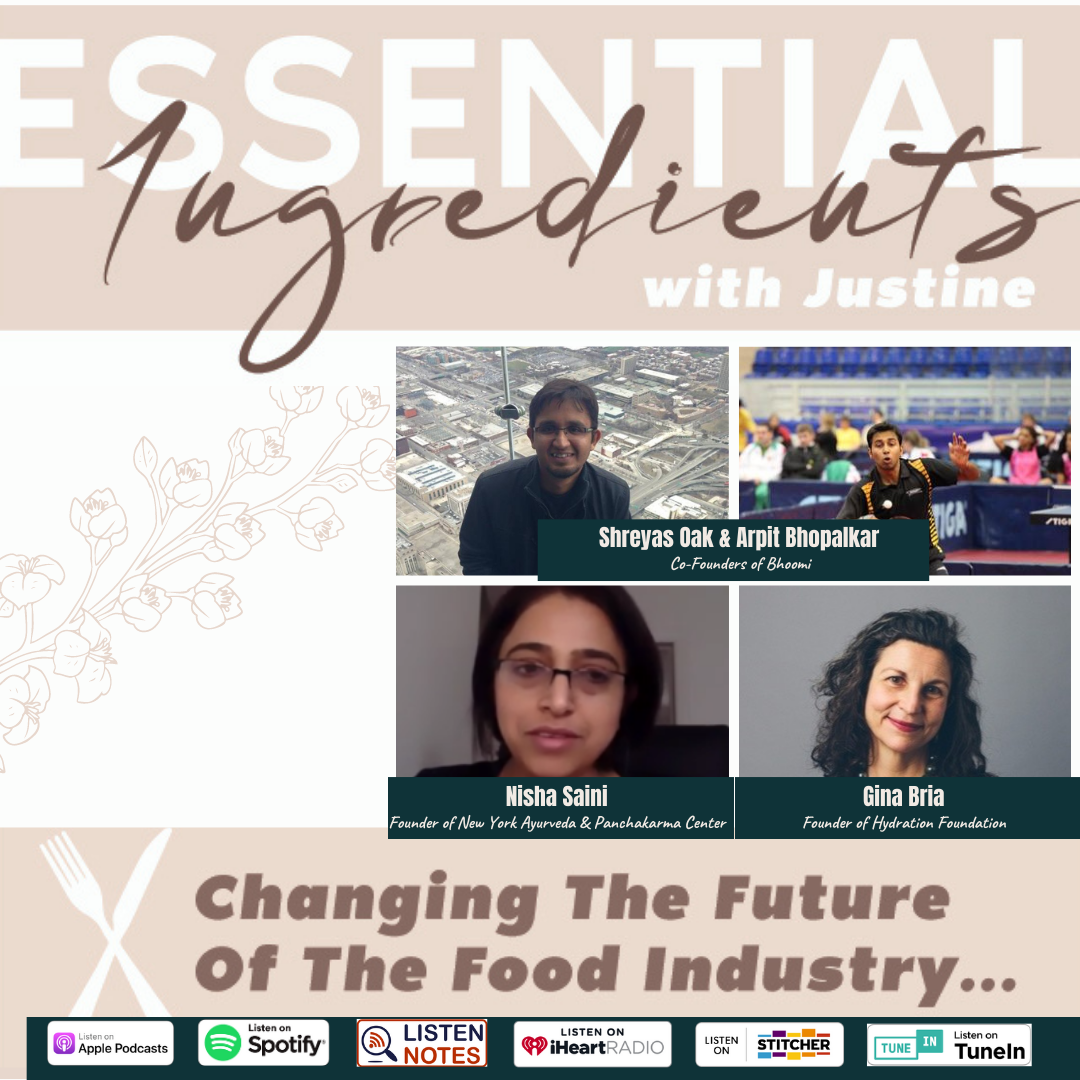
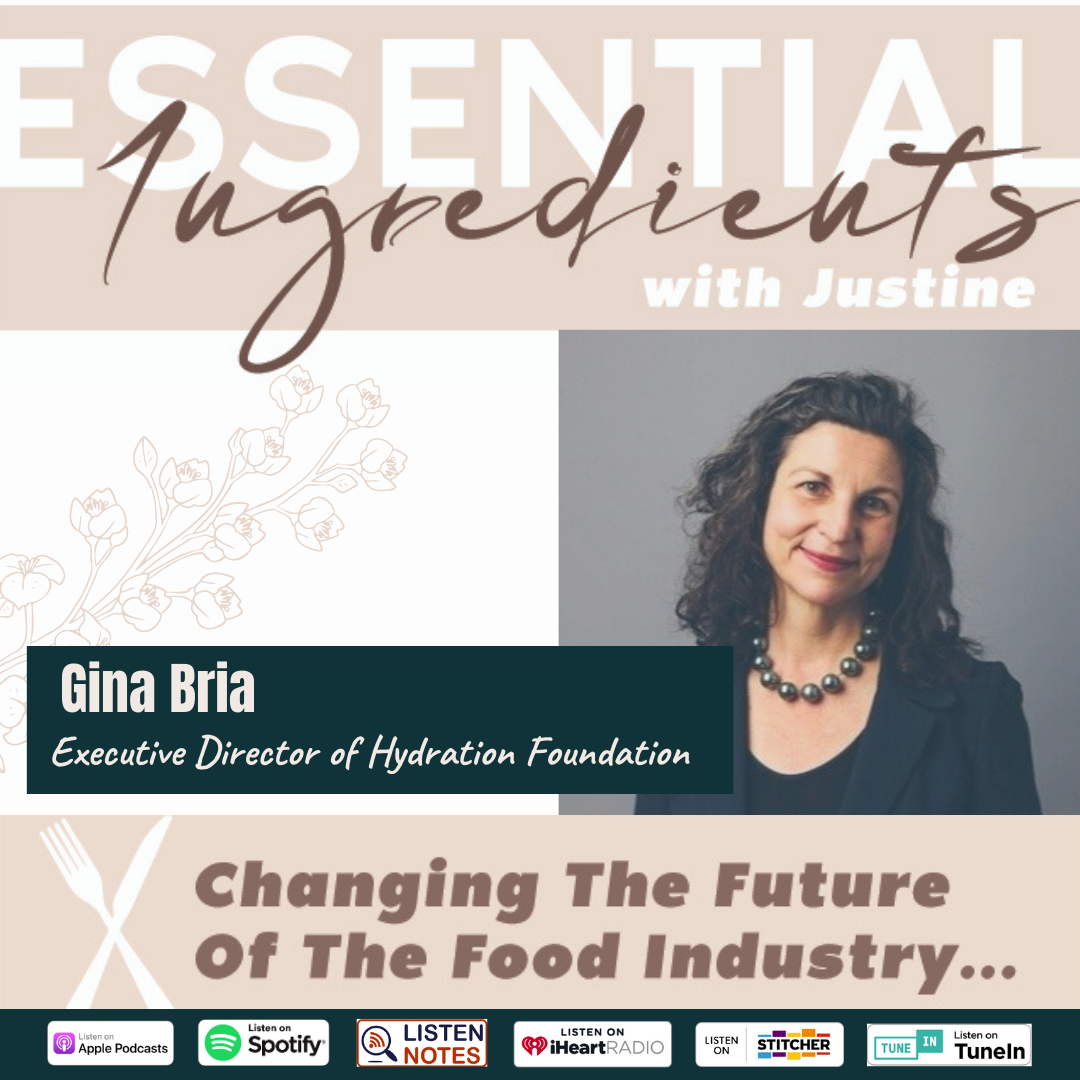
“Once upon a time, someone said that we need to drink 8 glasses of water a day and the world believed it! While it is true that we need water to live, counting glasses of water just isn't the right way to rehydrate. Join Justine and Gina Bria, Founder of Hydration Foundation, as they unveil the less known facts about water and hydration and share why hydration is an urgent call, not only for people but also for nature.”
Full Transcript
Full conversation between Justine Reichman and Gina Bria.
Good morning and welcome to Essential Ingredients. I'm your host, Justine Reichman. Today, we have Gina Bria from the HYDRATION FOUNDATION. I'm so excited to have you here, Gina. Thanks for joining us.
Oh, can't wait to talk. The conversation brings so much, it bears and makes new things happen. I love that.
Well, I hope that everyone is inspired as I am. Just to give people a little background, I met Gina at Equator Coffees, but we are both fellow New York transplants and we connected immediately. So ever since I met her, I've been super inspired about what she's building in the Hydration Foundation, the message she's sharing and the impact she's having. So Gina, would you share with us a little bit about your story?
Yes. I'm a cultural anthropologist, and as an anthropologist, I was looking at hydration strategies all over the globe. I was very curious about how desert people survived without eight glasses of water a day. Like, come on, why do they actually look better than we do? And I thought, well, there's gotta be some secret here, I've got to find out. So my big aha, my big discovery was they were using plants to hydrate, not liquid. And by plants. I mean things like cactus, and aloe, and tubers, and fruits, and seeds, and these desert plants had enough biological intelligence that they knew how to store and concentrate water. And then the humans that were using the plants were receiving all the benefits of a concentrated form of water, a kind of gel water. I mean, if you know what an aloe plant is, you know exactly what I'm talking about.
Of course, definitely. I'm curious, do you think that when these individuals were eating these plans, was this a mindful or a thoughtful choice that they made as a way to hydrate themselves? Or was it just part of what was available to them and by extension then ended up hydrating themselves?
Well, I love that you use the word thoughtful or mindful. Because what I'd love to get at in this conversation, and of course, Justine, you would get us right there. This is what conversations with you are like. There is a kind of thoughtfulness, a kind of mindfulness that has nothing to do with thinking through our brain and processing through all kinds of dense networks of rationality. There's a kind of receiving thoughtfulness in which nature is dying to share. So as a creature of nature, we go out and we are supported by the environment, which for us, which literally evolved us. Literally, we spring out, and that nature cares for us because we're part of it. We're living entities in a living entity. And what happens when we're not hydrated, we lose out on important biological nature information that runs our system naturally. So first big point, we are run by water. We are mostly water. If you do the molecular count, it's 99% water by molecular count. We're 99% water.
Wow.
That's stunning. We don't think about it because we're looking for the liquid form.
Back to my question, when you were studying ritual and you were investigating, you found out that these communities were actually more hydrated because they're eating these, and we'll talk about that gel water after, I want to talk more about that. Did they know what this was? Did they know what they were doing?
Well, knowing is a kind of body knowledge that we're missing. Our culture, they pour everything in through the top funnel, right? Everything has to go through the science brain, or the rational brain, or how does this work brain? And actually, nature is so complex that the way it works, or question doesn't get at the massive spectrum of answers that nature's given, or that biology is given. We can either have a nature conversation, which is one group of tribes of people thinking, or we can have the science conversation. And of course, the job where we sit right now, Justine, is to be able to have conversations so we can invite all our brothers and sisters into higher body health, but health is a small goal.
It's true.
It isn't our ultimate goal. Our ultimate goal is to be alive, fully alive, as much as this biology has for us. And also to give that liveliness back to our world, we feel so disorganized or disjointed from ourselves and our world because we're not getting enough hydration, enough information that the water molecule conducts.
So this conversation is so vast and there's so much that goes into it. And there's so many moving parts from gel water to nature, to all these different things. I really want to make it accessible to everyone who's listening to us, so could you break down for me a little bit about this gel water, and the importance of it?
Yes. So when I found out that cactuses or chia seeds had this concentrated water, very jelly-like form, first, I was trying to find out what the gel was. I thought it was like a polysaccharide, some kind of material, and I was trying to scientifically identify, chemically identify what the heck that was. So I started calling in my networks, none of my fellow anthropologists had any idea what I was even talking about. I will just back up and say that the way I approached this problem or this ethnography was I looked at different cultures, all those desert spots around the globe. I was very zeroed in desert cultures using gel like plants, and the gel like plant was the common denominator. On one side of the globe, it would be chia seed. The other side of the globe, it would be a tuber that had a gel like quality in it. In the Kalahari, for example. So I zeroed in on the gel, the plants all had this adaptive quality. Then I tried to find out who could tell me what that gel was. That was not an easy task, let me tell you.
So how'd you find out?
Well, I made this life changing phone call, and believe me, life can change in one phone call. I called up this guy at the University of Washington. He was a scientist, a bioengineer, and he studied cells and gels, that was the name of his book. I called him by the name of his book. I'm like, okay, cells and gels. All right, I'm going to give that guy a call. And it turned out to be Dr. Gerald Pollack at the University of Washington. Pollack lab, deeply famous guy. Did not know that at the time, can't believe he took my call. And I'm on the phone with him, and I'm like, ah, hi, I'm an anthropologist, like this matters to him. Hi, he's the world [inaudible] water authority, breakthrough science on a water state that had not yet been identified. Of course, mother nature has always had it, but it hasn't been scientifically identified. And this fourth state of water besides vapor, liquid and ice, there's this gel and this fourth stage turns out to be the most extensive stage of water. So if water is on a spectrum going from vapor to ice, that's how water processes itself to get clean again. Oh, my God, this is huge. So here he is, this talented scientist and I'm like, can you tell me what's that water in a cactus? It's literally concentrated water. It's called the fourth stage, and it's water in which the molecules of water can be concentrated enough by sunlight. Think desert by minerals. Think desert sand is all ceramic minerals, or by touching other biological elements in which water then excites itself and the molecules start to spin together and share their electrons. Once they share their electrons, the atoms start jumping, and that water becomes full of literally electricity. That electricity then runs our entire biology. And Oh, yeah, by the way, every other living thing.
So after you had this conversation with him, what happened? Because it's inspirational, and all of a sudden, this was life changing.
It was nuts. It was like, wait a minute. We're talking global implications. So the big problem is, I have a mother in a nursing home. And literally, while I am making these notes in my field notes about water and how people are using it in different cultures, and I'm making these phone calls to try to find out what I want, I'm getting phone calls from my mother's nursing home saying we had to hospitalized her, she's dehydrated. I was in this, literally, in this story going, this can't be happening. There has to be an answer in this story somewhere that I can help my mother with.
So what was going on with your mother, and your research, it just happened to be in parallel, that was coincidental. But how did it impact the future of what you, then went on to go do in what you are working on.
With my mom, the first thing I did is I ground up and send her up a package. I sent it to her nursing home and I instructed their staff to mix in a teaspoon of chia seeds into her orange juice in the morning. So it would make it slightly more like pulpy orange juice, but she'd never know because my mother was very picky about what. And by God, thank God, it literally worked. And when you see that moment, you are like, okay, I know what my mission is. I know what my work is for the rest of this time on my, while I have a body. Well, I have a body, I'm here. So with Dr. Pollack, we founded the Hydration Foundation, which serves to give people new and better forms of hydration. Then guzzling all that water, including things as simple as putting a little salt in your water from your tap, or using watermelon to hydrate yourself with. Holding the idea, Justine, the very idea in your head, picture a water, a bottle, and picture an apple. Know that an apple is more hydrating than a bottle of water. And why would that be? The reason is because that apple is full of concentrated water, which literally time releases it in your body that allows you to actually absorb it. But the most important part of that story is, it's full of electrical charge. The bottle of water that comes from the tap, or we buy in the store, that microbial charge has been lost, it's diminished. The water molecules have disorganized. They're not working together anymore and they're not sharing their electrical connectivity. So knowing about the electrical conductivity of water turns out to be the most important part of this story.
Well, I just want to share with you that, ever since I met you, I now very thoughtful about, when I'm thirsty, instead of going this morning just drinking water, I've eaten six peaches in a day instead of drinking water because I'm like, I'm thirsty, but Gina says that it's much more hydrating to have this, or that, or whatever. I'll go to the refrigerator, stock the celery, and then I'll get an apple. It changed my behavior, and I'm much more thoughtful about what I'm doing, and I'm trying to pay attention to see how I feel. Am I less hydrated? Am I more hydrated? Does that quench my thirst, so to speak? And so it's been really meaningful for me because the way that you present the information is so tangible and so approachable for me to hear and then make small changes to be able to have such a great impact. How are you feeling there at the moment? I'm a bit parched, but I think that is very dehydrating, this morning coffee.
Well, let me tell you how to make your coffee hydrating. Well, some people do. Some people are not drinking mushroom coffee, which is a super strategy because mushrooms, if you just look at the things, they're full of water, right? They're spongy. I mean, they're like, Oh, okay, got it. And mushrooms of course are full of electricity. And by electrical function, I mean, they help your body organize its signals to each cell so you become a more cohesive beam. So another way to get your coffee more hydrated is to throw a little ghee in it, or butter.
So is that similar to what we've all read about, what is his name?
Dave Asprey coffee. What he did is he modernized ancient strategies in high altitude cultures. So if you go to Peru, you go to the Andes, that's famous for cocoa, right? That's fat, liquid and minerals. Cocoa is fat, liquid and minerals. If you go to Nepal, you're going to get, well, you might not want it, but tea with yak butter. Other cultures use goats or camels with their hot morning drinks. So three clues, hot, morning, fat. Another is you could make your coffee with vortex water, because the water that you're using in the coffee is different from your tap or your bottle of water.
So where would we get this water?
I work with The Wellness Enterprise. They've been a great sponsor at the Hydration Foundation, and they have a portable spin, a funnel, it's about this long, it's very simple and it's a funnel, but it's organized in such a way that you put the water in the top and it spins itself over a series of ceramic faceted balls, and comes out the other end with an electrical charge. So here's some modern innovation, activating mother nature strategies that the ancients were using as well. So super smart, and I think we need all these solutions going on in our life.
Definitely. And if our listeners wanted to, or me, for example, to get one of those vortexes, where would I find it?
Oh, great. Yeah. So on my website, hydrationfoundation.org, we named it Hydration Foundation because it rhymes and you'll remember it.
I remembered, always. And I want to get back to talking about the Hydration Foundation for a minute. You mentioned you guys opened it and you wanted to educate and inform people around hydration, how to access hydration through plants. So initially, when you guys started this, what was the impact you wanted to have?
Great question co'z it has changed. Originally, we just wanted to get people aware of this hydration information. We put tons of recipes on there, we put the science on there so they could understand, because you have to talk people into this, like, wow, come on. Apple's going to hydrate me? Everybody knows you have to drink eight glasses of water a day, what are you talking about? So we really wanted to create lots of recipes and they're all there on that website. And also to target vulnerable people like the elderly, and to make people aware, a lot of the elderly are on pharmaceuticals. They're often on many pharmaceuticals. Each one of those pharmaceuticals has an opposing electrical charge, which takes down their hydration. Now, if anybody needs to be hydrated, it's the elderly, and I get that story from my mom so I have a particular concern about the elderly. Then there's pregnancy, and breastfeeding. Getting on an airplane, we're not doing that as much. But how to fly on an airplane? It was just those simple things. How to fly on an airplane? How to help your elderly mother? How to sleep through the night without peeing? We gotta talk about that so don't let me get off without giving you a recipe. But the whole essence of the Hydration Foundation was to better people's hydration, to open up this whole new world of knowing yourself as a water being. Not going for the chore of chugging eight glasses of water, but living as a biological water being. That could be a wonderful experience through your day to continue to feed yourself, nourish yourself, to be in fluid motion and to understand how all of that works together. And then what happened is the science of the microbiome started coming out. And realizing that, Oh, my God, not only we need to be hydrated, but our microbes need to be hydrated in our gut. Wow, that's a whole really new way to talk about why hydration is the most urgent project of the day. To be continued to be water being on dry land, how do we do that? And then it became apparent that the soils, the microbes in the soils are really the essential issue. And because we advocate hydrating through healthy plants, then growing healthy plants became a concern. And so we broadened our mission to hydrate people, plants, animals and soils. That's a very big vision, a lot of collaboration for that.
Are there any stories you can share of the impact from an individual, I see the yes, I see the head nodding.
This story makes me so happy. What we started to do at the Hydration Foundation is collect donations to restore soil. We get people better hydrated. We teach them that information, and it's either $33 an acre or $99 for three acres. And then we, as a gift for 99, gave people a summit that we created with all the experts. Now, what I did is collect 30 experts talking about why hydration was so urgent. Each one of them gives their own tip for how they hydrate themselves, outside of the eight glasses a day prescription.
I want to just touch on that for a second, do we really need eight glasses, I mean, everybody said this for as long as I can remember. Is it true that we need that eight glasses? Because we're all different shapes and sizes.
If you're a 198 pound athlete doing jumps, you're gonna need a bass amount of water.
But do you need eight, or do you need 20?
But the question is the problem because it's a prescription for all conditions and all--
Exactly, that's what I was saying. The other point is we're not actually hydrating ourselves as much as if we're eating those plants. So prescription seems to be a little bit off and not really tailored to the individual. Generalization, if I'm 120 pounds and somebody else is 300 pounds, our needs are very different.
Very different.
And depending on how active we are, any of those things, I mean, I think that it really, you can't just make a broad statement that you need eight glasses of water.
Right. And the real prescription would be to identify for each individual that you are a water being, that you need to find out how to replenish yourself as you move through the conditions of your day. This is why we always help people look at your level of fatigue. By 3:00 o'clock, you hit the wall. You're dehydrated, that's what the issue is. If your brain fog is high, that's a hydration. 80% of your brain is made of this water, and it does the most electrical conduction of all the organs in your body. If you're not sleeping well, you need a lot of hydration to sleep well. By the way, sleeping is when water does its most sanitation work in your brain and your body. You have to know these strategies. And also, you need to know you need to move because that's the distribution mechanism for the body. So just think of yourself as a fish on land. You have to be dealing with this co'z it's really, it's not only important for your health. It's not another task, it's another way of being that we've missed somehow in our indoor environment.
Completely. Gina, can we go back though, because I don't want to miss. You had mentioned sleeping through the night not having to pee.
Yeah.
There a lot of people out there that would like to know how to make that happen.
Well, it's going to be a slow process to train yourself out of it co'z it's a hormonal issue, a chemical issue that builds just like insomnia pills, or those anxiety chemicals build that we're used to living at that level, but it really helps to finish your day with like a half a cup of camomile tea. Some of these are gonna sound like, Oh, I've heard that before. Or a little glass of magnesium powder. So camomile tea is a biological element of plant biology, which then touches the water, which then electrifies the water. Same with magnesium, or a strategy I really love and I used a lot by my elderly friends now is chia pudding, which is not a liquid form of hydration. It's very simple because you have a few spoonfuls of this and that water is then time released very slowly through your system through the night. You will find these practices eventually get you through a long night of sleep, which is a glorious thing. You know, a fish at rest is a beautiful thing.
I would agree.
Well, let me give you the recipe, it'll just take you one second because I'm going to teach it to you by memory so you'll just remember it. When you go to your grocery store, you buy a can of coconut milk and then you put in five tablespoons of chia seed. Doesn't matter whether they're white, or black, or ground or whatever, don't matter. But five, because you've got five fingers. So now you just go, Oh, yeah, those five fingers of chia seed, and then you mix that up and you let it sit maybe four or five minutes, then you mix it again because it can clump and you don't want that. Then you let it sit and you watch how it becomes a beautiful pudding. You can sweeten that with a little honey or a jam, like a raspberry jam on top. You make this amazing treat for yourself that you find just nourishes you. Of course, you can have it for breakfast, you can have at any time, but this is one of those surprising strategies about hydration that people are always amazed at. Because the whole story up till now has been liquid, liquid, liquid, but not.
I love that. Those are all really easy things for us and tweaks for us to make. Go adjust what we're eating in the morning for breakfast, we can adjust what we're eating in the evening, the snacks that we're having also really support our body to be more hydrating, which is just better for us, for our wellness. I think you and I were having a conversation once where we were talking and you mentioned that you were talking to doctors, they said a lot of the time, one of the things that helps their patients the most is actually making sure that they are hydrated. Do you remember this? And you were telling me that you interviewed some doctors, I think it was Dr. Zach Bush and maybe some other people and they were all saying the same thing, which really supports your mission.
Right. The point is our system is run on hydration because we are water beings. All electrical function in our bodies depends on the conductivity of the water inside of us. And it isn't about more, it's about quality. So once we have, and by the way, match that with the information that we didn't know, we were so much water. We're really water beings. We crawled out of the sea and now we're here on two legs and we have to take special care of the water qualities that we are. Once we discover this about ourselves, who we are biologically and who we are as a soul becomes more alive because we're taking care of the natural place that we exist in. And even your eyes, your eyes are embedded in the eye jelly for lack of a better word. And the precision of your perception relies on how well hydrated your eye is, literally. If you have less hydration, your eye doesn't see as well. So what I'm trying to share is that hydration makes us function so that we receive all of the beauty of the world outside of us. If we receive the natural optimism of mother nature and we receive more solutions for how we go about what we have to manage in our day as a human, modern human moving through, dental appointments, all the things that we have to manage, but still alive and alert to the beauty of the world has to give us. So this is a very different way of living, and boy, Justine, we're in a pandemic, we're in an extraordinary global moment and we need this information more than ever. Your whole immunity runs on hydration. Every system, your lymph system, your blood circulation, your oxygenation, your brain capacity, pick it, I don't care, your digestive system. Now that you line them up like that, your whole fascial system, you realize, Oh, my God, yeah, I am water. I am made of water. So upping your water is an important strategy for coping with COVID and for coping with our new ecological conditions and figuring out how we are going to offer ourselves to our moment in history as a water being capable of receiving vast amounts of information from mother nature. Let's go do that.
That it's just amazing. I'd love all the information and how tangibly you make it accessible for everyone. And this pandemic has changed the way of living, the things that we're doing, our activities, what we're eating, all those different things. And to that end, I want to ask you, I know that your focus is hydration, and making it accessible, and educating people so that they can know how to better hydrate themselves through plants and the impact it can have. But I want to ask you in the sense of food, this is all about people making more informed choices and businesses being able to make thoughtful decisions as they build their business, what is your vision for the future of food and the impact that you want to have both in the short and the long term?
Wow. COVID has had such an impact on showing us how food security is the future issue. And our biggest issue in food security is recovering land from contamination. We get that land decontaminated, the rivers get decontaminated, the oceans get decontaminated, the atmosphere gets decontaminated, so the quickest route to recovering our food security and getting people close to plants is trying to help mother earth get hydrated. The decontamination literally does what it does to us. The chemicals do to us, they are hydrated. The chemicals on the land, serious dehydration.
Well, there's so much I want to talk to you about and more. I mean, I want to go into the soil, how the fires are impacting that, and how it's going to impact the plants that we're eating. But we're going to save that for another conversation because I think there's more to explore here, more for our listeners to tap into and more that I want to learn. I really appreciate you joining me this morning on Essential Ingredients, and I hope our listeners enjoyed this conversation. And if you have any questions, make sure to email us or follow us on Instagram at Next Gen Chef, you can follow Gina. Everything will be in the show notes. And I hope that you guys will subscribe to this channel and continue to hear more talks like this, more interviews with thought leaders, and change makers, and founders about the future of food. Participate in the conversation and change the narrative, change the future of food.
Share This Episode
Enjoyed this conversation? Share it and tag @nextgenpurpose
Listen on Apple ▶Listen on Spotify ▶Your Host
Justine Reichman
Founder & CEO of NextGen Purpose. Host and Executive Producer of Essential Ingredients — 11 seasons, 330+ episodes, and a growing movement.
About Justine →