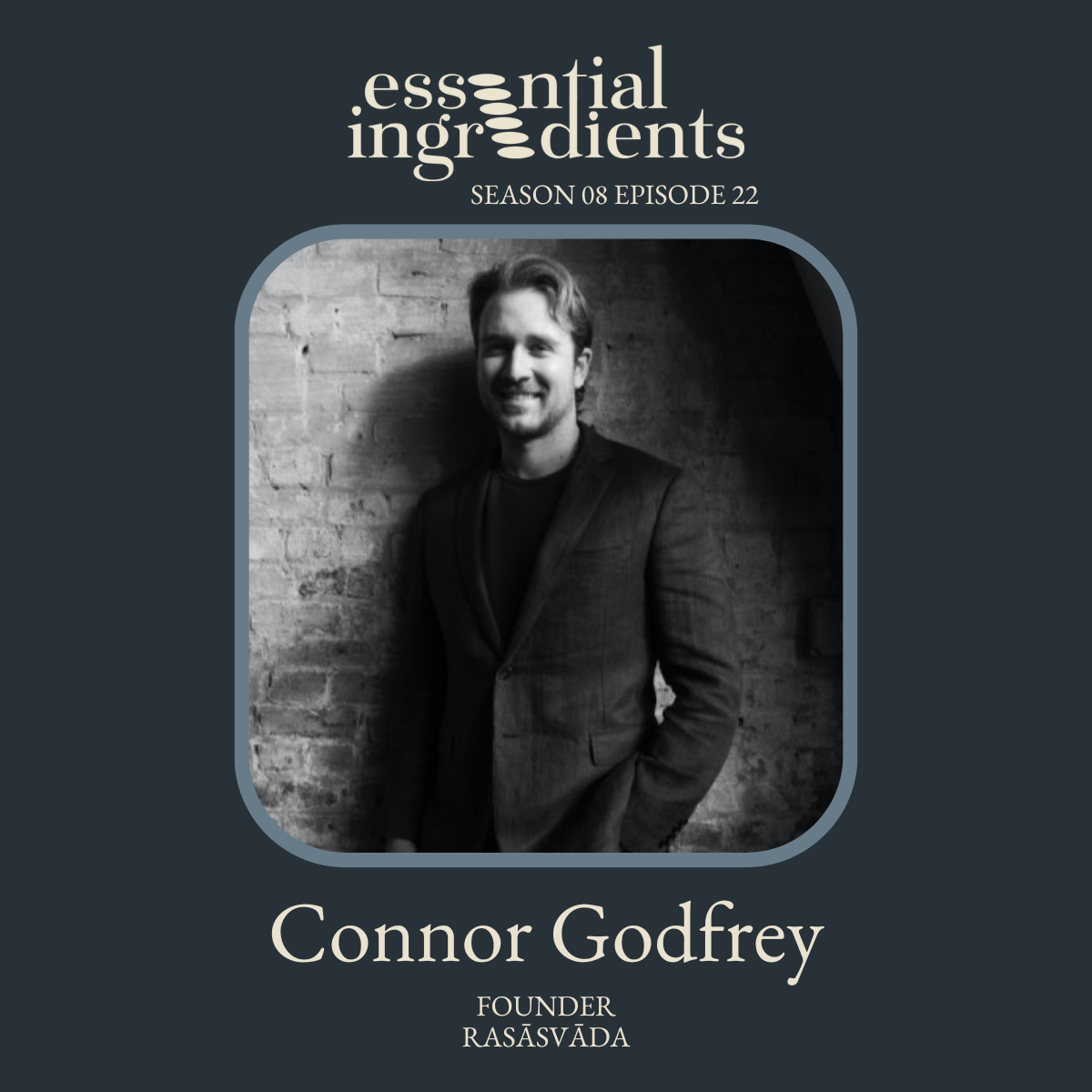
Connor Godfrey · Founder, Rasāsvāda
Watch on YouTube
Adaptogenic Spirits— Ancient Herbal Wisdom for Modern Health Restoration
The Incorporation Method helps you turn what matters into practical changes that fit your life.
“I try to remove ego from as many of these decisions as I can as that's one of the greatest inhibitors to future success. —Connor Godfrey”
Full Transcript
Full conversation between Justine Reichman and Connor Godfrey.
Hi, Justine. Thank you for having me on. I really appreciate it.
Oh, it's my pleasure. So for those not familiar with you, Connor, or your new name to them, can you introduce yourself? What do you do, and the name of your company?
Yep. I'm Connor Godfrey. I'm the founder of Rasasvada. We are a spirit restorative company that is focused on helping you on your lifelong journey.
What is your goal with Rasasvada?
Our goal with Rasasvada is to help you on your journey. Our first range of products are three non alcoholic spirits that are made of 100% plants, and contain 0% preservatives. They're inspired by traditional Chinese medicine and other eastern medicinal modalities.
Awesome. What about your background made this something you wanted to pursue or inspired this journey?
That's a great question. So for me, I grew up around Eastern medicine. My cousin had started a tea company about 25 years ago called Rishi Tea so I've learned a lot about the healing practices and arts associated with Eastern medicine. And when I was going through a difficult period in my life, I was dealing with a lot of personal and professional unrest. Let's say I was in a serious relationship that had ended, and the job that I was in ran its course. I was really trying to figure out what I wanted to do with the rest of my life. Some might say that I was going through a quarter life crisis, for lack of a better term, so I really turned to a lot of that knowledge base that I grew up around. And whether it was a placebo effect or not, it really seemed to help me. And I thought that I might be able to take that and help others on their life journey.
I love that. Thank you so much for sharing that because I know it's personal. But I feel like sharing stories like that is what connects with other Founders and their inspiration to be able to build their new business or come up with their next great idea. So I'm curious, I know you've had a lot of access to Eastern medicine. I know you didn't study Eastern medicine, so how do you gather enough information that you could prove? I don't know if you did studies or if you did focus groups, etcetera, to be able to create these different products to deal with these different stressors when you're going through this in life.
To be completely frank, a lot of my research was done by reading books, or desktop due diligence, or consulting with people that didn't know more than myself. There are a lot of studies in Asia around a lot of these plants and ingredients that we've incorporated into our spirit restoratives. But in the United States, we haven't necessarily explored a lot of these ingredients as much from a scientific standpoint. They are starting to be explored more, but we still have some catching up to do. I'd say that with regards to what I did, as I said, a lot of it was trial and error. And for me, it was reading about things that did have validity. Like ginseng, for example. Incorporating it with other ingredients that are also darlings of traditional Chinese medicine like Schisandra Berry, the two are harmonizing for each other so I think it's life is all about, it's a constant learning experience. And for me, this was one step in that journey.
As you're going through this journey, and as you're playing with these different herbs, how long did it take you until you found your first, if you will, combination.
So I had a little bit of an advantage in the sense that I was starting off by using a lot of Rishi Tea that was already formulated to help with specific benefits. And I was trying to add other benefits to deal with the various stressors that I was going through at that point so it didn't really take me very long because of that, to be quite honest. But it didn't really take my cousin very long either to formulate the products. Took him about a week's time, and that's the benefit of working with someone that has that knowledge base.
Was he a Chinese herbalist, or was he a practitioner?
He's a Chinese herbalist, but he's all also very well educated in Ayurvedic medicine, and Western herbalism as well.
If we think about your story, you are going through challenges in your life and it inspired you to take a step back and look at what you had been surrounded with your whole life. And equally, you are inspired by what your cousin built as a tea company. And now, you're looking to make this into a beverage company, something that you use different kinds of beverage. I can fit French, if you will, versus a tea that you made. So now, what was your cousin's response when initially you're using his remedies or his collaborations? Now, you're not using them. You're making it a cocktail. What was his response to this?
First and foremost, I think that he was really excited that I had taken a lot of the knowledge base that he had imparted on me over the years, and tried to supplement whatever areas I might be missing with my own research and create things that really would help me along my journey. So I think he was quite excited by the prospects of potentially working together and on the impact that he had on my life.
How could you not be moved and humbled by that, right? You have an older cousin, who has had all this experience that you, he's maybe shepherded you in some ways. And now, you're coming up with your own innovation that's inspired largely by what he created. I would be honored. Truthfully, I'd be honored and excited to be able to see what's coming out next and collaborate potentially. I'm excited to hear, did you guys end up collaborating on anything? Or was it just the Rasasvada? Or was there something that you guys created together?
Rasasvada, we're partners in the business. He handles all of our formulation in sourcing ingredients. We source ingredients from six different continents. And through his network, we're able to source the very best of whatever harvest of each ingredient that we incorporate into our range of spirit restoratives. So that's something that we're incredibly excited about and very proud of.
Wonderful. So this is your first foray into entrepreneurship, is that correct?
Correct. I did find out later that I am a 6th Generation Entrepreneur, actually. But it is my first foray into it. I used to work in private equity before doing this. And as a 25 year old, I thought that I knew maybe a lot more than I did. And I thought that I had all the skill sets needed to grow a business. But I think I was in for a rude awakening when I first started working on it. But it's been one of the best learning experiences I ever could have asked for.
I agree. I think of my journeys as an entrepreneur and as an MBA on the job, I got my MBA by working, by doing.
That's right. There's no better way of learning than through experience.
So now you have your business, and this is your first entree. And I'm sure I will be partnered up with your cousin. it allows you to focus on your vision for what you want to do, and also have the advantage of having his expertise of running a successful business. So what were you most afraid of when you started this business? That maybe when you look at it now, you're like, okay, that was easy, or that's crazy. How can I be nervous about that? This is really what I should have been nervous about because we all have these misconceptions.
That's a great question. I would say, I probably wake up every day with many fears. The largest is the fear of failure. But for me, at least, what I've quickly learned is that hurdles, impediments, things going wrong will occur every day. But with more and more experience, you gain better visibility into a lot of these things that will wind up happening, and you're better able to navigate those potential pitfalls. I would say, there isn't necessarily one thing. But I think that through experience, we've been able to really navigate the waters a lot better than in the past.
I think that there's a lot to be said for just going in there like you did, and working with your cousin. And eyes wide open, but everything's new. So if you're looking at it from that perspective, everything is scary. Like you said, you've got a lot of fears. But now, if you look at this a few years later, how do you regard those fears?
I think one of my big philosophical things is that I believe that adversity, one thing my dad always told me when I was growing up, times of adversity or moments of adversity are what truly shaped you as a person and your character. And I now take all of these moments as how am I going to respond to these various periods of adversity or moments that occur. And I think you have to treat it as a little bit of a game at the end of the day. You can't get too upset by it, you need to just figure out how to navigate and be solutions oriented.
I couldn't agree with that more. I'm always about, you got to focus on the problem, as opposed to focusing on the solution can be your juggling. What do you do first? Focus on this, or focus on that? And it can be challenging to make that decision to sometimes just fix it? It depends on the moment, it depends what's going on. Sometimes, you have to fix the problem in order to focus on the next step. But other times, you just gotta focus on fixing it, and then going back to picking it out. So I don't know if that's been part of your process and navigating that, and trying to understand, am I supposed to fix it first? Or am I supposed to solve it first?
So that's definitely part of my process. But the biggest thing I think about is, I know I'm going to make mistakes. I know there are going to be issues that I'm going to have to navigate. But how do we make them as inexpensive as possible? Because at the end of the day, some of these mistakes can be very costly. And the thing I've learned is if I can limit the expense, then it's really not going to be that bad. It may be a little bit of an annoyance,
We're talking about costs now, and we're talking about building a business, which can be very expensive. So did you decide to self fund? Or did you raise money? What was your plan?
For us, we are self funded. We are self funded for the first two years. And then we did small friends and family rounds. We've continued to self fund the business. Pause that when we've needed capital infusions.
And so do you have a desire to go and raise money at some point? Do you see that as part of your future? Or do you see it being something that you're gonna keep in the family and you just want to build out yourselves?
That's a good question. It's something that I've obviously thought a lot about as to which direction we would go. For me, I think having something that I could give to my future children one day would be amazing. But at the same time, I'm not going to say that if there was a great strategic opportunity that presented itself that I wouldn't explore it. I think I'm very open minded when it comes to these things. And to one of your earlier questions, I tried to remove ego from as many of these decisions as I can, as I think that's one of the greatest inhibitors to future success.
Ego gets in the way of so many things. Negotiation, ideas, we get attached to them because of ego as opposed to growing and pivoting when necessary. I'm sure you've had experiences like that where you've seen that happen.
Definitely, Especially in my space. You've seen more and more companies move away from bottled products and move to ready to drink RTD cans and so on. So it's something we're constantly thinking about is, how should we be pivoting? What do we need to do to keep up with the market? How can we continue to innovate? These are all things that we're constantly thinking about.
You have a list of things that you check in quarterly, or annually, or whatever it is.
We definitely do an audit every year, every birthday. We do an audit and figure out what's worked and what hasn't. One thing that we've learned is we had marketed the product as a non alcoholic spirit for years and years. And when you market yourself, people think of you as a non alcoholic whiskey or whatever their vice of choice is. Our products are very bitter and herbaceous in nature so we're not going to deliver that experience for people, and it's going to lead to a bad first impression. One learning we had this year was we need to look at our business and how we want to position ourselves, and how we market ourselves. And we think we should be really focusing more on a lot of our roots as a traditional Chinese company that's based on traditional Chinese matters, and based on other Eastern medicinal modalities that have been practiced for hundreds of years. Let's talk about that. Our products are made in the same way, we use the same ingredients, and we see a lot of the benefits ourselves, and in customer interviews or clients talk about the differences that our products have made in their lives. So let's focus on those.
Can you share a story about one of your customers and the impact it's had on them?
One of my clients has been an incredibly loyal client with us from the beginning. We launched in June of 2020. So obviously, a very interesting time to launch a business during COVID. Ruby Artemisia is her product of choice. And she, unfortunately, had to deal with a really bad case of COVID. She said that the only thing that really helped her was Ruby Artemisia. And it's something I've thought a lot about as to what could be some of the reasons for that. It's something that I believe that there are a lot of very impactful ingredients in there that can potentially promote healing within the body. First and foremost, I'm not sure entirely why that helped her with COVID. I would have thought a Rose Bergamot would have just given that that's packed with antiviral, antifungal and antibacterial ingredients. It's packed with ginseng. And (inaudible), when they're combined together, that's thought to boost immunity. But for whatever reason, she claims that Ruby Artemisia was her cure.
What a great story, because so many people have gone through COVID. Somebody who has long COVID, so many people are tired from COVID weeks after they have COVID. But to be able to have something that really has no side effects, correct?
No side effects. Everything in there is good for you. There are tons of adaptogenic ingredients in there. So the whole premise around that is that you can have them in perpetuity. Given your background, Justine, not all of these ingredients, you should really consume everyday necessarily, or there are people that talk about that from a TCM standpoint that your body acclimates to some of these ingredients, and you don't get as many of the benefits necessarily. But I think the brain is very powerful. And I really do believe in the body's ability to cure itself with a good mindset as well.
So what are you most hopeful for when you launch this business?
That's a great question. First and foremost, my goal was always to try to help others that were dealing with periods of adversity in their life, much like I was when I started the company. The other thing that I would really like is for more people to think about their health and wellness regimen. And sometimes, it's really hard to get started. And I think that trying to find various ways that you can just do something small to really incorporate that into your self care regimen, I think that can really go a long way in making a difference. And it can lead to a trickle down or snowball effect. So my hope is that I can help people deal with adversity, and really be an additive to whatever wellness journey they are on.
What role does education play in this? Because I see this as something that people really, it's not firsthand knowledge. Some people are more open to it than others. I could see it being a bit of an obstacle for people that are not familiar. So in my mind, I feel like education must be integral to your marketing or your strategy. I'd love to hear from you how you're integrating it, and what role it plays?
We're definitely focused on educating our consumers on a lot of these rarefied plants and herbs that we're using in our products that are not typically found in many functional wellness products that are out in the market. Paid advertising is a big part of that. We're starting to think about doing some more educational series. We write journal articles on a lot of our ingredients. We write journal articles on restorative rituals that you can incorporate into your life. We really want to try to add value to our clients and our customers in other ways as well outside of just our three products for now. So those are really our focuses right now. Obviously, opportunities like this to speak with people like yourself, and talk about our range of products is a great way to educate consumers that haven't heard of our range just yet. But really for us, it's those things I mentioned. And we're hoping to continue to expand and do more video, for example. We think that's a really compelling way, an easy way to educate consumers on what a lot of these ingredients do, and how they've historically been used.
So what's the most revolutionary part of your product?
I think the fact that our products are made of 100% plants and don't contain any of the harmful preservatives that many other products out in the market do add to really help with their shelf stability, to get on to grocery store shelves and things like that. We've been able to achieve three years of shelf stability in our Rose Bergamot and Ruby Artemisia with no preservatives whatsoever. And that's something that we're really proud of.
Wow. So if somebody wanted to get a hold of your product, what would be the best way to find your product?
So first and foremost, we'd love for you to check out our website, rasaspirit.com. But we also served it in many high end hospitality establishments. In New York City, you can find us at The Carlyle Hotel, The Mark Hotel. You can find us at Blackberry Farm and Mountain and other establishments like that. As well as The Zero Proof bottle shop, that have been incredible partners to us. And we really want to try to drive our customers to their storefronts as well.
Awesome. Connor, thank you so much for sharing with us a little bit about your journey, what inspired you and where you're headed. Are there new products we could stay alert for coming up soon?
We're definitely thinking about other ways that we can continue to innovate and find other restorative rituals that people practice in their daily life where we can create products that are made of 100% plants that they can find value and add into those rituals and routines. But nothing that I can really mention to you now just yet. But I'm very excited about some of the things that we have in the pipeline.
Congratulations on your initiative. I'm super excited to continue to follow your journey. And even learn more as you guys build new products and new recipes to see who else you can help out there. So those of you joining us today, thank you. To learn more about Connor, you could click on our show notes. We will have a link to his LinkedIn. We'll have a link to his website, etcetera. So thanks again.
Share This Episode
Enjoyed this conversation? Share it and tag @nextgenpurpose
Listen on Apple ▶Listen on Spotify ▶Your Host
Justine Reichman
Founder & CEO of NextGen Purpose. Host and Executive Producer of Essential Ingredients — 11 seasons, 330+ episodes, and a growing movement.
About Justine →