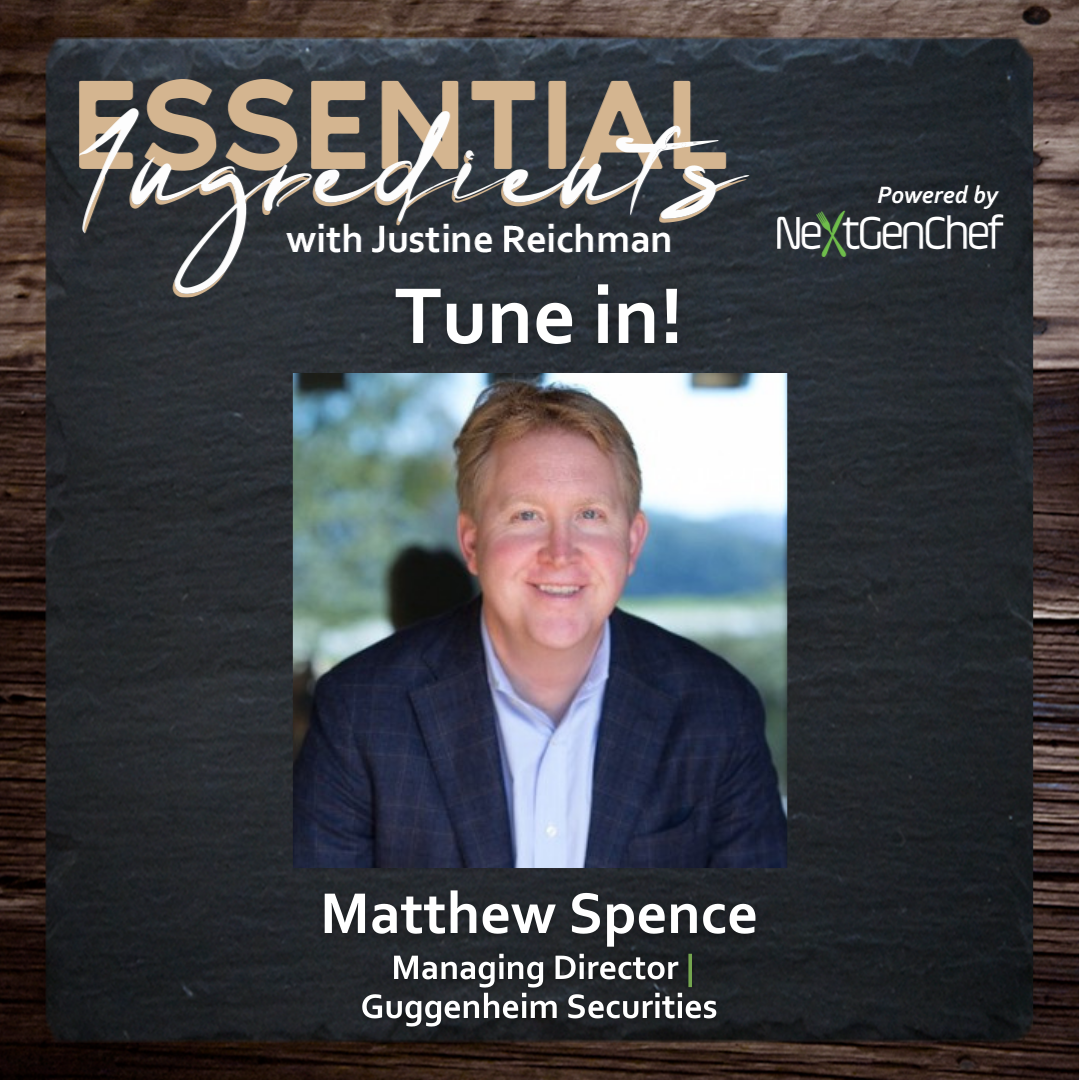
Dr. Matthew Spence · NextGen Purpose
Watch on YouTube
Tackling the World's Biggest Problems by Supporting Tech and Innovation with Dr. Matthew Spence
The Incorporation Method helps you turn what matters into practical changes that fit your life.
“The food industry is not just about what we eat. It's also about how we produce it — And that's a big deal!”
Full Transcript
Full conversation between Justine Reichman and Dr. Matthew Spence.
That's great, thanks. So I'm Yonatan. And in Brevard, we basically produce and provide protein, alternative protein, which is very much needed in the food industry today, which is greatly expanding into plant based products in different categories. Especially, there's a need for a neutral, a very mild source for protein in terms of flavor and color to increase the nutritional profile of different products without changing the properties of favorite color, texture, or cost. And the existing solutions at the moment are not suitable enough. For example, soy has very strong flavors. This is exactly what we're trying to solve in Brevel.
I'm just curious to just start from the beginning and really understand, how long have you guys been working on this?
We've actually been working on this for quite a while, for five years now. We started in 2017. The reason we've been working on it for so long is that, maybe I'll go a step backwards about what exactly we're doing, how we're solving this challenge. So we're using microscopic algae, microscopic organisms that are exponentially fast and need very little resources in terms of sustainability. They're just off the charts compared to any other protein source. But today, to produce microalgae protein efficiently and taste good is a very challenging problem. And this is not something that can just be brute forced in terms of scale to reduce class or something like that. We had to develop a unique technological solution to produce microalgae protein very cost effectively, and with flavor and color, which are suitable for the food industry. So my younger brother, he's actually the mind behind the technology, he's a mechanical engineer, this genius mechanical engineer. And he actually worked as chief engineer in a different microalgae company where he improved and scaled up their technology. But they understood that. I mean, the way he saw it is that improving coal trains, no matter how fast to get a coal train running, will still be slower than the most basic electrical train out there. And so we had to completely redesign the way microalgae are grown to solve this. So we developed a really unique technology and managed to use it to produce the protein we have today, and we're already piloting with a variety of different companies. We will actually be in for the franchise by the end of the year. We're finalizing contracts, we're building the first factory in Israel to produce a sense of protein for the industry. So there is already a commercial escape factory they're looking to scale.
So there's your genius brother who is the mechanical engineer, what would you say you are in this trio?
So I came with the passion. I'm a vegan for the past decade and a bit. I think with a passion, the three of us have passion to make the world a better place and are very focused on solving the nutritional side of this, and providing a solution which is truly sustainable, truly nutritional. Many vegans, basically, it's vegan junk food, unfortunately. And today, plant based cheese for example, plant based meat have a very poor nutritional value, like rice milk, oatmeal. It's basically water and sugar. Unfortunately, I give it to my kids to eat with their cereal. But I would rather, if I had a solution, if I had an option which had much higher or protein content, a much higher nutritional profile, of course, I would choose it over other options. If plant based cheese is basically, usually starch and oil, if it had any significant nutritional value, but of course, I would prefer. For vegans, it's easy. But for flexitarians or other, the average consumer shifting to or mixing in their diet plant based alternatives which are also healthy would be much easier. I mean, once we have these options, it's much easier to shift. Of course, they have to be, I mean, first of all, they have to be tasty.
It's most important.
And it has to be affordable. You have out of these niche products which are like, so you buy them once from out of curiosity, but then it's not sustainable. So basically, I come with this passion of solving this challenge. My elder brother--
That was my next question. What about your other brother? What does he come to? Where's his place in this trio?
So he's a doctor. He's a medical doctor. And yes, okay, from the health perspective. So the three of us joined, decided together. My younger brother had this idea that we can solve this with my graduate, and have the right technology. I want to solve this from a moral and sustainable standpoint, and from a health perspective. Then we joined and founded Brevel..
What was the inspiration for this specific idea? How did you guys come together to come up with this idea?
So among the different sources of nutrition of protein and nutrition in general, microalgae is really off the charts compared to any other source. Meaning, they need only a very small fraction of the land area that is needed to grow protein compared to sawyer of course to animals, that's obvious. I mean, just to put this in perspective, with a single system of ours, we can produce more protein. I'm sorry, I have the numbers in an, I have it in meters. With a single system of ours, we can produce more protein of than 14,000 square meters of soy protein production.
So we can put it in the notes, so that we can translate the meters that's equivalent to, for the rest of the world to understand it. Interpret that. So for those listening to the podcast, stay tuned and make sure you check out our notes on the website so that you can know what that actually means if you can't interpret what meters are. So don't worry.
It should multiply by 9 to get the square feet. So that will be like almost 100,000 square feet of soy protein production.
That's not insignificant.
No. I mean, in terms of land area, that's huge. And compared to beef, it's just crazy. With a single system, we can produce more protein than 250,000 square meters, which quickly, that will be like 2 million square feet roughly of beef production. Now, this is the way the future food in the future food will be. It won't be feeds or other crops eventually, it will be very efficient indoor production systems. I mean, this is a bit of a long shot, but the way I like to think about it, once we colonize Mars, no one will grow their potatoes, or wheat, or corn. People will eat microalgae. In terms of resource efficiency, microalgae are really the only reasonable thing to grow in space or on Mars. And if the resource is efficient enough to grow, microalgae were the first organism that managed to use external energy to do sunlight at 2 billion years ago here on Earth, and the first organism that managed to grow efficiently with external energy from outside of thermal events that were before that. Actually, microalgae is produced out of the oxygen we have today in our atmosphere. And still today, it produces 50% of the oxygen on a daily basis in the oxygen cycle. I mean, these are the basics of our life here on Earth. And in terms of resource efficiency, they are way off the charts compared to any other. There are other good solutions out there, there are fungi, bacteria and yeast. Other excellent solutions which are also now developing in the food industry and will be part of this solution. But looking really far ahead, eventually, it will be microalgae that will lead the way in terms of sustainable nutrition. And it's really, it's something that is very, it's just around the corner. Making micro algae a major part of our diet, if only we can solve cost and taste, which are the current main challenges. And this is exactly our mission.
What do you expect, or what do you see as some of the feedback that you're receiving so far when you talk about this with people?
I was actually initially very surprised by the feedback with the food technologist. So we were going to be sending samples to many different food companies who already have products on shelves, candies, cheese, yogurt, milk, eggs as well. And we're sending them samples so they can increase the protein content and nutritional value of the product without changing any other property. If it's taste, texture. Now, we're sending the samples. Many times I'm sitting with them with the food, the client, just when they first test our product. And the first of our was surprised by the color, and they expected to see this green powder, which is usually what microalgae is. And it's actually yellowish and white powder, which we provide, which we don't, without any processing. It's the way our microalgae grow in our systems. On the first day, they see that it's not green so it doesn't disrupt the color of the food applications. Then they smell it and say that this is interesting, doesn't have any special smell, and then they taste it. And they're really blown away because it doesn't have any of the taste that you would expect from microalgae in this very sea green flavor. It actually has a mild peanutty flavor, some people describe it as a very mild, maybe cheesy flavor. And it doesn't leave any off taste in your mouth. Especially for the technologists which we speak of, they're used to testing soy protein and pea protein, none of these other proteins which have very strong negative flavors and off taste. Our protein has none of these. And initially, I was very surprised, I was very nervous with these first meetings and was very surprised by the positive feedback we had. Of course, we have challenges. We're still working on and improving, making it a bit wider yet improving the solubility and all of these properties. We're still in development with our partners. I mean, the initial feedback is amazing.
That's great. Well, I know that this is just the tip of the iceberg and there's so much more for you to share, but you're gonna be at the future food tech conference, this is just a prelude too. And this was a special part of a series that we did as part of the prelude for the future food tech conference, a special series that we did as a way to introduce speakers that will be at the future food tech conference. I want to thank you for joining us here today. And I'm curious, what are you most excited about seeing at the future food tech conference?
So I'm really looking forward to the conference. I'm looking for partners in the industry. I mean, everyone who will be there at the conference is passionate about solving this huge challenge of how to make our food system healthy, nutritious and sustainable, and its cost levels which are relevant for the industry. So I'm looking to meet very inspirational people, other colleagues from the industry, partners from large corporates, investors, other startups, and really get additional ideas, see where we can partner with other people, see what we can learn, and maybe help other companies as well. I mean, this is the place where all of the people are really passionate about solving these challenges in the food industry. That's all I'm really looking forward to.
Well, thank you so much for joining me, and I hope that you'll circle back with us after the conference and let us know what you learned at this conference, and some of the things that you see that are coming up in the space, and what's new, and what's next there for us to keep an eye out on.
Amazing.
Thank you for joining us.
Thank you Justine.
Thank you so much.
Share This Episode
Enjoyed this conversation? Share it and tag @nextgenpurpose
Listen on Apple ▶Listen on Spotify ▶Your Host
Justine Reichman
Founder & CEO of NextGen Purpose. Host and Executive Producer of Essential Ingredients — 11 seasons, 330+ episodes, and a growing movement.
About Justine →