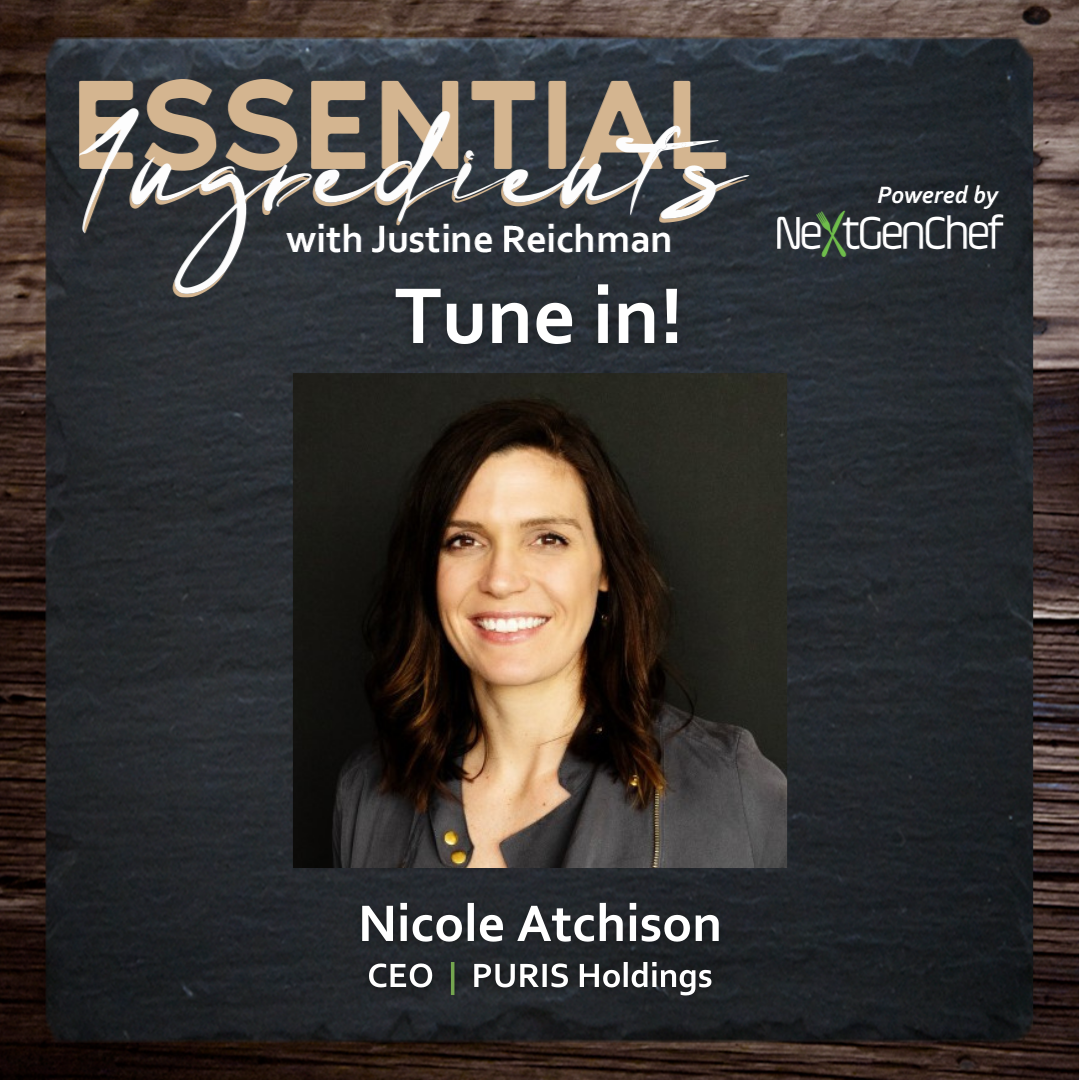
Nicole Atchison · NextGen Purpose
Watch on YouTube
Pea Protein Making its Mark in Plant-Based Alternative Space with Nicole Atchison
The Incorporation Method helps you turn what matters into practical changes that fit your life.
“The meat industry is an example of an industry that has a disproportionate and large impact on the environment. Knowing this, we can no longer close our eyes and continue depending on the old system.”
Full Transcript
Full conversation between Justine Reichman and Nicole Atchison.
Hey, Justine, how are you?
I'm well, thank you. I'm so pleased to meet you and to get to know you a little bit before this Future Food Conference, which is, this is a special edition for the Future Food Tech Conference. It's an opportunity for us to get to speak to some of the guests, and you are one of those premier guests that they're having, speak at the conference and so I'm so pleased. Hadar, so tell me a little bit about, what is ICL?
Okay. So first of all, Essential Ingredients is a great name. You will find out why I love it so much because once we continue discussing, you will understand. So ICL actually is one of the leading mineral companies in the world. And from mining minerals, we are actually dealing with a few sectors. One of them is agriculture, the other is food, and the third one would be industrial products. So we focus on food. Traditionally, we mined phosphate salts, and this would give us the accessibility to all the food industry in the world. And then the other, let's say potash and phosphate, they are actually one of the basic traditional fertilizers that exist. So we are a leading company in fertilizers in the world.
Wow. Okay, that is quite a speciality too.
Yeah. It's not like you. When I say agriculture, you can span all across the agricultural world. It's not the full umbrella, so it's kind of specific to the crop nutrition, part of the inputs. And then in food, we are also kind of specific in what we are looking for is innovation. And we are looking for more of the functional proteins, functional alternative proteins that could replace ingredients. There was a dog barking.
You heard him? Only nine pounds.
So small.
They're small, but mighty.
Okay. So that's it. That's it. Basically, I joined ICL only a year and six months ago. So since then, I was recruited in order to lead the external innovation activity. Back then, it was only open innovation. So the organization tried to grow its innovation funnel by interacting mainly with academy supporting by funding joint projects with academia. You should take the dog for a walk.
When people come into the house, I have to use my earbuds so that doesn't happen. But anytime somebody new comes in, I'm sure the folks listening or watching can appreciate this. Our dogs are protecting us, and they're gonna protect me.
That's amazing. I mean, it's amazing. What's the dog's name?
We have two. Minnie and Misty. One is the Chihuahua, one is a Chiweenie. And whether it's the FedEx guy, the garbage truck, whatever it is, if there's somebody that they do not recognize, they bark like my life depends on it.
I got it. Okay.
So hopefully, I'll mute myself the next time so it's not a distraction. This is how we do things now. A remote, we get all the good and the bad that comes along with it. And part of that is construction and dogs.
That's it. I mean, it is what it is.
It is. Exactly. So you came on to do external innovation. So before you came on, they were working on internal innovation solely. What does that mean? What does that mean when we say internal innovation?
It means, well, the internal ecosystem of ICL was blooming with innovation when I arrived. Actually, it was mind blowing because they established, when I arrived a year and a half ago, they already established an internal accelerator for the employees. Meaning that the employees are pitching ideas to management and getting ideas funded, and projects just launched with employees' ideas. So this is amazing.
For a special kind of innovation, like when they put this out to the employees, were they looking for something in particular?
So first of all, it was to encourage a culture of innovation in the organization. Imagine a mining company, something very traditional that exists for almost a century now. So in order to create some kind of emotion, some kind of a movement, they established this, that's my cat now.
We just thought it'd be fun to break all the animals' parties today, and bring your pet to work.
And it was, of course, needs that are eternal for the organization, and just ideas that bump into people's heads, how to make things better, more innovative, more efficient, more sustainable. So that was part of the movement that started transforming the organization. Another activity of Innovation is also operational excellence. So there's a unit that is actually in charge of implementing drones, 3D printers and robots in order to create efficiency in operations.
So now, then they went and they were recruiting for external innovation and they found you, and what was the goal when they hired you? What were they looking to achieve in terms of external innovation?
Exactly. So the timing was right. I mean, internally, everything was blooming and moving on and people were saying innovation is part of the day to day culture. Looking outside organization, things that are not produced here, not invented here, looking outside the R&D funnel, and also, the need to engage and interact with the global ecosystem, that was the need at the time. So they were looking for someone to be that agent of change to create engagement of this global corporate in the global innovation ecosystem, particularly in the agri and food ecosystems. Because they put us as an engine of growth, the agri food ecosystem.
And what was their main motivation within the food system? What were they hoping to achieve? Or what are they here to achieve?
Since the company itself has a big fertilizers and crop nutrition business, and a lot of market access, actually, it's one of the leading fertilizers company in the world. And in the food business five years ago established an alternative protein business. And last year, they build a lateritic protein plans for manufacturing high end alternative protein for the food industry. So looking outside, we are looking for new technologies to bridge the gaps of technologies of things that we don't produce and we don't have.
What is your role in doing this?
So first of all, when I arrived, what I did was mapping what's going on internally. So what I told you about the internal accelerator, and the culture of innovation, and operational excellence, and then I saw that mergers and acquisition was part of the activity. What they didn't do is investment in early stage startups. So first of all, what I did is start implementing and establishing what we call today the ICL Planet Startup Hub. The ICL Planet Startup is actually the arm that is doing investment in early stage startups. We are looking at startups in the agriculture and food business, especially in crop nutrition. And what do I mean by crop nutrition? So the areas of interest could be biostimulants, organic innovative fertilizers, the next generation of fertilizers, nitrogen fixation technologies, co2, capturing technologies, all these kinds of technologies. And in fooders, as I said, we are looking for startups that are active in functional plant proteins, functional ingredients, all kinds of white biotechnology that could be any kind of process that could contribute to that. On top of that, that's the areas of interest of ICL Planets. I am implementing an impact strategy on top of that, so it's a layer of choosing the right startups to our portfolio that have the intentionality to do measurable positive impact. So that's part of the scope that we are looking for.
I want to be mindful that this is supposed to be a sneak peek into what people are going to see in the coming Future Food Tech Conference, so that is just a bird's eye view of what people will get to learn about what you're doing, the innovation happening in ICL, and how they can participate. And what do you see going forward when you look at ICL, and what you're building for the external innovation hub in the next few years?
Well, my hope is that, first of all, we will have a large portfolio of companies that we are already interacting with, because the ICL Planet has existed for only a year. So far, we have invested in two companies. And what I see in the upcoming years is having a broad portfolio of very impactful food startups and agriculture startups. What I want to see is now the value proposition is not only money, so it's not only investing here, there is an added value, it's also in the process. So we are doing a process together with startups like pilot or go to market processes. So it is a strategic kind of investment. What I hope to see is that we have created a very firm, sustainable relationship with startups. I think that's the main barrier in the interaction between a large corporation and a small startup that is moving so fast in the corporate that is moving so slow. And what I'm trying to achieve here is that kind of relationship that is really sustainable, that you can see the fruit of the collaboration, that you can see products in the market, that you can see that we have contributed to these startups to become a big sustainable company.
Well, so for the startups that you're investing in, what are you looking for from them?
Well, I mean, everybody would say, and you will probably think that I'm looking for the best technology and the best protection. But now, I'm looking at the best team.
I would tell you that it's--
It's all in the people, really. Technologies come and go, but only based on the people, and the team, and the skills of the team, and the interpersonal relationships that you can create with this team, the chemistry that you have with the team, their ability to manage their business, to scale their business, but it's all a matter of people. So first, I'm looking at the team and the skills of the team, and the energy of the team. Can this team bring us to the next stage? Can they keep this business plan intact? Yes, exactly. Are they focused enough? Are they flexible enough? They need to be both focused and flexible.
You need to do that as things change. You need to be able to see what's new, and what's next, and understand. Hader, thank you so much for joining me here today on Essential Ingredients. I can't wait to hear what you get out of the conference. Before we go, I'd love to hear what you are most excited to see for the Future Food Tech Conference?
First of all, I think I would like to say the people that I haven't met for so long. I mean, the people that maybe didn't arrive in San Francisco last March and maybe new people that are now starting to get out of the houses and they come more to a face to face, how do we say, today is 3D meetings. Really, I want to meet more new people that come to network and get to know their new initiative.
Wonderful. Well, I'm looking forward to hopefully meeting you in person someday and continuing to follow how your things evolve at the ICL Planet Initiatives. It sounds like we have some synergistic work in terms that we're both trying to build food systems and create greater access to healthy food, and I can see why you said Essential Ingredients was. Hadar, thank you again for joining me.
Great. Thank you for talking with me.
My pleasure. Thanks again.
Share This Episode
Enjoyed this conversation? Share it and tag @nextgenpurpose
Listen on Apple ▶Listen on Spotify ▶Your Host
Justine Reichman
Founder & CEO of NextGen Purpose. Host and Executive Producer of Essential Ingredients — 11 seasons, 330+ episodes, and a growing movement.
About Justine →